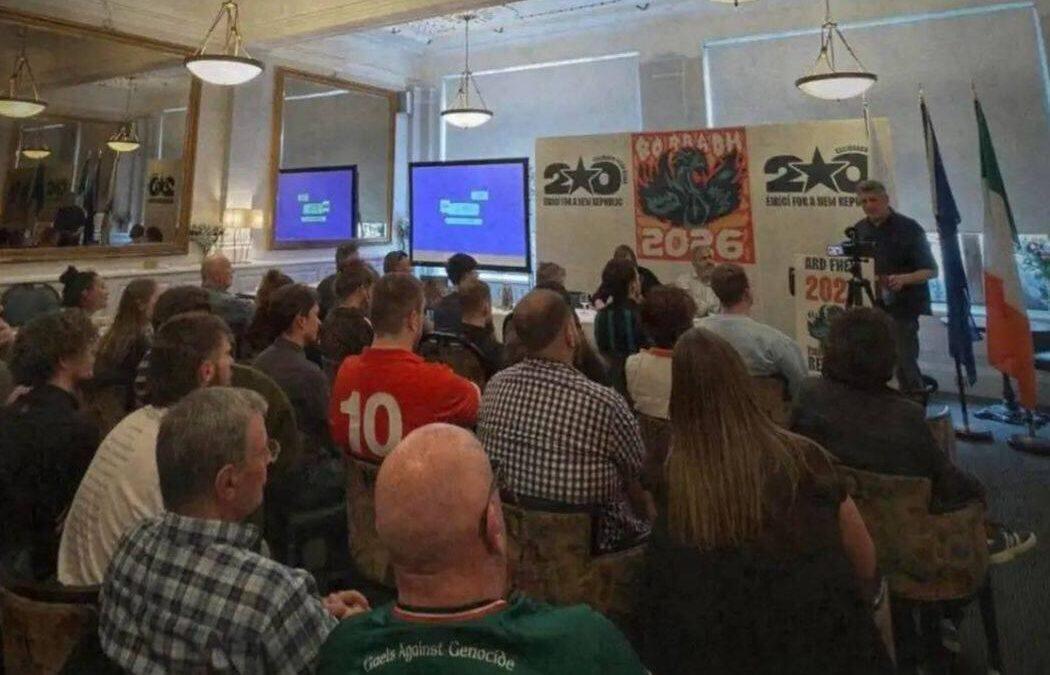
The Masar Badil, the Palestinian Alternative Revolutionary Path Movement, and Samidoun Palestinian Prisoner Solidarity Network participated in the 20th anniversary events of Éirígí for a New Republic, an Irish republican socialist political party, which held its anniversary event and annual Ard Fheis, or conference, in Dublin. In their presentations and solidarity messages, they emphasized the unity of struggle between the Palestinian and Irish peoples in confronting colonialism and building an international front for liberation.
The Masar Badil affirmed that the relationship between the Palestinian and Irish peoples is not fleeting or symbolic, but rather a historical extension of two parallel struggles against settler colonialism, forged by the sacrifices of martyrs, the steadfastness of prisoners, and long experiences of revolutionary and popular resistance. The movement stressed that these ties must evolve into a higher level of coordination and joint action, thereby strengthening the formation of a unified international front against colonialism, Zionism, and the forces of plunder and exploitation.
The movement also called for expanding the circle of solidarity with the Palestinian people in Europe and the world, and activating the role of popular forces and progressive movements, considering that the Irish experience, with its revolutionary legacy, constitutes a living model in confronting colonialism and building paths to liberation.
The movement stressed the importance of the revolutionary left worldwide taking a clear and decisive stance in support of peoples’ struggles against colonialism and hegemony, foremost among them the struggle of the Palestinian people as the vanguard of resistance in the region. It called for strengthening all forms of support and solidarity with resistance forces in Palestine, Lebanon, Yemen, and Iraq, considering them a living expression of the peoples’ will for liberation and for breaking the power structures imposed upon them.
The Masar also stressed the need to confront all forms of aggression and foreign interference in the affairs of the region, including U.S. and Zionist policies that aim to subjugate peoples and plunder their resources, emphasizing the importance of standing with the peoples facing this onslaught, foremost among them the Islamic Republic of Iran, which is waging a historic confrontation against U.S.-“Israeli” aggression and the policy of siege and political and economic pressures.
For her part, Charlotte Kates, international coordinator of the Samidoun Palestinian Prisoner Solidarity Network, delivered a political intervention addressing the repressive policies practiced by the occupation against Palestinian prisoners in the occupation jails, including the so-called “Prisoners’ Execution Law,” in flagrant violation of all international laws and conventions. Kates emphasized that the Palestinian prisoner movements’ represents a vanguard of the Palestinian liberation struggle, and that its experience intersects with that of Irish prisoners who also faced policies of repression and imprisonment.
Samidoun emphasized that the prisoners are the true and trusted leadership of the Palestinian people, representing struggle and steadfastness within the prison cells and embodying an unbreakable will for freedom. Samidoun also condemned the occupation’s policies that target the most basic human rights of prisoners, from medical treatment to family visits and education, considering these practices part of a comprehensive war against the prisoner movement and its role in defending the Palestinian cause.
At the conclusion of the events, it was emphasized that the unity of struggle among peoples and liberation forces constitutes a fundamental pillar in confronting projects of hegemony and colonialism, and that Palestine will remain the compass of international struggle until its liberation from the river to the sea, and the achievement of return and the right to self-determination.
This meeting confirms that the interconnectedness of peoples’ struggles is not just a political choice, but a historical necessity in the face of a global colonial system, where Palestine remains at the heart of the liberation battle and the compass of international revolutionary action.
source: Masar Badil