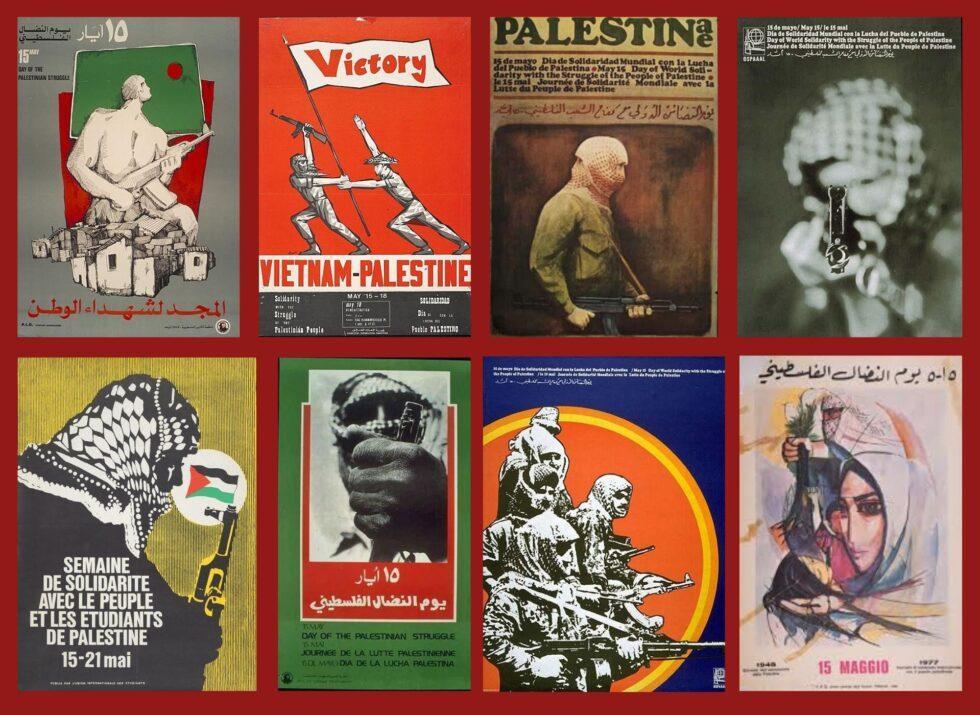
The following article by Khaled Barakat, member of the Executive Committee of the Masar Badil, the Palestinian Alternative Revolutionary Path Movement, was originally published in Arabic at Al-Akhbar:
Restoring the “Day of Palestinian Struggle”: From the Discourse of the Nakba to the Project of Liberation
By Khaled Barakat
Monday, May 11, 2026
Every year, as the fifteenth of May approaches, Palestine returns to the forefront of global memory as an open wound since 1948. Images of displacement, massacres, the destruction of Palestinian villages, and the uprooting of the people from their land are revived under a name and a slogan that has become firmly entrenched in political and media discourse: the “Nakba.” Yet the question worthy of discussion today is this: Is this expression alone still capable of conveying the nature of the historical stage through which the Palestinian people are living? And does it serve Palestinian, Arab, and international liberation consciousness, or has it come instead to confine the Palestinian cause within the framework of tragedy, victimhood, and humanitarian catastrophe?
From here emerges the need to restore consideration to a political and struggle-oriented concept adopted by the forces of the Palestinian revolution after the launch of the contemporary fedayeen movement in the 1960s: the name “Day of Palestinian Struggle,” alongside the slogan “International Week of Solidarity with the Palestinian People and Their Inalienable Rights.” These names were not merely linguistic substitutions; rather, they expressed a historic transition in the Palestinian people’s consciousness of themselves, from the position of a stricken victim to the position of a fighting people waging a protracted people’s war and a battle for liberation and return.
Here, it is worth pausing at the intellectual roots of the term “Nakba” itself. When the Syrian Arab thinker Constantine Zureiq coined this term in his famous 1948 book The Meaning of the Disaster, he did not mean only what had befallen the Palestinian people. Rather, he was speaking of “the Arabs’ disaster in Palestine” — that is, the historical, political, and civilizational defeat suffered by the official Arab order and Arab elites at the hands of the Zionist project and Western colonialism.
From this angle, Zureiq was correct and accurate in his characterization; the Nakba was not merely the loss of land, but an expression of a comprehensive Arab incapacity that allowed the establishment of the Zionist entity on the land of Palestine and the displacement of its people. However, the Palestinian national movement, particularly after the launch of the contemporary Palestinian revolution, sought to move beyond the condition of the “Nakba” as a title of defeat, toward redefining the Palestinian as the bearer of a project of resistance and liberation, not merely the victim of a historical catastrophe. Hence came the emphasis on the concept of “Day of Palestinian Struggle” as an expression of the transition from the era of defeat to the era of militant action and historical initiative.
The Palestinian national movement, especially in its revolutionary ascent after the defeat of 1967, understood that reducing Palestine solely to the “Nakba” carried a political and moral danger. The Nakba is a description of a historical event that took place in 1948; Palestine, however, is an ongoing cause and an open struggle against the Zionist settler-colonial project. Therefore, emphasis was placed on transforming the fifteenth of May into an occasion for political, popular, and revolutionary mobilization, affirming that the Palestinian people had neither been defeated nor disappeared, but had reorganized themselves in the refugee camps, in the arenas of resistance, and in the movements of students, workers, and fedayeen, becoming a historical force fighting for liberation.
Anyone who reads revolutionary literature, Palestinian political thought, and the writings of the fedayeen organizations during the rise of the contemporary Palestinian revolution will find that the fifteenth of May was not merely a “Nakba anniversary,” but an international occasion bearing the name “International Week of Solidarity with the Palestinian People and Their Inalienable Rights.” This concept was linked to a Palestinian, Arab, and international vision that regarded Palestine as a comprehensive cause of national and human liberation, not merely a humanitarian issue tied to refugees or the outcomes of war. However, this concept began to gradually decline with the rise of the political settlement project and the transition from the discourse of comprehensive liberation to the discourse of the “Palestinian state” within the conditions imposed by the existing international order.
In this context, November 29, the anniversary of the United Nations partition resolution on Palestine issued in 1947, was institutionalized as the “International Day of Solidarity with the Palestinian People.” The irony here is that this date is not connected to the will of the Palestinian people or their struggle, but to an international decision that legitimized the partition of Palestine and granted the Zionist movement international recognition for establishing a colonial entity on the land of historic Palestine. Therefore, restoring the fifteenth of May as the “Day of Palestinian Struggle” also means restoring the political compass that links international solidarity to the idea of liberation and return, not to the logic of partition and settlement.
The difference between the two expressions is not superficial. “Nakba” refers to catastrophe and defeat, while “Day of Palestinian Struggle” refers to resistance, continuity, and popular will. The first focuses on what colonialism did to the Palestinian people, while the second focuses on what Palestinians do to confront and uproot colonialism. Between the two discourses lies a profound difference in the construction of political consciousness, especially among the new generations in Palestine and the diaspora.
This does not mean abolishing the characterization of the Nakba or diminishing its historical importance, but rather restoring it to its proper context. The Nakba is not a frozen memory that ended in 1948; it is an ongoing colonial process extending over more than seven decades. But confronting this ongoing Nakba cannot be achieved solely by weeping over the past or revisiting scenes of displacement. It requires highlighting the path of popular and armed resistance, the steadfastness of the prisoners, the uprisings of the people, the refugees’ commitment to the right of return, and the growing international solidarity with Palestine.
Reviving the use of the name “Day of Palestinian Struggle” today also carries an important political significance in confronting attempts to liquidate the Palestinian cause and reduce it to merely a humanitarian or relief issue. The Palestinian cause is not a refugee crisis in need of aid, but the cause of a people waging a battle for national liberation against a settler-colonial project backed by Western imperialist powers. Therefore, the language used to describe the cause is not a secondary matter; it is part of the battle over consciousness and historical narrative.
Likewise, restoring the concept of the “International Week of Solidarity with the Palestinian People and Their Inalienable Rights” reaffirms the internationalist dimension of the Palestinian cause. Palestine has never been merely a local or isolated humanitarian issue; it has always constituted a global symbol in confronting colonialism, racism, and domination. Historically, the Palestinian revolution was linked to liberation movements in Africa, Asia, and Latin America, and to the struggles of peoples against apartheid, colonialism, and occupation.
In light of the transformations unfolding today, the rise of global popular solidarity movements with Palestine, and the revival of the slogan “From the river to the sea,” the need appears urgent to once again present the fifteenth of May as a day of struggle, confrontation, and global popular mobilization, and not merely an occasion for mourning tragedy. For despite massacres, siege, genocide, and displacement, the Palestinian people continue to resist, and Palestine continues to produce new forms of steadfastness and struggle.
Restoring the name “Day of Palestinian Struggle” and calling for “the liberation of Palestine from the river to the sea” is not merely nostalgia for the literature of the Palestinian revolution in the 1970s. It is an attempt to reconnect the present with the roots of the Palestinian liberation project, and to restore the understanding that Palestine is not only a matter of memory, but also a matter of the future. A future forged through popular struggle, resistance, organization, and collective will, not through surrender to the logic of permanent defeat.
For this reason, the fifteenth of May must be presented as a day for renewing the pledge to Palestine, return, and liberation, and as a day for affirming that the Nakba did not bring an end to the Palestinian people, but rather launched one of the longest national liberation movements of the modern era.
source: Masar Badil