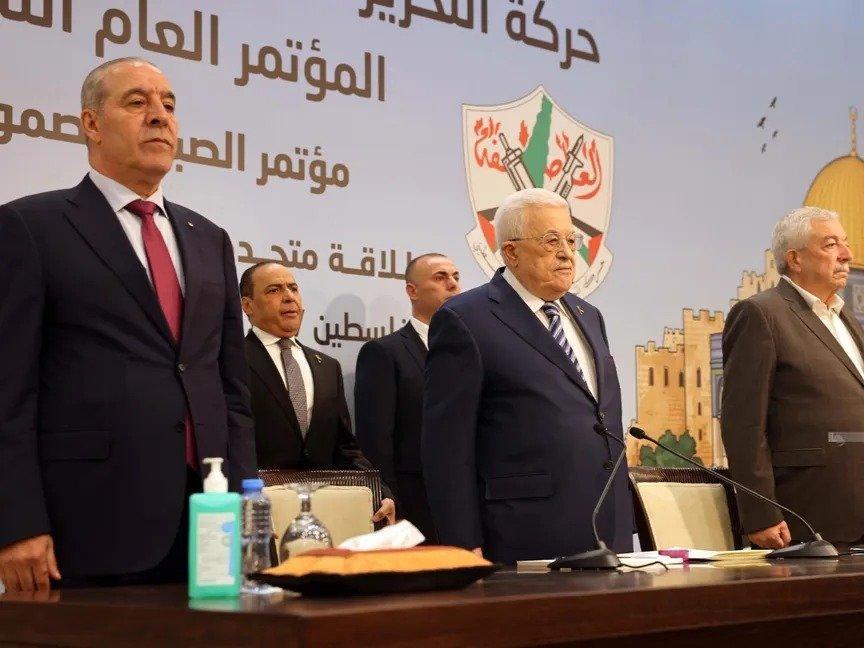
Fatah’s Eighth Conference: A Stark Expression of the Defeat of the Comprador Class and the Fragmentation of the Movement
The Palestinian people are indifferent to the convening of Fatah’s eighth conference and pay it little attention. The movement that was once the backbone of the Palestinian national liberation struggle has today become closer to a holding company and a mechanism of control over the security and financial apparatuses of the Palestinian Authority in Ramallah. A party without spirit or intellect, whose existence depends on the decision of the occupation and the support of certain Gulf regimes, especially Saudi Arabia, the normalization states, and intelligence agencies in Washington and Tel Aviv. We know of no political movement that sinks lower with every “national conference” in the way Fatah does.
Fatah’s Eighth General National Conference is being held amid an intense struggle between competing centers of power within the movement, at a moment coinciding with 78 years since the uprooting and displacement of the Palestinian people, and at a time when the Palestinian cause is being liquidated and dissolved. The Palestinian people are confronting an open war of genocide in the Gaza Strip, accelerating settlement expansion in the West Bank and Jerusalem, racist laws in the occupied interior of 1948, and the ongoing marginalization of Palestinian refugees in exile. This gathering is taking place in occupied Ramallah with the permission of the occupation and under its watchful eye. This fact alone reveals the depth of the comprehensive structural crisis experienced by the traditional Palestinian leadership and confirms that the existing political path has moved from a state of deadlock and paralysis to a comprehensive defeat for the capitalist class of the “economic peace” camp and the agents of the Israeli banks.
The division within Fatah is not merely an organizational dispute or a difference in viewpoints, as some attempt to market it, but rather a reflection of the collapse of an entire project founded on the illusion of the “independent state” and the Oslo Accords. It is the project of a comprador Palestinian class that stole all Palestinian institutions, seized the keys to the prisons and the seal of the Palestine Liberation Organization, and whose functional role is to entrench the reality of occupation while securing its own interests and privileges. The movement that once led the “Palestinian national project” has, under the dominance of a parasitic stratum, individual leadership, and bureaucratic security apparatuses, been transformed into a crisis-ridden framework devoid of legitimacy and national direction, disconnected from the pulse of the Palestinian street and from the liberation struggle taking place on the ground. It is even disconnected from Fatah’s own base and supporters. The loud popular question today is: where is the movement while the Palestinian people are subjected to a genocide?
The continued monopolization of the “independent decision” within the movement, the Authority, and the Palestine Liberation Organization is, in reality, the consolidation of an individual leadership that has turned institutions into hollow structures. This has weakened the organizational structure, marginalized militant cadres, and closed the door to any genuine reassessment of the movement’s catastrophic political path. Instead of Fatah serving as a framework for national struggle, it has been transformed into a tool for administering the existing reality under the constraints of the occupation, including the continuation of security coordination and the suppression of the national resistance struggle. A movement incapable of achieving its own internal unity will not unify the Palestinian national movement or the Palestinian people as a whole.
The Ramallah conference reflected this decline clearly. Instead of becoming a moment for radical reassessment in light of the major transformations taking place in the Palestinian arena, the conference appeared more like a reproduction of the same crisis, but according to rules even worse than before, through a process of political inheritance on the one hand and the neglect of the major national questions on the other. There was no clear position on the war of genocide in Gaza, no reassessment of the failed path of negotiations, and no serious vision for confronting the settlements that continue devouring what remains of Palestinian land. Meanwhile, the participation of the diaspora was miserable and symbolic. After the leadership of the Organization marginalized and excluded Palestinians in exile, who constitute the historical, demographic, and political depth of the Palestinian cause, and removed them from any effective role in shaping national decision-making, this policy has now extended to Fatah itself.
What the conference revealed was a stark expression of the defeat of the traditional leadership before the Zionist colonial reality and its failure to present any political or strategic alternative capable of confronting the current phase. While the resistance in Gaza and the West Bank wages decisive battles, and the prisoners’ movement engages in an unprecedented struggle, the official leadership continues its dependence and sinks deeper into a swamp of arrogance and justification.
This structural crisis can no longer be repaired through cosmetic reforms or internal organizational changes. Rather, it demands a comprehensive reconsideration of the entire structure of the Palestinian political system. The continuation of this approach means entrenching fragmentation and weakness while prolonging the life of the occupation. This existing Palestinian Authority is no longer even a “Fatah Authority,” but rather the authority of a comprador class operating according to the mood and program of the occupation and the directives it receives from Washington, Riyadh, and Tel Aviv.
Accordingly, there emerges an urgent need for a revolutionary alternative capable of safeguarding the Palestinian liberation project and rebuilding its foundations on new bases grounded in the unity of the people and the land. This requires building a unified national front that serves as a collective struggle framework representing the Palestinian people in the homeland and the diaspora, far removed from the logic of monopolization and exclusion.
The present historical moment demands a clear rupture with the path of negotiations and security coordination, and a complete alignment with the option of comprehensive resistance as the only path capable of confronting the Zionist colonial project and restoring the inalienable national rights of the Palestinian people on the road to liberation and return.
Khaled Barakat
Source: Masar Badil