In 1971, three academics investigated and analyzed the role of “charitable institutions” in the shantytowns (formed by land occupations) of Lima, publishing a profound and rigorous work entitled “From Invaders to Invaded,” disseminated in Cuadernos de DESCO*.
The work focuses on the effects that the intervention of “benefactors” (today we say NGOs) has on the residents. After documenting the enormous expansion of the shantytowns resulting from the occupations (“invasions,” as the media calls them), in which millions of people are concentrated on the peripheries of the capital, they emphasize that the charitable institutions seek “the political demobilization of the residents.”
These institutions represent imperialism, the “national bourgeoisies,” and businesspeople who, by “helping” the residents, manage to “politically neutralize broad urban sectors that cannot organize themselves anywhere other than within the shantytown.” They add that the “benefactors” also intend to organize the consumption of the residents, and their success is largely due to the desertion of the left, incapable of uniting this broad urban sector. A second issue they address is the attitude of “social scientists,” particularly Americans, who conducted studies in the slums.
They quote the German sociologist Martin Nicolaus: “The professional eyes of the sociologist are fixed on the lower classes, and their palms are extended toward the dominant classes.”
They point out that the fieldwork of these professionals has been “of great use to the Peace Corps, USAID, other benefactors, their academic prestige, the foundations that finance their studies, their doctoral theses, the delight of Americanists, etc., but with few exceptions for the residents of the slums.” The third issue addresses the analysis of the modus operandi of the “benefactors” who, by approaching the most active sectors of the shantytowns, “clientize the leaders of the residents’ associations, who, in order to maintain their leadership, must respond to the demands of the residents.”
Furthermore, they spread the idea that there is no dominant class and that poverty is the fault of the poor and not a structural issue. Finally, although there is much more, the three authors state that they are not interested in presenting an academic study but rather in exposing institutions that “are merely instruments of popular demobilization and transmission of the ideology of dominant national and foreign sectors.”
They want their work to help residents better understand their “benefactors.” Based on this brief glossary of an excellent work, I would like to remind everyone that social programs have existed for more than half a century in our continent, the same amount of time as those who denounce them without getting their investigations taken seriously. There have certainly been changes in the methods and styles of international cooperation for development and promotion, but the essential elements were already in place more than half a century ago. This raises some questions. Why do left-wing organizations and grassroots movements continue to accept these programs that, for half a century, we have known run counter to the interests of the people and the popular sectors? Why do thousands upon thousands of academics and social scientists allow themselves to be used by those in power, when their degrees give them other options and they can work in other fields?
I believe these attitudes cannot be understood without considering that the triumph of capitalism, however temporary, has convinced many people and political parties that confronting the system is dangerous. I’m not referring to their lives being in danger, because they don’t live in Gaza, nor in working-class neighborhoods or indigenous communities.
The danger they perceive relates to their professional careers, individual success, and, above all, economic and job security. If we look closely, left-wing parties and a good part of the leadership of social movements are now made up of people with academic degrees, who hold titles that are passports to social advancement, and who are part of what Emmanuel Todd, not without a certain malice but with great insight, calls the “mass oligarchy.”
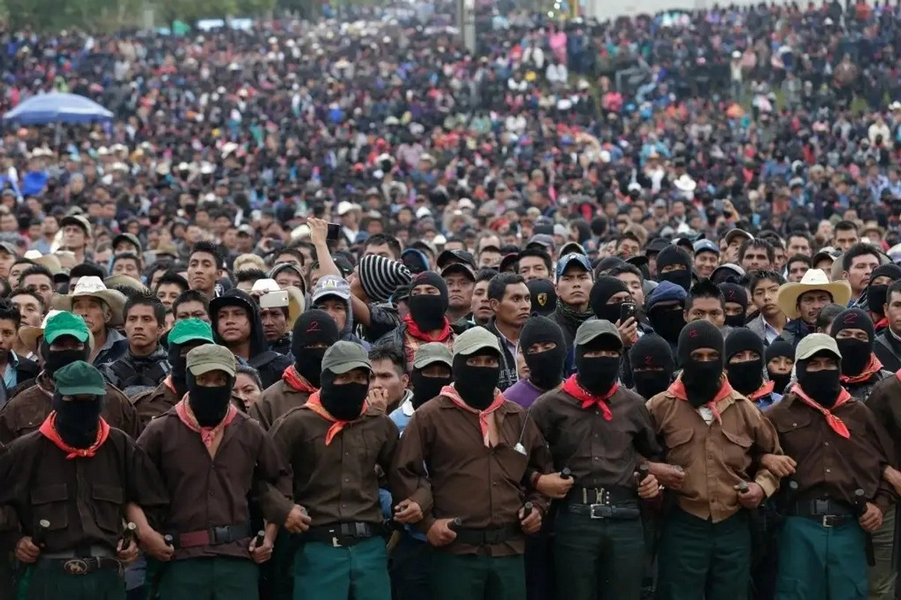
This reflects the tremendous mutation of the system, which has integrated the upper echelons of the popular sectors, showing the rest the path to individual success. In particular, it has managed to co-opt leaders (“clientelize,” as the work I’m discussing puts it). These leaders are key figures in stabilizing the system of domination. Therefore, the Zapatistas’ commitment to not giving up, not surrendering, and not selling out remains an essential ethical reference point, especially in these times of systemic turmoil.
*Alfredo Rodríguez, Gustavo Riofrío, and Eileen Welsh were the authors. The work is available online.
Original article by Raúl Zibechi, La Jornada, May 29th, 2026.
Translated by Schools for Chiapas.