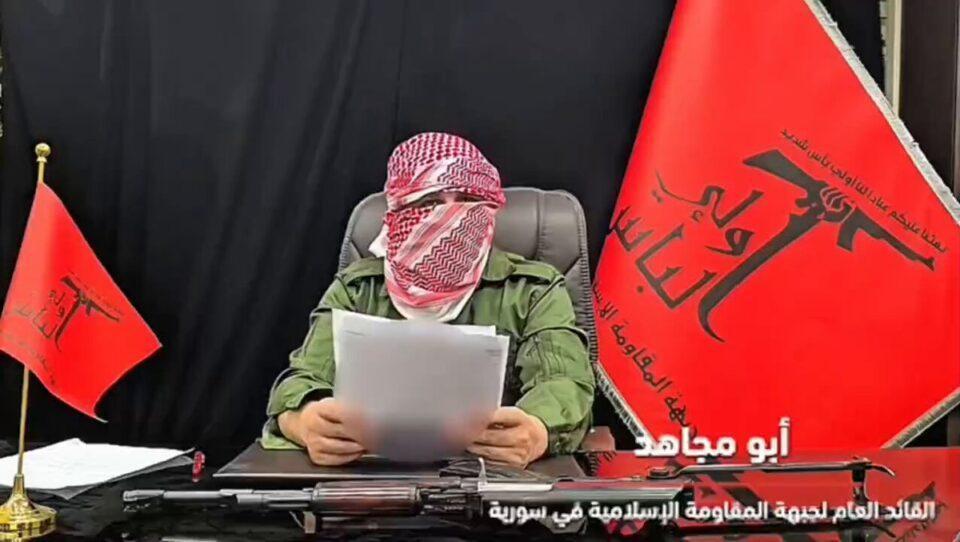
Welcome, Abu Mujahid. We’d like to start with the origins: the “Syrian Islamic Resistance Front – Uli al-Ba’s” was formed as an armed group following the collapse that struck Syria and the fall of the old regime in Damascus. What is the Front’s true ideological identity? And why did you decide to announce the formation of this group at this particular moment?
Abu Mujahid:
Thank you, and thank you to all your followers. The “Syrian Islamic Resistance Front – Uli al-Ba’s” is a popular and military resistance movement with an Islamic orientation and a deeply Syrian national identity. Our formation was necessitated by a very harsh reality: the collapse of state institutions and the country’s descent into a military and security vacuum exploited by foreign powers to advance the project of dismembering Syria.
We represent the will of those Syrians who have refused to bow to the results of the so-called “revolution” and who, at the same time, refuse to submit to the occupation and its instruments.
Journalist:
Speaking of the current situation: what is your official position regarding the “de facto authority” that currently controls Damascus?
Abu Mujahid:
Our position is clear, and we have stated it openly in our official statements: the current authority in Damascus is an illegitimate de facto authority and does not represent the aspirations of the Syrian people.
We believe this authority was imposed through regional and international intelligence agreements and deals—Turkish, American, and with Israeli complicity—with the aim of protecting the interests of those countries at the expense of Syria’s sovereignty and independence.
For this reason, there is no truce between us and them. On the contrary, we consider them a front used to consolidate the occupation.
Journalist (interrupting):
However, you speak of independent decision-making, while numerous regional and international research centers describe your Front as a new structure tailor-made for the Iranian Revolutionary Guards and the old “axis,” with the aim of maintaining armed influence within Syria. How do you respond to these accusations?
Abu Mujahid:
This description is part of the psychological and media war waged by intelligence agencies linked to the Damascus regime and their regional supporters, with the aim of demonizing any Syrian resistance movement.
Our military and political decisions stem from our leadership on the ground. It is true that we share certain views with all the forces opposing the Zionist and American project in the region, but our rifle is Syrian, and our financial support comes from the true sons of this people, who refuse to sell out their country in the marketplace of international agreements.
Journalist:
Your military statements regarding operations in southern Syria against Israeli forces have sparked much debate. Can you describe the situation on the ground and the most significant operations carried out by your units?
Abu Mujahid:
The battlefield is our clearest proof. After the Israeli enemy crossed the lines of the 1974 armistice agreement and penetrated Syrian territory by taking advantage of the chaos, we decided to engage in direct combat.
In early 2025, we launched our operations along the front lines in the areas of Quneitra, Daraa, Sweida, and the countryside around Damascus. Among the most significant operations we have documented are:
– The downing of an Israeli drone that had violated airspace in the southern sector;
– Direct attacks with automatic weapons and rockets against Israeli forces’ gatherings and vehicles near the village of Taranja, in the northern countryside of Quneitra;
– The battle of Kuweya and Beit Jinn, where we made the occupation taste the bitterness of defeat;
– The bombing of the Shaddadi base, which housed an American operations room and supported the Islamic Republic of Iran in the war against what we call the forces of global arrogance;
– Attacks against Israeli observation posts and fortifications along the border, using concentrated salvos of 107mm rockets and mortar rounds on the Red Hills.
We are waging a true war of attrition against the enemy, and our weapons will not stop until the last Zionist soldier has left our land.
Journalist:
However, there is a great deal of skepticism at the local level. Some factions and tribal groups in Daraa claim that the attacks against Israel are spontaneous initiatives by villagers and that the “Uli al-Ba’s” Front merely appropriates them in the media to construct a fictitious image of organized strength. How do you respond?
Abu Mujahid:
The proud tribes of southern Syria represent our backbone and our main popular support, and many of their men fight in the ranks of the Front.
Our organization is not imaginary. We have political, military, and media structures that manage these battles with discipline and careful planning.
Journalist:
Following the martyrdom of the previous Commander-in-Chief, you announced the convening of the “First Extraordinary General Conference” and the formation of the so-called “Unified Military Council.” What is the significance of this step from an organizational and operational standpoint?
Abu Mujahid:
This conference marked a strategic turning point, signaling the transition from the phase of “limited operations” to that of “organized revolutionary escalation.”
The Unified Military Council aims to bring all military capabilities under a single command to increase the effectiveness of operations on the ground. We do not operate alone: there is full coordination and joint operations with allied forces and factions that share our doctrine and objectives. We are building a military resistance structure capable of sustaining a long war.
Journalist:
You have issued a “call for general mobilization” in your latest statements. Who exactly is it directed at, and what objective do you intend to achieve?
Abu Mujahid:
The call for general mobilization is a summons addressed to every free and honorable Syrian, and to all those who have felt excluded from the new political order or who refuse to see the flag of occupation flying over their land while the Damascus regime remains silent.
We invite them to join the ranks of the resistance and put their military skills at the service of the battle for liberation.
Journalist:
Abu Mujahid, your front is facing a parallel intelligence war in addition to direct military conflict. How do you handle the issue of recruiting agents in the field? And what is the truth about the coordination between Israeli intelligence and the de facto authority in Damascus to track down and arrest your operatives?
Abu Mujahid:
We are waging an extremely complex and intense security battle. Through evidence and investigations into dismantled networks, we have documented the existence of undeclared collaboration and coordination between the intelligence services of the Zionist enemy and the security apparatus linked to the de facto authority in Damascus.
The common goal is to dry up the sources of the resistance and stifle any armed movement in the south and center of the country.
The Damascus authority today plays, in our view, the role of a security apparatus protecting the borders of the occupation: it conducts roundup campaigns, hunts down the mujahideen, and arrests and imprisons them for their resistance against the Israeli occupation. At the same time, the occupation uses aircraft, drones, and networks of informants to monitor the movements of our leadership.
Journalist:
How does the Front respond to this intelligence infiltration? And what fate awaits your fighters captured by both sides?
Abu Mujahid:
We have an internal security and intelligence apparatus that operates around the clock to identify spies and dismantle infiltration cells.
As for our prisoners, whether in Israeli occupation prisons or those of the Damascus authorities, their release is a moral obligation for us. We are closely monitoring every case. We reiterate that their capture will not halt our path, and that whoever is responsible for the bloodshed or the arrest of a mujahid will face the consequences. Our capabilities are sufficient to reach agents and traitors wherever they may be.
Journalist:
Commander General Abu Mujahid, you recently announced the entry into the “escalation” phase. What will the next phase look like on the ground? And what message do you want to send to those betting on the end of your front?
Abu Mujahid:
The next phase is one of “breaking bones” and military earthquakes on the battlefield, which will spare no one. The time for limited operations and isolated responses is over.
Our message to the Zionist enemy operating in southern Syria and to its commanders who view this land as a hunting ground is clear: your days are numbered. Our rockets and attack drones are ready to strike fortifications and military bases. The sacrifices of our martyrs will become a nightmare that will haunt your soldiers wherever they may be.
Journalist:
And what about your threats against the de facto authority in Damascus, which you accuse of complicity and persecution?
Abu Mujahid:
Our message to the tools of the occupation and the de facto authority in Damascus is even harsher.
Woe to you if you think your prisons will protect you or that security agreements with foreign powers can guarantee your stability. Anyone who has been complicit in the persecution of the mujahideen is already on our list. Our intelligence capabilities know your command centers.
The reckoning will take place on the battlefield and in the streets, very soon and without hesitation. No border will protect you from what we consider a necessary purification of the country.
Journalist:
Your operations are concentrated in the south, but your message is much broader. What is the geographical scope of your struggle? And does your hostility extend only to Israel?
Abu Mujahid:
The boundaries of our struggle coincide with those of the entire Syrian Arab Republic. There are no territorial divisions for us.
Our struggle is not limited to the Zionist enemy in the south, but also includes the Turkish occupation in the north and its local structures, as well as the American presence east of the Euphrates that plunders the resources of the Syrian people. Our goal extends to the liberation of Damascus from what we define as an authority incapable of defending national sovereignty.
We reject any form of division of the country: federalism or fragmentation. We believe in a united and strong Syria.
Journalist:
Last question: in an international context that seems favorable to the dominant powers, how do you envision the end of this conflict? And what message do you wish to leave?
Abu Mujahid:
History teaches us that occupying forces and the regimes that support them, no matter how militarily strong, ultimately crumble in the face of the will of the resisting peoples.
We did not take up arms for power or positions, but to defend our land, honor, and identity.
The “Uli al-Ba’s” Front will continue to be the operational arm of the resistance. The blood of our martyrs will be the fuel that will lead to the liberation of Syria from occupation and its tools. Victory, in any case, will come.
Journalist:
Commander-in-Chief of the “Uli al-Ba’s” Front, Abu Mujahid, thank you for this in-depth discussion.
Abu Mujahid:
Thank you for giving a platform to the voice of the free resistance.