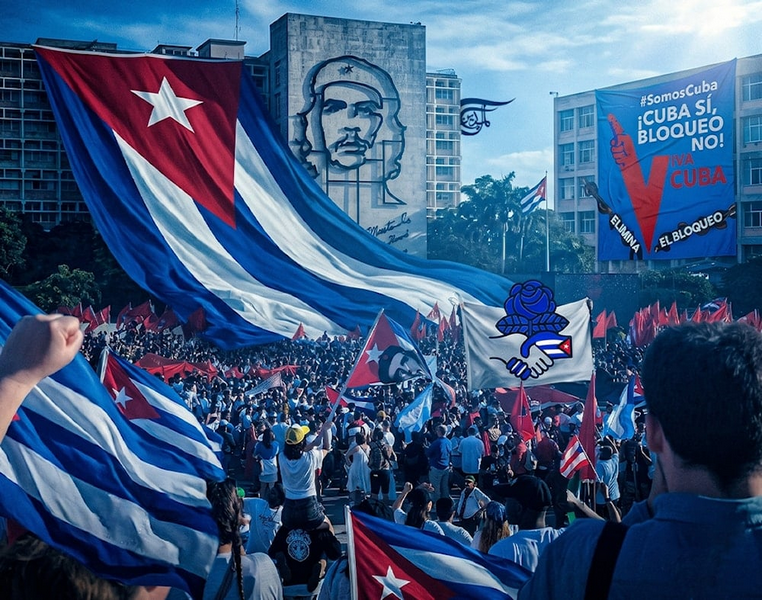
This is not about democracy or the well-being of the Cuban people. After more than six decades of resistance, history demonstrates that the United States’ objective has always been the same: to crush the example of dignity that the Cuban Revolution represents. From the failed Bay of Pigs invasion in 1961, through sustained terrorism, to the more than six hundred assassination attempts against Fidel Castro, the pattern is clear: the will to destroy a country that dared to challenge U.S. hegemony. This enmity was born from a sovereign decision made in 1959: to recover natural resources, nationalize foreign companies, and build a socialist project in the empire’s own backyard. Every measure of aggression the island has suffered responds to this systematic imperial logic.
In the current context, with an imperial escalation that has dangerously accelerated in 2025 and 2026, Washington’s true intentions are to provoke regime change, destroy our socialist system, and achieve recolonization. Secretary of State Marco Rubio increasingly instigates policies of asphyxiation and demands that Cuba have “new people in charge,” while Donald Trump has publicly declared that it would be a “great honor” to take control of the country. Military options are being openly discussed to return the island to the status of a de facto colony under the Platt Amendment, which granted the United States the right to intervene militarily in Cuba, among many other humiliating conditions. What Washington wants now is to restore that status of submission.
On January 15, 2026, Trump signed an executive order declaring Cuba an “unusual and extraordinary threat” to US national security. This declaration has no basis in reality. What threat can a small, blockaded country with no offensive military capability pose to the North American superpower? The answer is none. The false “threat” is a rhetorical device to legally activate the economic blockade and lay the groundwork for military intervention. It is the same pattern used before the invasions of Iraq and Afghanistan: first fabricate a threat, then demonize the government, then impose sanctions, and finally justify armed aggression.
But those pushing toward armed confrontation should look at the Middle East. The maximum pressure policy against Iran has not managed to bend the heroic Islamic Republic. A military aggression against Cuba would be an even more resounding failure. The island has a united people trained in defence, with a history that includes defeating a CIA-organized invasion in 72 hours. Any intervention would condemn the United States to a new Vietnam in the Caribbean, with rising casualties, financial cost, global repudiation, and internal fracture. If this aggression were to take place, the Trump administration would head into the midterm elections with two resounding failures.
In April 2026, the US government announced an unjust indictment against Army General Raul Castro for an event that occurred 30 years ago: the downing of two planes that repeatedly violated Cuban airspace in 1996. The terrorist organization Brothers to the Rescue carried out provocative flights over Havana with total impunity. Declassified documents reveal that Washington was warned several times by the government of Cuba, but allowed the violations to provoke a fatal outcome, with the aim of generating a political conflict. Accusing Raul Castro 30 years later is an act of legal cynicism to prepare the ground for military aggression.
The primary tool of this criminal scheme is economic asphyxiation. The 1960 Mallory Memorandum openly admitted the objective: “to provoke hunger, desperation, and the overthrow of the government.” The blockade has cost the island more than $1.5 trillion, equating to decades of truncated development. Today, airlines have suspended flights to Cuba, hotel management companies and investment partners have withdrawn, and the entry of parts for thermoelectric plants is blocked, contributing to increasingly prolonged blackouts.
These are not surgical sanctions but massive punishment against the entire population. Washington seeks a return to colony status. Its goal is not a cosmetic change but total dissolution of the Cuban system. They want Cuba to abandon its alliances with China and Russia — which are not military in nature — and align unconditionally with the United States. They pursue the plunder of our resources: privatize state enterprises, healthcare, and education, and control strategic sectors. Thus, they try to erase the example of a small country that refuses to kneel, prioritizes social justice over corporate profits, and has shown the world that one can live with dignity without submitting to the northern master.
Does Cuba deserve to be ‘punished’?
Leaving aside that imperialist acts against Cuba and the rest of the world have no legal or moral basis, one might ask: Does Cuba deserve to be “punished”? The premise of Washington’s demagogic policy starts from a false construction designed to justify a genocidal siege. If Cuba is a solidary country that practices full social justice within and outside its territory, the answer is clear: the true criminal is the one who imposes the punishment, not the one who resists with humanism. Cuban solidarity is not an occasional gesture but a state policy sustained for more than six decades, deeply rooted in revolutionary ethics.
Cuban medical cooperation is the most emblematic example of revolutionary internationalism. More than 600,000 Cuban health professionals have participated in 165 nations, saving millions of lives. At home, Cuba achieved an infant mortality rate of 4.9 per thousand live births and became the first country to eliminate mother-to-child transmission of HIV and congenital syphilis, certified by the World Health Organization. That is tangible human rights, not empty rhetoric.
The Henry Reeve Brigade, founded in 2005 for disasters and epidemics, supported Pakistan after its earthquakes, fought Ebola in West Africa, and aided Caribbean nations hit by hurricanes. An international campaign nominated them for the Nobel Peace Prize. Furthermore, Cuba’s literacy method ‘Yo sí puedo’ (Yes I Can) was awarded the UNESCO King Sejong Prize for its contribution to fighting illiteracy. During COVID-19, while rich powers hoarded supplies, Cuba deployed more than three thousand collaborators to 35 countries in just three months, including Italy and Andorra. Furthermore, Cuba created its own vaccines—Soberana 01, Soberana 02, and Abdala—with technology transfer to Iran, Vietnam, and Venezuela, all despite the blockade. While big pharma speculated, Cuba shared its science.
But Cuban solidarity is not limited to health. The “Yes, I Can” literacy method, endorsed by UNESCO, has taught more than ten million adults in nearly thirty countries, earning UNESCO’s King Sejong Prize. Operation Miracle, launched jointly with Venezuela, has performed millions of free eye surgeries in 35 countries, restoring sight to more than six million people. In Jamaica alone, until the government yielded to U.S. pressures in March 2026, Operation Miracle had restored sight to nearly 25,000 Jamaicans. In Honduras, the program was cancelled under the new conservative president Nasry Asfura.
Cuban solidarity has also extended to the military sphere. Operation Carlota in Angola was the largest internationalist military mission ever undertaken by a Global South country. Nearly 300,000 Cuban soldiers helped defeat South African apartheid, paving the way for the liberation of Namibia and the end of the racist regime. More than 2,000 Cubans gave their lives in this heroic feat. This demonstrates that Cuban solidarity, whether with a vaccine, a doctor, or a rifle, has always been a response to injustice, not a threat.
All this solidarity power is based on solid internal social justice: free and universal access to health and education are unshakable conquests of the Revolution. Cuba has committed no injustice, nor does it deserve to be punished. The injustice is the US blockade, which seeks to punish a country whose only crime is being an example of dignity and humanism. While Cuba guarantees tangible rights, its accusers trample on those same rights with growing inequality, privatized health systems, educational exclusion, and the repression of its people.
International solidarity with Cuba: Achievements and contradictions
Cuba does not resist alone. International solidarity has become a strategic actor, though with lights and shadows.
In material terms, the “Our America” Convoy brought together nearly 300 organizations from more than 30 countries, coordinating shipments of food and medicine. The “Granma 2.0” Flotilla sailed from Veracruz in March 2026, transporting more than 30 tonnes of critical supplies, including nearly 100 solar panels to mitigate the energy crisis. Participants range from trade unions in Brazil and Argentina to religious groups in Canada and feminist collectives in Mexico.
In the narrative battle, solidarity acts as an antidote to media poisoning. The study Solidarity Does Communicate recorded 3.3 million mentions of Cuba in March 2026 on digital platforms. Activists articulated a coherent three-layer narrative: the blockade as the cause of suffering; concrete humanitarian aid as a response; and solidarity as political legitimation. Among others, figures like Jeremy Corbyn and Pablo Iglesias participated in events, generating emotional content on Instagram and Facebook. Solidarity successfully competes against the most powerful disinformation machine in the world.
On global political pressure, the UN General Assembly has condemned the blockade 33 times between 1992 and 2025. In the last vote (October 2025), 165 countries voted in favour, 7 against, and 12 abstained—a slight erosion due to US pressure, but still an overwhelming majority confirming global support for ending the blockade.
The International Court of Justice has established that unilateral coercive measures violate the UN Charter when applied extraterritorially. The National Network on Cuba in the United States (NNOC), with more than 70 organizations, coordinates vigils, lobbying, and car caravans in US cities. Even within the aggressor country, there is organized rejection of White House policy. In March 2026, the Pan-African movement issued a letter signed by 33 organizations from 16 countries, calling the blockade “a persistent act of war and a crime against humanity.” Global support for Cuba is real and majority, but its effectiveness clashes with the U.S. veto in the Security Council, which paralyzes any binding action.
The structural limitations of global support and solidarity
No serious analysis can hide the deep limitations facing international solidarity with Cuba. It is not just about the ineffectiveness of certain actions, but the very structure of the international system, where impunity for Washington’s acts remains the norm. This impunity has been visible in Gaza, Lebanon, and Yemen, where despite global condemnation and UN resolutions, the US and “Israel’s” war machines continue to operate without consequences. The same pattern applies to Cuba: unanimous condemnations at the UN have not lifted a single ‘sanction.’
The first major limitation is the political, financial, and tariff pressure Washington exerts on any government or entity that dares to support Cuba. The Treasury Department has fined European, Asian, and Latin American banks for processing Cuban transactions. Title III of the Helms-Burton Act allows lawsuits against foreign companies that ‘traffic’ in nationalized properties, creating a climate of financial terror. Added to this is the U. control of the SWIFT banking system, turning any act of solidarity into a risk of ruin. Furthermore, the arbitrary inclusion of Cuba on the US State Sponsors of Terrorism list—a designation widely rejected by the international community—severely restricts access to correspondent banking, international financing, and humanitarian purchases, imposing collective punishment on the entire population
The result has been a wave of cancellations of medical cooperation agreements under direct US pressure. Jamaica ended a nearly 50-year agreement in March 2026. Honduras did not renew its contract, leaving thousands of rural patients without care. Guatemala closed a 30-year program involving 412 Cuban collaborators. Guyana, Antigua and Barbuda, and the Bahamas also suspended or cancelled their agreements. Cuban Foreign Minister Bruno Rodríguez has denounced that Washington pressures and extorts governments to end the presence of Cuban medical brigades, aiming to besiege the Cuban economy. To legitimize this, Washington labels the program “forced labour” and “human trafficking,” which Cuba rejects since Cuban doctors serve voluntarily, driven by ethical conviction. The mechanism is clear: the power of the dollar, control of banking, and extraterritorial US laws force small countries to sacrifice their public health for Washington’s geostrategic interests.
The second limitation reflects the asymmetry of world powers. China and Russia maintain diplomatic and economic relations with Cuba, vote against the blockade at the UN, and have offered credits and political support. However, they have not put a limit on aggressive U.S. policy against Cuba. No power has been willing to challenge the U.S.-led political and financial order without risking confrontation. Solidarity from great powers is real in diplomatic discourse, but its capacity to reverse the blockade encounters the same structural limitations faced by the entire Global South. It is the suffocating reality of an international order where the U.S. veto and financial dominance impose rules.
The third limitation is systemic impunity. The United States has abandoned any pretense of rules-based leadership: it vetoed ceasefire resolutions in Gaza, threatened the International Criminal Court, and ignored fundamental treaties. The blockade against Cuba is not an anomaly but another expression of that impunity. The UN General Assembly can condemn it 33 times, but as long as the Security Council is paralyzed by the US veto, those condemnations remain symbolic. The world condemns, but no one dares to stop the aggressor for fear of reprisals. When Washington imposes sanctions on European banks that trade with Cuba, those banks comply. Impunity is not an accident; it is a structural feature of the imperial order.
This combination of factors—direct coercive pressures, interests of emerging powers, and systemic impunity—explains why, despite decades of solidarity, the blockade not only persists but hardens. It is not that solidarity is useless; it fights on a battlefield where the rules are set by the aggressor. The lesson is clear: the defence of sovereignty cannot be delegated to any external solidarity. Fundamental resistance lies on the island.
The communication battle
Greater coordination of campaigns on social networks is essential to neutralize the lies launched by the United States. Imperial psychological warfare knows no borders. The digital offensive against Cuba uses three techniques: framing (presenting Cuba as a “threat”), agenda setting (creating a sense of imminent collapse), and gaslighting (making Cubans doubt their own reality). The objective is to poison public opinion and break resistance from within.
To neutralize the empire’s lies, it is key to build a global communication front based on seven axes: articulate a unified three-layer narrative; prioritize emotional content on Instagram and Facebook; coordinate posting times to create trends; ally with content creators; systematically dismantle false accusations; create a global directory of digital activists; and leverage international events. The communication battle is a decisive trench. When solidarity is coordinated on a global scale, it can successfully compete against the most powerful disinformation machine in the world.
In conclusion: fundamental resistance lies on the island
Washington’s recipe is old: strangle the economy to generate discontent and, amidst the suffering, facilitate an intervention. The unjust accusation against Raul Castro is nothing more than the latest piece in that machinery: criminalize the leader to delegitimize the Revolution and pave the way for military aggression, while working to create a humanitarian crisis in the country. But as we demonstrated at the Bay of Pigs in 1961, during the 1962 missile crisis, in the special period of the 1990s, and every single day of resistance since then, the Cuban people, their Revolution, and their sovereign example are not negotiated; they are defended. International solidarity—from the flotillas breaking the blockade to the content creators amplifying our truth on social networks, from the governments condemning the siege at the UN to the unions sending solar panels—is a necessary and valuable complement. But the heart of the resistance beats on the island, in every Cuban who, despite shortages, endless lines, scheduled blackouts, and media poisoning, refuses to kneel and is willing to give their life in defense of the homeland, if necessary.
But Cuba’s struggle is not only for its own survival. It is a fundamental trench in a much larger battle. Halting the aggressive and predatory advance of the empire before it engulfs the entire planet is a shared responsibility of all conscious humanity. At stake is the very possibility of a multipolar world, respectful of sovereignty and social justice. Therefore, while the threats of Trump and Rubio and the infamous accusation against Raúl Castro resonate in international headlines, the Cuban people continue working, studying, producing, and defending their right to exist with dignity.
References:
- Cuban News Agency. (2021, April 6). Cuban president and FM denounce the genocidal policy of the US blockade. http://www.cubanews.acn.cu/cuba/13196-cuban-president-and-fm-denounce-the-genocidal-policy-of-the-us-blockade
- Cuban News Agency. (2023, April 6). Cuba condemns validity of the Mallory Memorandum. http://www.cubanews.acn.cu/cuba/20917-cuba-condemns-validity-of-the-mallory-memorandum
- Prensa Latina. (2026, April 6). Cuba no está sola, afirma activista boliviano ante bloqueo de EEUU. https://www.prensa-latina.cu/2026/04/06/cuba-no-esta-sola-afirma-activista-boliviano-ante-bloqueo-de-eeuu/
- (2025, January 15). The United States adopts measures in the right direction, but the blockade remains. https://en.granma.cu/cuba/2025-01-15/the-united-states-adopts-measures-in-the-right-direction-but-the-blockade-remains
- (2026, February 16). Cuba is not a threat! https://en.granma.cu/mundo/2026-02-16/cuba-is-not-a-threat
- Juventud Rebelde. (2022, March 28). Organismo de Naciones Unidas premia a gestores cubanos de vacunas antiCOVID-19.https://juventudrebelde.cu/index.php/ciencia-tecnica/2022-03-28/organismo-de-naciones-unidas-premia-a-gestores-cubanos-de-vacunas-anticovid-19
- (2020, October 4). Medical brigade that worked in Dominica returns to Cuba. http://en.cubadebate.cu/news/2020/10/04/medical-brigade-that-worked-dominica-returns-cuba/
- (2026, May 20). Cuando Leonard Weinglass interpeló al Gobierno de Estados Unidos sobre Hermanos al Rescate. https://www.granma.cu/mundo/2026-05-20/cuando-leonard-weinglass-interpelo-al-gobierno-de-estados-unidos-sobre-hermanos-al-rescate-20-05-2026-13-05-34
- Prensa Latina. (2026, May 20). Estados Unidos, culpable del derribo de avionetas, entonces y ahora. https://www.prensa-latina.cu/2026/05/20/estados-unidos-culpable-del-derribo-de-avionetas-entonces-y-ahora/
- (2026, May 20). La acusación contra Raúl es fraudulenta y carece de fundamento legal, político y moral. https://www.granma.cu/cuba/2026-05-20/la-acusacion-contra-raul-es-fraudulenta-y-carece-de-fundamento-legal-politico-y-moral-20-05-2026-22-05-40
- (s.f.). Enmienda Platt. https://www.ecured.cu/Enmienda_Platt
- Cuadernos Artesanos de Comunicación. (s.f.). Informe sobre votaciones en la ONU. http://www.cuadernosartesanos.org/cdm1.pdf#21#13
Pedro Barata
Source: Al Mayadeen