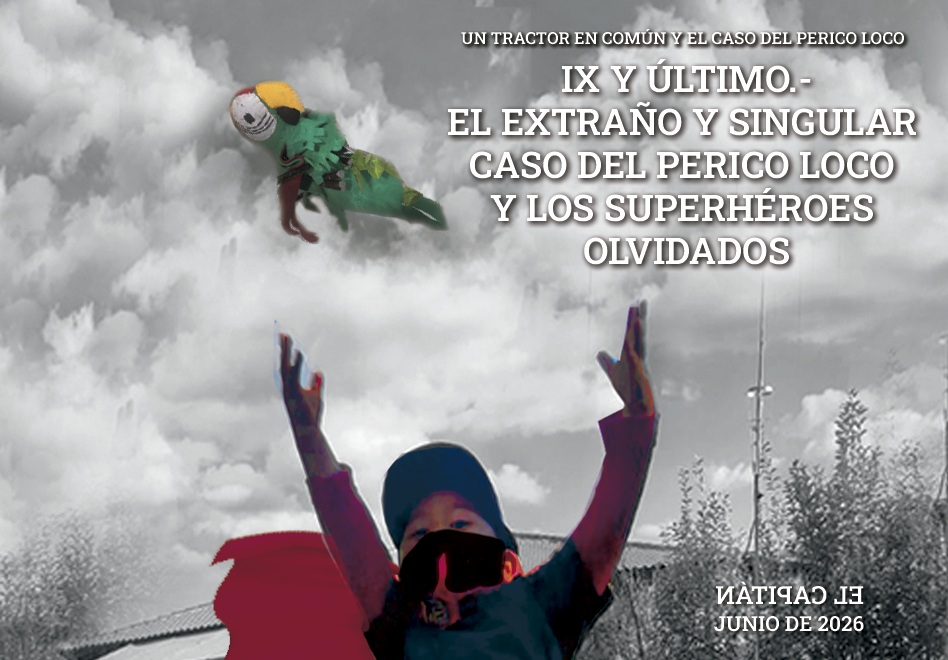
A Tractor and the Case of the Crazy Parakeet
I should clarify, right off the bat, that the parakeet isn’t—and never was—crazy. It was all just a misunderstanding. But before I continue, let me tell you about the difficulties we’ve faced in recounting this story to you. The first—and, in my opinion, most important—is respecting the secret identities of superheroes. I know it might seem strange that, in a story about a parakeet—who, by the way, isn’t crazy—the topic of superheroes and their secret identities would come up.
You see, believe it or not, we superheroes suffer. Yes, speaking in the first-person plural. And the thing is, even though I don’t have superpowers and I’m not a star from Marvel, DC Comics, or whatever, in my spare time, I’m the gatekeeper in charge of access to the village where forgotten superheroes come to live temporarily.
Yeah, you probably already know that all superheroes have a secret place where they take refuge so they can walk around without a mask, without underwear tucked into their pants, or those skirts and tight-fitting suits that superheroines usually wear—which, let’s face it, are hard to believe—and so they can just chill in “casual” mode. There’s, for example, the Fortress of Solitude, where Superman goes without underwear and shares dog food with his dog Krypto. Then there’s the Batcave, where Batman, Robin, Alfred, Batgirl, and Catwoman play Rayuela, or “You Bring It” (also known as “English Hide-and-Seek”), which is the game featured in the video from two posts ago, with Veronica “tackling” her victim. Of course, there’s Aunt May’s house, where Spider-Man stuffs himself with butter cookies. Iron Man has his high-tech mansion (Elon Musk’s wet dream).
There are also the places where superheroes gather to, as they put it, “save the world”—like the Hall of Justice—though in reality they just get together to show off to one another. The Justice League is like a shareholders’ meeting, where they tally up the profits from Marvel, DC, and the villains who tag along with them.
You’ll agree that the way these characters acquire their superpowers is usually ridiculous: Superman is nothing more than an immigrant, separated from his parents by the evil Lex Luthor, dressed in an ICE uniform. And yes, seeing him with his tight underwear over his tight pants, one wonders if, in the Fortress of Solitude, there’s a closet from which the native of Krypton will finally emerge—even if his weakness is social media. Batman and Iron Man? Bored millionaires, tired of exploiting workers and pretending to fight the villains they themselves created. Peter Parker was bitten by a spider. Who hasn’t been bitten by a spider? And yet, you don’t see anyone charming a redhead with the old “hey, I got bit by a spider” line. The Hulk is just a driver—enraged and with liver problems—and you can find him in any city traffic jam. Captain America is the product of experiments—like AIDS, Ebola, and COVID-19—and he came out of Vietnam and the Bay of Pigs pretty battered.
They—in addition to wearing ridiculous and provocative outfits (those colorful shorts, the little skirts, the costumes that look like “body paint,” the cumbersome capes that are outdone by any well-tied bandana), and other paraphernalia—usually have a secret identity. That is, an identity that makes them seem “normal.”
But this story isn’t about those boring superheroes; it’s about others—the forgotten ones. These superheroes go unnoticed most of the time because they only reveal themselves on special occasions. You see only ordinary people: the supermarket cashier and the elderly man who bags the groceries; the public transit driver; the anonymous street sweeper; the elementary school teacher; the CNTE teacher; the mother searching for her missing child; the migrant who must cross the vast border (courtesy of the 4T) stretching from the Suchiate to the Rio Grande; the boy who plans to change his name to “Goku,” despite his parents’ opposition; the doctor skilled with a scalpel who treats prostate and uterine issues; the indigenous Zapatista woman who prays for a fierce downpour the next day so she won’t have to go out and gather thorns; the other woman who carefully chooses the lights that will adorn her on Pride Day. In short, ordinary people who perform feats so often that they aren’t even aware of it.
Well, sometimes these people become aware of their powers and realize they need a secret identity. They know that if they don’t, journalists and cameramen will show up to bother them, they’ll end up in comics and trending topics, they’ll be prey to streaming services, and all those things that pretend to be modern but are really just frivolous. So it turns out that these people decided to build a community together, where they can be who they are without anyone bothering them. That’s where I work, guarding the gate.
And, of course, there are also the places where supervillains gather. And it’s not in Washington, Tel Aviv, Moscow, the Paris-Rome-London axis, or Beijing where they reside. No, the ones who live there are just employees of the real bad guys: the bankers. Well, but that’s another story.
I’m telling you this so you can picture a boy with an unusual superpower. I have to protect his secret identity for obvious reasons, and I also had to get permission from his parents to share what I’m about to tell you. Since we need to give him a name so you can identify him in this story, we’ll call him “Ernesto.” And not to pay homage to that brilliant figure who was and is Oscar Wilde, but because, if I had named him “Marcos,” it would have been too vain. So let’s stick with “Ernesto.”
Well, that’s why Ernesto’s superpower is something incredible: he invents games without needing artificial intelligence! And without any electronic devices! With that sense of wonder at the world that only a child can experience, he plays with whatever he can find.
I met him at one of the previous seminar/seedbeds. It was during one of the breaks, and I was presenting the editorial team with the hypothesis that the World Cup final would be between Mexico and the United States. I was explaining how, in the final, everything was planned so that the U.S. team would be the one to lift the trophy (while they threw a party for Infantino and his henchmen of the moment). Trump had invited Sheinbaum to the final. We’ll never know if she attended or not because here’s what happened: the CIA and ICE showed up in the Mexican team’s locker room with the classic “You know the drill,” and threatened the players with revoking their U.S. visas and said Malu Campos would be the team’s godmother if they didn’t lose. As expected, that worried Vasco and the others. Did the threats from the “Empire of Stripes and Shadowy Stars” have any effect? We’ll never know. What is certain is that the letter in which the players and coaching staff expressed their solidarity with the searching mothers was never made public.
Because it turns out that, in my scenario, all the latino homies surrounded the “New York” stadium and slammed the doors shut, marching right past the ICE and the U.S. Navy, and hurling a shower of tacos and raw tamales onto the field, just as the game was about to start. Trump was knocked down by a migrant girl, and as he tried to get up with his fist raised and shout “Fight! Fight!”, a cascade of Eje Central-style hot sauce (I don’t know if it’s still called that) covered his face. When he tried to wipe his face, the orange paint came off, leaving him green with a looooot of chili. The Air Force quickly rescued the tycoon as best they could and transported him to Epstein Island, hoping that nostalgia would lift his spirits. The game, however, was not suspended. On the contrary, since the players had fled to save their commercial deals, a pickup game broke out with the searching mothers. They filled the cup with pozol and passed it around the crowd. Although, it must be said, more than a few—men, women, and everyone in between—couldn’t appreciate the heavenly flavor of sour pozol. In the end, everyone gathered in the center of the field and dedicated a resounding “culeeeeeero” 1 to Gmail for blocking the registration emails.
Just as I was wrapping up my brilliant hypothesis—and ignoring the skeptical glances from the Tobi Club on the editorial team—I began to outline my “Plan B,” in which the final would be between Japan and South Korea (an epic battle between K-Pop and anime) —I spotted a little boy—I’d guess about 3 or 4 years old—running around with… some girls from the Popcorn Squad! At that very moment, the little boy fell onto the gravel. All of us “machines” held our breath, expecting the inevitable scream and tears that would challenge the sacred law that “men don’t cry.” A deathly silence fell over the world… okay, okay, over the CIDECI plaza. But no, the boy got up, brushed off his clothes, and kept running aimlessly.
Shortly afterward, I saw him throwing what I assumed was a rag. He was tossing it upward, as high as his short stature would allow. He tried again and again. The rag would rise and then fall back down. I approached cautiously, sensing that something serious and momentous was happening. I ventured, “What are you doing?” The boy, without stopping to toss the rag—which wasn’t a rag, I now know, but a toy shaped like a parakeet—and without stopping what he was doing, said to me, “It just won’t fly.” I wanted to explain the law of gravity and all that nonsense to him, but it was clear that wouldn’t stop him. I pulled up a chair for him and suggested, “Try standing on the chair.” The boy did so and tried again, but the toy once more landed with a thud on the ground. I then told him, “You have to convince it that it can fly.” The boy paused to catch his breath (defying the law of gravity can be exhausting, believe me) and asked me, “How?” In a burst of honesty that surprised even me, I replied, “No idea.” Then SubMoy called me to prepare one of the topics for the workshop.
A few days later, I found out what had happened: in the place where that damned little devil of a kid was spending the night… oh no, that’s from another story. Well, where the boy slept with his mother, there’s also a parakeet. But it’s not just any parakeet—it’s multilingual. It speaks dog language, cat language, and decent Castilian Spanish. Little Ernesto thought it would be a good idea to ask the parakeet how to fly.
But lo and behold—who would have thought it? Parakeets have their own efficient intelligence service (unlike the Mexican government’s, which, it solemnly declares, is only now realizing that FIFA is raking in a multimillion-dollar business), and it had found out that one of its own had been thrown to the ground regardless of his condition.
Of course, he flew into a rage and attacked the mother, who had no idea what was going on. The boy Ernesto declared, “Don’t worry, Boss, I’ve got your back.” And sure enough: a bite from the furious parrot struck the child on the cheek and caused the mother no small number of injuries to her arms. All hell broke loose. Lawyers, prosecutors, and even a jury made up of some Chihuahua puppies and several kittens showed up.
Taking refuge in the Common Settlement of Forgotten Superheroes (PCSO, for its acronym in Castilian), Ernesto told me what had happened and asked me for two things: first, and most importantly, that his mother—and everyone involved—forget the incident because, if they didn’t, she and the others would find out that the little boy was a superhero. In other words, he had to regain his secret identity. The other request was that I represent him at the trial where they would decide who was at fault.
I gathered as much information as possible, including the videos you’ll be able to watch at the end of this post. I also learned that the prosecutor was a little bug with delusions of being a “shopping mall senator” in the U.S.—before they revoke his visa and J.C. Penney loses one of its most loyal customers. Yes, just like you, I suspected it was none other than Durito. The situation looked complicated, so I suggested to little Ernesto that we try to reach an out-of-court settlement. The boy hesitated, but refused. Truth and justice (what the Searching Mothers and the Missing of Ayotzinapa hope for) had to prevail. So I showed up for the trial while that damned beetle stared at me and smiled mockingly.
Durito presented photos and videos of the boy throwing the doll into the air and, maliciously, a slow-motion shot of the moment it hit the ground. There were cries of outrage. I had a complicated case, and the odds were stacked against us—in Las Vegas, the odds were 77 to 1 that we’d lose.
I began my presentation by quoting the late SupMarcos—may God keep him in His holy glory and may the Blessed Virgin shower him with blessings. The late SupMarcos explained that heaven and hell do exist, but not as they are portrayed by various religions. Sup pointed out that both heaven and hell were in the same place and that there were no angels, no heavenly courts, no Saint Peter, or anything of the sort—only a multitude of little animals of all sizes. He said that the person, whether supposedly damned or saved, would appear before them, and they would say, “Just as you treated us in life, so will you be treated here.” In other words, if you mistreated animals—kicked them, killed them, dressed them up in ridiculous costumes for Christmas, Halloween, and national holidays, or forced them to perform all sorts of tricks and participate in competitions—then that’s what would happen to you. So you had to imagine what it would be like to be kicked, or dragged around, or dressed up in a pumpkin costume, or as Chucky, or as Trump, or as Salinas Pliego… for all eternity.
I explained that little Ernesto had not only never hurt any living animal, but also that his intention—as the superhero that he is—was to free the rag parakeet from the bondage of the unjust law of gravity, and that he didn’t want to harm it but rather to help it “fly.”
And that is why he approached the live parakeet with the purest scientific curiosity. Although the parakeet thought, given the circumstances, that he would be thrown up into the air again and again only to fall back to the ground, ruining his magnificent plumage.
The parakeet asked to speak and addressed the jury—made up, as I’ve already said, of puppies and kittens. Contrary to what one might think, the parakeet did not speak out against our superhero. On the contrary, he explained how he suffered every time his feathers were clipped. That flying is the aspiration of every self-respecting parakeet, no matter how multilingual or made of rags he may be. That he understood Ernesto and that the only one to blame was the damn capitalist system. And he went on to give an explanation that the bigwigs—who claim to study… but never learn—would love to be able to give.
The jury deliberated. I rejected the requests for house arrest or, the very minimum, a restraining order. Durito pulled some sour faces because he knew he was doomed. And finally, the verdict was handed down: the puppies and kittens, along with another parrot that happened to be passing by, decided that there was no crime to punish, that it had all been a misunderstanding, and that, if anything, the system that allows animal abuse should be tried and sentenced.
El Perico and Ernesto hugged, and I could tell that the bird was whispering something in the little boy’s ear. Of course, without biting him. Ernesto nodded in agreement, and his face lit up. Did the parakeet reveal the secret so the doll could fly? Only the boy knows that. And it must be something amazing, because now he’s trying to make a rock “fly.”
The moral of this story is clear: it’s better to check whether the tamale is undercooked or not before chowing it down. The sewer system and the outhouse will thank you for it. And, of course, consider switching to Yahoo… or Hotmail. Oh, oh, Hotmail doesn’t exist anymore? Hmm, that explains why nobody chats with me anymore. Sigh.
Anyway, as SubMoy already said, you do things with what you have and with your head. You’re welcome, Vasco (if you want a lineup suggestion for the final, that’s a separate charge). If they take away the mattress commercials, there’s always “La Migaja Hammocks” (they’ll be listed on the stock exchange soon—watch out, Musk).
Ta-da.
(now not to be continued)
The Captain.
Mexico, June 2026.
P.S. — Well, here’s the call for submissions for the Resistance and Rebellion gathering and the Arts gathering. Both will take place in August 2026.
semillerojulio2026@proton.me
encuentroryragosto26@gmail.com
encuentroartes2026@gmail.com
Original text published at Enlace Zapatista on June 17th, 2026.
Translation by Schools for Chiapas.
Footnotes
- a highly offensive chant yelled at the opposing team, banned by FIFA as a homophobic slur