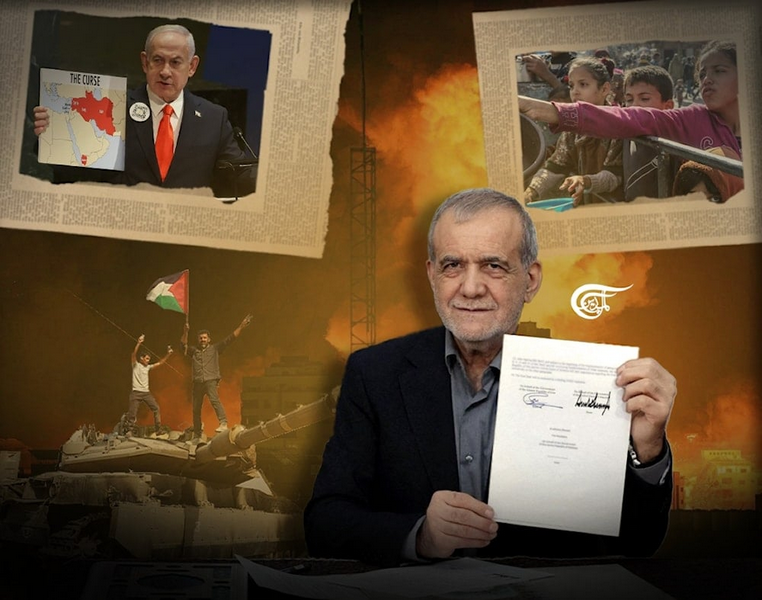
While there has been significant focus on the importance of the Lebanon ceasefire within the broader Iran-US Memorandum of Understanding, little attention has been paid to the predicament of the Gaza Strip – the front from which the regional war began.
A recent call between Hamas official Bassem Naim and Iranian Foreign Minister Abbas Aragchi ended in assurances that the Gaza ceasefire is being discussed amidst the ongoing negotiations between Tehran and Washington. After all, the first clause of the Memorandum of Understanding (MoU) affirms that the war must end on all fronts.
Lebanon is the only front that is explicitly mentioned in the Memorandum of Understanding, because of the fact that it was a battlezone that reactivated more recently, requiring the implementation of a real ceasefire agreement; especially as the Israelis had violated the previous ceasefire 15,400 times.
However, the issue of Gaza could in fact become more relevant to ending the regional war than even the predicament of Lebanon. One must not forget that is where this war began. Without the Hamas-led offensive on October 7, 2023, there never would have been a US-Israeli aggression on Iran. This is why the issue – beyond its moral implications – is of vital importance.
Israeli Prime Minister Benjamin Netanyahu’s “seven fronts” war seeks “total victory” across all fronts, with the Iranian front being the most important. So far, he has proven incapable of achieving any decisive strategic victories, only a series of tactical victories, which have left them stuck. Some 92% of the Israeli population believe that Iran won the war, which is a dramatic shift from the polls conducted following the 12-Day war last year, when the majority of Israelis said they approved of the war and how it was managed.
This time around, Hezbollah’s choice to join and make an impressive comeback undid the Israeli propaganda that brainwashed its population into believing that they had defeated the Lebanese Resistance. Up until September of 2024, the Israelis were widely accepted to be stuck militarily, having failed to defeat the Palestinian Resistance in Gaza and also lacking any real options against Lebanon.
The terrorist pager attacks and assassinations of Hezbollah’s senior leadership ended up resulting in a series of tactical victories, giving way to a propaganda win that enabled the Israeli regime to sell its people the idea that they had achieved a strategic victory. Almost immediately after the November 27, 2024, ceasefire was declared in Lebanon, the government of neighboring Syria fell. Netanyahu spared no time in claiming this as his victory.
These two events managed to drastically change the balance of power regionally and give the illusion that Iran was severely weakened, its Axis of Resistance battered, and that it could be on the verge of collapse. As it turned out, that was far from the reality on the ground.
Washington and their allies in Tel Aviv tried almost everything they could to bring down the Iranian government, including fueling an armed rebellion inside Iran and then launching a full scale assault. None of this worked.
The Israeli plot has clearly been to expand its territorial control and achieve the so-called “Greater Israel Project”, but this all depends upon the collapse of the Iranian-led Axis of Resistance.
Facing a predicament whereby the defeat of Iran and Hezbollah appears improbable, the Israelis now appear to be pivoting back to the Gaza Strip as their punching bag, aiming at eventually ethnically cleansing the population. Hamas and the other Palestinian resistance factions know this. The bottom line, they will not stand idly by. What this means is simple: A major operation will eventually be carried out by the Palestinian Resistance if it is left alone.
Iran has the opportunity to not only ensure that the front at the heart of the region’s primary cause remains, but that it can be granted leverage with which to negotiate. Left to its own devices, the only option available to the Palestinian Resistance is to launch another major offensive that will end up bringing the entire region back to step one. Therefore, Tehran understands that if it wants any ceasefire to truly hold, it is a requirement for Gaza to be part of it. Otherwise, it would be a strategic disaster.
The Zionist entity understands this. Therefore, it could end up choosing to pursue an agenda of going after the civilian population in Gaza once again, as a means of totally collapsing the MoU and ushering in a new phase of the conflict; believing that this will then grant them the upper hand.
Robert Inlakesh
Source: Al Mayadeen