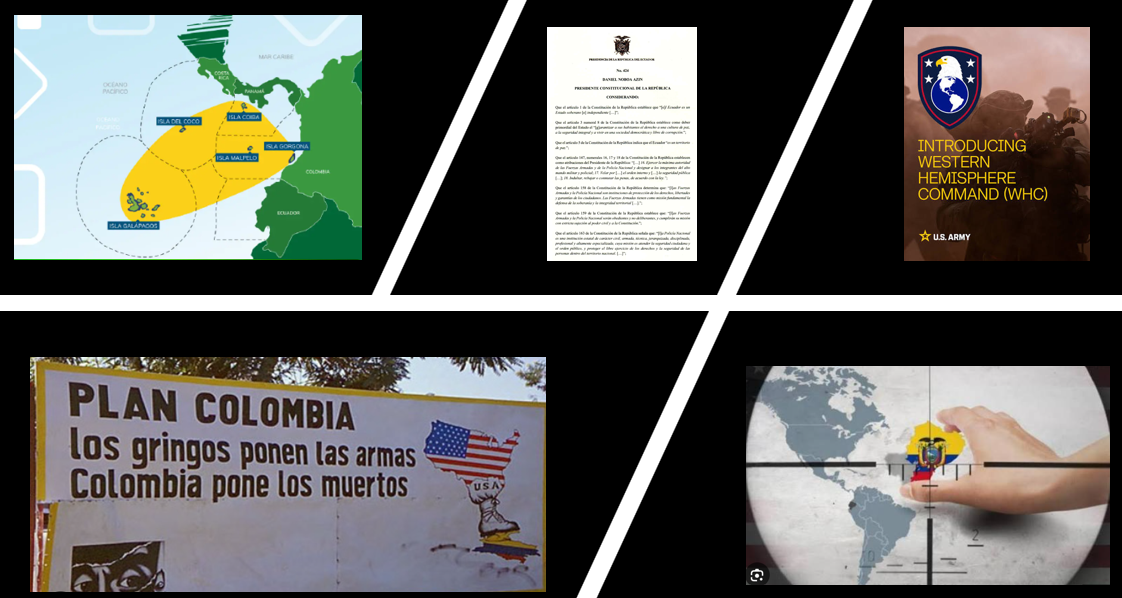
Under the guise of security, Plan Colombia left behind a military, legal, and ideological architecture that served the market and external control. Today, Plan Ecuador threatens to replicate that legacy: less sovereignty, more control, and a subjugated democracy.
The signing of Executive Decree 424 by Daniel Noboa’s government constitutes one of the most significant geopolitical events in Ecuador’s recent history. Under the pretext of combating transnational organized crime and restoring public safety, the Ecuadorian government has institutionalized a new cycle of strategic subordination to U.S. military interests, reopening a path that the country had sought to close with the withdrawal of U.S. troops from the Manta Base in 2009.
The decree also grants special immunities and privileges to foreign military personnel deployed on Ecuadorian territory, reigniting a long-standing debate over jurisdiction, sovereignty, and democratic control of national security (Lexis, 2025). This represents Ecuador’s gradual integration into Washington’s global military architecture, the purpose of which goes far beyond the fight against criminal organizations.
Latin American history shows that U.S. interventions are rarely presented as projects of domination; they are cloaked in moral and civilizing rhetoric. Yesterday it was the fight against “communism”; then, the war on drugs; later, the war on terrorism; today, the fight against transnational organized crime and the defense of democracy. The enemies change, but the strategic function remains intact: to expand military projection capabilities into regions considered essential to U.S. economic and geopolitical interests.
In this regard, the so-called “Plan Ecuador” appears to be a contemporary adaptation of a long tradition of hemispheric security programs previously implemented in Colombia, Mexico, Central America, and the Caribbean.
Platforms of Geopolitical Domination
One of the greatest analytical errors is to view military bases solely as spaces intended for the deployment of troops. In reality, they constitute nodes in a complex global infrastructure of intelligence, surveillance, electronic warfare, satellite control, logistics, and special operations. They are components of what U.S. strategic doctrine has historically conceived as the preservation of its primacy over the Western Hemisphere, a principle reaffirmed in the recent U.S. National Security Strategy (The White House, 2025).
The United States maintains the most extensive military network ever built by a major power. Various studies estimate that there are between 750 and 900 military installations spread across more than eighty countries—an architecture without historical precedent (Vine, 2020). Their function goes beyond conventional defense: permanent electronic surveillance, protection of energy corridors, securing logistics chains, rapid intervention capabilities, and exerting political pressure on governments considered strategic.
In Latin America, much of this presence operates under less conspicuous names, such as “cooperative security locations,” “logistics centers,” “joint task forces,” or “access sites.” The semantic shift, however, does not alter its geopolitical nature.
Ecuador on the Pacific Chessboard
Ecuador’s geographic location explains Washington’s renewed interest. Ecuador simultaneously links the eastern Pacific, the Amazon, the Andean region, and the maritime routes connecting South America with Asia. From a U.S. strategic perspective, it constitutes a prime platform for monitoring the Pacific corridor and projecting capabilities into one of the world’s most biodiverse regions, rich in water resources and critical minerals.
This dimension takes on even greater significance in a context marked by structural competition between the United States and China. The Economic Commission for Latin America and the Caribbean has documented how China has become one of the region’s main trading partners and investors, particularly in infrastructure, energy, mining, and telecommunications (ECLAC, 2024). Ecuador is no exception.
The current dispute no longer revolves solely around governments or ideological alignments. It centers on control of bio-oceanic corridors, strategic minerals, freshwater sources, biodiversity, and supply chains that are indispensable for the global energy transition. In an increasingly multipolar world, where U.S. hegemonic power is in relative decline, Latin America is once again taking center stage in the competition for 21st-century resources.
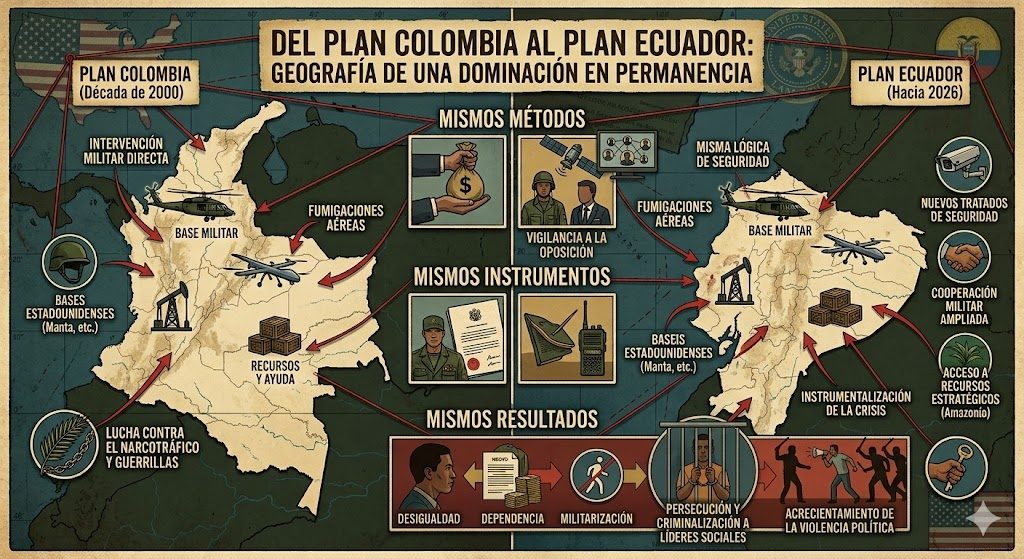
From Plan Colombia to the Export of a Model
The Colombian case is particularly revealing. Originally presented as a strategy to combat drug trafficking, Plan Colombia ultimately became one of the largest contemporary testing grounds for counterinsurgency, militarization, and state restructuring in Latin America. More than $13 billion was invested in military training, intelligence, crop spraying, surveillance systems, and institutional strengthening (BBC Mundo, 2016).
The results reveal profound contradictions. Drug trafficking did not disappear; illicit crops were displaced, and illegal economies diversified their accumulation mechanisms. What did take root, however, was a powerful military infrastructure, a growing doctrinal dependence on Washington, and a permanent model for the securing of the territory and political life.
The Commission for the Clarification of the Truth and various researchers have documented how this strategy was accompanied by mass displacements, the expansion of paramilitarism, systematic persecution of social organizations, and thousands of extrajudicial executions known as “false positives” (FOR, SICSAL, SOA WATCH, 2020; Truth Commission, 2022). These events served a doctrine under which the civilian population became a permanent target of surveillance, suspicion, and persecution.
The legacy of Plan Colombia was not limited to the military sphere either. It contributed to the formation of an armed force increasingly oriented toward defending the market order and transnational strategic interests, more closely aligned with U.S. hemispheric security doctrine than with the constitutional mandate to provide comprehensive protection for citizens. At the same time, a generation of legal practitioners and security experts emerged whose doctrinal and institutional contributions warrant critical evaluation, as in many cases they ended up supporting the consolidation of a more conservative state—one that was reactive to social transformations and focused on preserving the stability of the economic model rather than expanding rights and popular sovereignty.
Added to this was a foreign policy increasingly aligned with Washington’s interests, aggressive toward neighboring progressive governments, and deeply intertwined with conservative and far-right administrations in the region. In the current context of the global rise of authoritarian and neo-fascist tendencies, this aspect becomes even more dangerous, as it turns foreign policy into an extension of U.S. geopolitical priorities rather than a tool for sovereign integration and Latin American cooperation.
As David Harvey (2004) points out, the expansion of military apparatus often accompanies processes of accumulation by dispossession. Security thus functions as the political infrastructure of extractivism, ensuring the appropriation of territories, natural resources, and strategic commons for global capital. From this perspective, militarization is not merely a response to public order issues, but a governance mechanism that serves the struggle for resources and geopolitical control in Latin America.
The Constant Creation of Enemies
Perhaps the most disturbing feature of this architecture of power is its constant need to create enemies. Yesterday it was communism; then, drug trafficking; later, global terrorism; today, transnational organized crime. The names change, but the political function remains intact: to legitimize states of emergency, expand extraordinary powers, increase military spending, and normalize foreign presence on sovereign territories. Security thus ceases to be a public policy aimed at collective well-being and becomes a technology of control and governance.
The fundamental issue does not lie in whether Ecuador must confront organized crime—an inescapable obligation of any state—but rather in who defines the threats, who controls strategic intelligence, who manages the information, and who ultimately benefits from the territorial and economic reorganization that accompanies militarization.
Decree 424 does not merely usher in a new security policy; it marks Ecuador’s integration into the renewed U.S. military geography of the 21st century. The so-called “Plan Ecuador” thus appears as an update of the model tested in Colombia—a combination of irregular warfare, technological surveillance, military cooperation, intelligence, and control of strategic resources—now embedded in the struggle between a declining unipolar order and an increasingly multipolar world.
The real debate, therefore, goes beyond the fight against organized crime. What is at stake is the sovereignty of the peoples, democratic control of the territory, the protection of the commons, and the inalienable right of Our America to shape its own destiny without external guardianship or enclaves of domination.
Latin American history shows that no imperial structure is eternal; in the face of militarization, dispossession, and subordination, the peoples will once again raise the banners of dignity, self-determination, and social justice. Defending sovereignty also means defending Mother Earth, the waters, the forests, and the diverse ways of living in the world that our communities have built. For true peace does not arise from occupation or fear, but from respect for life, for the worldviews of peoples, and for their inalienable right to exist, to make decisions, and to flourish in freedom.
Two centuries later, Our America remains a collective and unfinished task of liberation.
References:
- FOR, SICSAL, SOA WATCH. (7 de octubre de 2020). Desde el inicio hasta el final. Estados Unidos en el Conflicto Armado Colombiano. Obtenido de Kavilando: https://kavilando.org/lineas-kavilando/conflicto-social-y-paz/8049-desde-el-inicio-hasta-el-final-estados-unidos-en-el-conflicto-armado-colombiano
- BBC Mundo. (2016). Plan Colombia: las consecuencias inesperadas de 15 años de la estrategia antidrogas. https://www.bbc.com/mundo/noticias/2016/02/160201_colombia_plan_colombia_15_aniversario_consecuencias_inesperadas_nc
- BBC Mundo. (2025). Daniel Noboa y el decreto que permite presencia militar extranjera en Ecuador. https://www.bbc.com/mundo/articles/c3g23990xn7o
- CEPAL. (2024). *Perspectivas del comercio internacional de América Latina y el Caribe 2024*. Santiago de Chile: Naciones Unidas.
- Comisión para el Esclarecimiento de la Verdad. (2022). Hallazgos y recomendaciones finales. Bogotá.
- Harvey, D. (2004). El nuevo imperialismo. Madrid: Akal.
- Lexis. (2025). Decreto Ejecutivo No. 424 otorga inmunidades a personal extranjero en el conflicto armado. https://www.lexis.com.ec/noticias/decreto-ejecutivo-no-424-otorga-inmunidades-a-personal-extranjero-en-el-conflicto-armado
- The White House. (2025). National Security Strategy of the United States. Washington, D.C.
- Vallejo Duque , Y., & Insuasty Rodríguez, A. (2025). Crisis y resistencia en un orden global en reconfiguración. Revista Kavilando, 17(1), 2–17. https://doi.org/10.69664/kav.v17n1a535
- Vine, D. (2020). The United States of War: A Global History of America’s Endless Conflicts. University of California Press.
Original text by Alfonso Insuasty Rodriguez published at Desinformémonos on June 29th, 2026.
Translation by Schools for Chiapas.