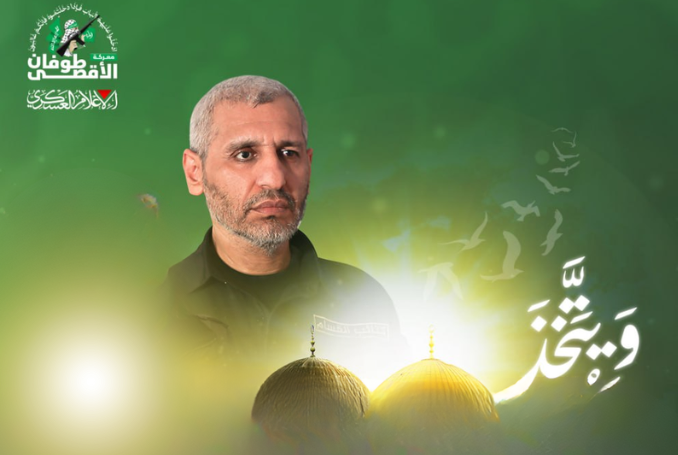
The Palestinian Resistance Movement Hamas commemorated on Monday the second anniversary of the assassination of Mohammed al-Deif, the longtime commander of its military wing, the Izz ad-Din al-Qassam Brigades, describing him as one of the most influential figures in the history of the Palestinian resistance.
Although Deif was killed in a zionist airstrike on July 13, 2024, Hamas did not officially announce his death until January 30, 2025, stating at the time that the delay was related to security and military considerations.
In a statement marking the anniversary, Hamas described Deif as an “exemplary and unparalleled” leader who devoted his life to the Palestinian cause and played a defining role in developing the movement’s military capabilities over four decades.
The movement said his legacy continues to inspire Palestinian resistance fighters despite his death, describing his assassination as a loss that had strengthened rather than diminished the movement’s determination.
From Refugee Camp to Al-Qassam Commander
Mohammed Diab Ibrahim al-Masri, widely known by his nom de guerre Mohammed Deif, was born in 1965 to a Palestinian refugee family in Khan Yunis after his family was displaced during the 1948 Nakba.
While studying science at the Islamic University of Gaza, he became active in student, religious and charitable work before joining Hamas during the First Intifada in 1989.
Occupation forces arrested him that same year, holding him for approximately 18 months without trial.
Following his release, Deif became increasingly involved in the military organization of the Al-Qassam Brigades. During the 1990s, he helped establish Hamas’ military infrastructure in the occupied West Bank before returning to Gaza.
In 2002, following the assassination of Salah Shehadeh, Deif assumed command of the Al-Qassam Brigades, a position he held for more than two decades.
Under his leadership, Hamas significantly expanded its military organization, developing command structures, weapons production and operational capabilities that became central to the movement’s strategy.
A Figure Shrouded in Secrecy
Throughout his years in command, Deif maintained an exceptionally low public profile.
Only a handful of images of him ever emerged publicly, and for many years he appeared only through audio messages or heavily obscured video recordings, earning him a reputation as one of the most elusive figures in the Palestinian resistance.
Zionist intelligence repeatedly identified him as one of its highest-priority targets.
Between 2001 and 2014, the occupation carried out multiple assassination attempts against him.
Several of those attacks left him seriously wounded, including injuries that reportedly affected his vision and mobility.
One of the most devastating attempts occurred during Israel’s 2014 military offensive on Gaza, when an airstrike killed his wife and two of his children. His extended family also suffered heavy losses during the occupation’s war on Gaza following October 2023.
Associated with Jerusalem and Al-Aqsa Flood
Deif became closely associated with the defense of Jerusalem and Al-Aqsa Mosque.
His public warnings during the Sheikh Jarrah crisis in 2021, when Palestinian families faced forced displacement from the occupied East Jerusalem neighborhood, elevated his profile beyond Gaza and made him a symbol for many Palestinians participating in protests across historic Palestine.
His most widely known public appearance came on October 7, 2023, when an audio message announced the launch of Operation Al-Aqsa Flood.
In that address, Deif stated that the operation was intended as a response to years of zionist occupation, attacks on Al-Aqsa Mosque, settlement expansion and violations of Palestinian rights.
The speech became one of the defining moments of the conflict that followed.
Hamas Says His Legacy Endures
In Monday’s statement, Hamas credited Deif with transforming the Al-Qassam Brigades from a relatively small armed organization into a disciplined and organized military force.
The movement portrayed him as the principal architect of its military doctrine, saying his strategic planning shaped many of its operations over the past two decades.
Hamas also stated that Deif became “a nightmare” for the regime’s security establishment because of his ability to evade repeated assassination attempts while overseeing the continued development of the Brigades.
The statement concluded that his death would not mark the end of his influence, asserting that his legacy would continue to guide the resistance.
It described his blood and sacrifices as “fuel” for the ongoing struggle, while expressing confidence that future generations would continue what it characterized as the path he helped build.
source: Palestine Chronicle