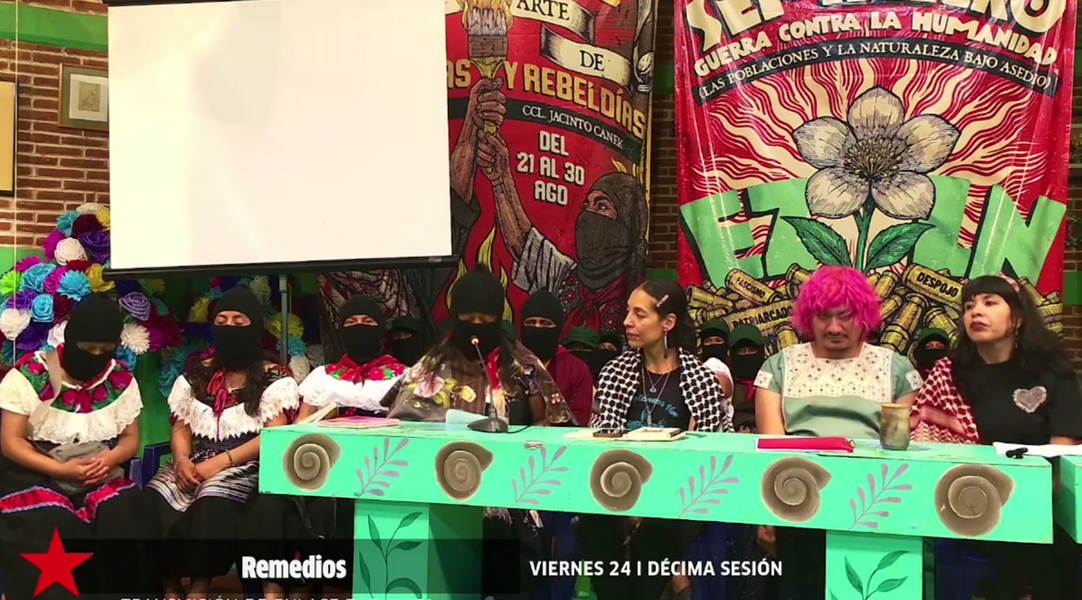
“The capitalist system is an inhumane, cruel, and criminal system,” declared Insurgent Subcomandante Moisés, spokesperson for the EZLN, during the “War Against Humanity” Seminar (Populations and Nature Under Siege), held from July 20 to 24. And he concluded: “We do not believe this system can be humanized.”
Subcomandante Moisés’s harsh words were borne out throughout the five days of the workshop, during which men, women, and others described the new and old ways in which the system exploits and dominates humanity and nature. Topics discussed included global state terrorism, militarization, recolonization, racism, violence, dispossession, water hoarding, ecocide, forced disappearances, forced recruitment, fracking, exploitation, financialization, artificial intelligence, migration, wars, criminal corporations, exclusion in urban and rural areas, gender, and extractivism. Far from the rhetoric of “shared prosperity” and “conscientious capitalism”—which are nothing more than an updated version of Margaret Thatcher’s “there is no alternative”—the Zapatistas and their guests emphasized something that has fallen by the wayside: the problem is capitalism.
Since their inception, the Zapatista communities have been known for fostering and promoting critical thinking. The study groups they organize on an ongoing basis have featured Immanuel Wallerstein, Silvia Federici, Pablo González Casanova, Sylvia Marcos, Adolfo Gilly, Fernanda Navarro, Michael Löwy, Paulina Fernández, and many others who have helped shape our understanding of and transform the world. Likewise, the Zapatistas have developed their own theory, the result of their emancipatory practice and in dialogue with a grassroots internationalism, which allows them to view the world and chart their course. In this regard, it is worth recalling the reflections they developed beginning in the late 1990s on the characteristics of new forms of war, which are extremely useful for understanding what is happening in the world today (https://n9.cl/60cjz). Strong organization, sound theory, accurate and constantly updated analyses, a vision for the future, and action plans—these are essential for all struggles that seek to transform their reality.
At the “Semillero” convened by the Zapatistas, there were not only descriptions of the new calamities—of the nightmares that large segments of humanity experience on a daily basis—but there was also hope, a great deal of hope. There was talk of new working-class organizations fighting exploitation by app-based companies, of the resistance of sex workers, and of the indispensable role of Indigenous peoples in defending the territory in its broadest sense—that is, water, air, the seas, and the subsoil… There was talk of women’s and transgender organizations, of migrant caravans, of coffee and bread cooperatives, of local farmers, of the resistance of people of African descent, of housing organizations, of the “anti-monuments” in Mexico City, of the “not here” movement in Topolobampo, of the battles over narratives, of Cuba and of Palestine… always Cuba and always Palestine.
The families searching for missing persons in Mexico held a special place throughout the Semillero, not only in the analysts’ presentations but also in the words and actions of the Zapatistas. Thus, Sub Moisés announced that in December 2026, a delegation of 1,111 Zapatistas will travel to Mexico City to meet with “compañerxs of La Sexta and the Declaration for Life,” and also to express “in person our admiration, our affection, and our respect for the collectives of searchers. We feel we must embrace them, listen to them, and let them know that here, in the mountains of southeastern Mexico, we share their pain and, above all, their commitment to truth and justice.”
There are still details to be revealed about this new initiative launched by the Zapatistas, but it is already clear that it will revitalize the political debate and move beyond false dichotomies between neoliberals and neoconservatives, and between “pro-government” and “opposition” forces. It involves acknowledging that there is indeed an alternative beyond capitalism—and this requires understanding that the struggles against capitalism and for life today take on new characteristics, offer new proposals, and involve new ways of organizing, imagining, and building another world.
During the Mexican Revolution, in villages and on estates, people used to say “here comes the bola” to refer to the group of poor, ragged revolutionaries who swelled the ranks of the Zapatistas and Villistas. More than a century later, the neo-Zapatistas have revived the expression “bola” to refer to the process by which indigenous people in Chiapas escaped from the haciendas and farms to begin building what they now call “the Common.” “In a ‘bola,’ in a ‘group,’ in ‘the Common’”—that is how the Zapatistas now refer to the alternative being built from below. Here come the Zapatistas, inviting us to build a world in common.
Original text by Raúl Romero published by La Jornada on August 3rd, 2026.
Translation by Schools for Chiapas.