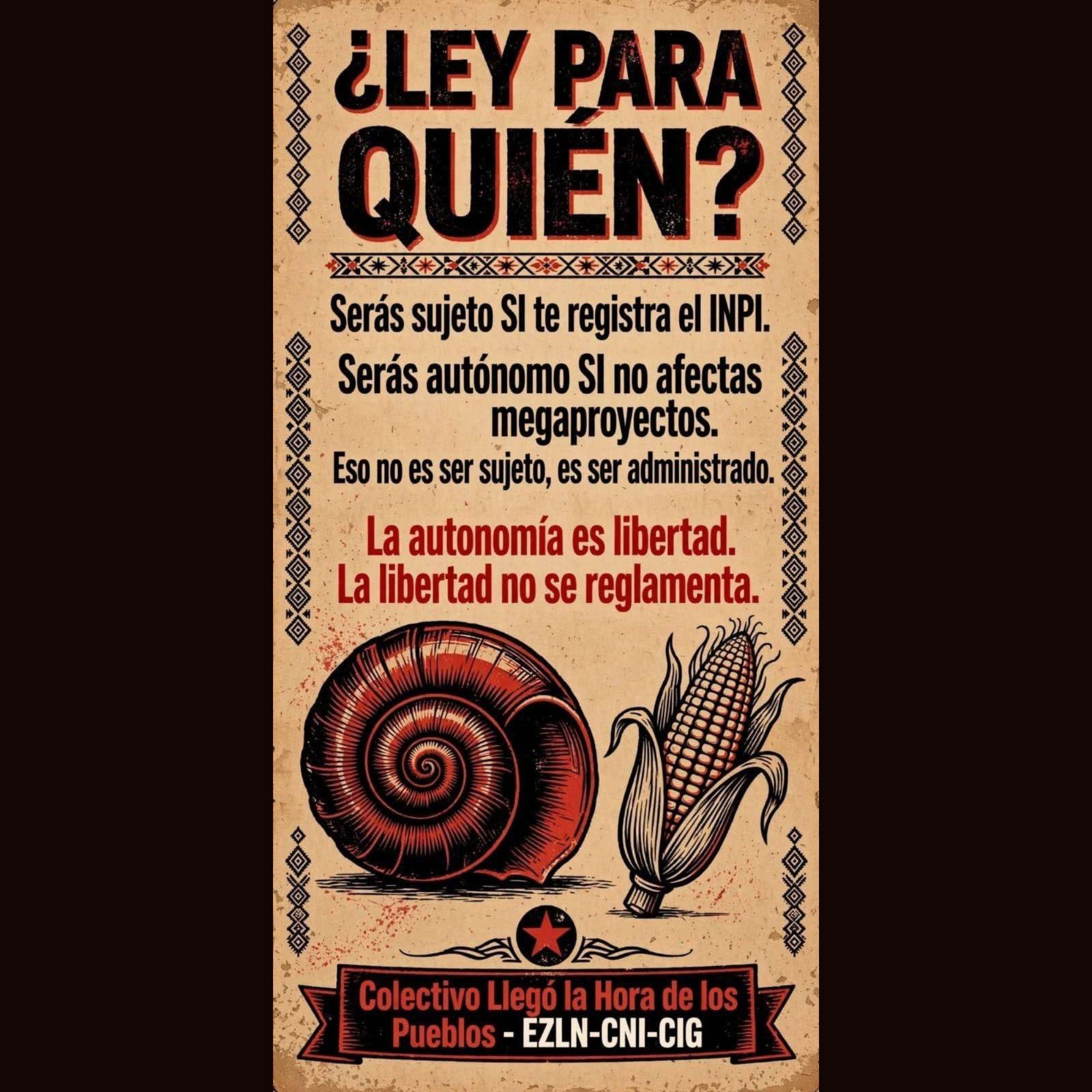
- Before analyzing the document, our Collective clearly distinguishes between different ways of understanding the autonomy of indigenous peoples: one that makes the exercise of autonomy dependent on recognition by the State, and another that is put into practice independently and without recognition by the Mexican State. For this universe of peoples, communities, and movements, the proposed law is more or less irrelevant in many respects, although it is a fact that it will seriously impact all indigenous peoples.
- It is a serious matter that the initiative seeks to regulate, limit, and define the nature and content of freedom. It is highly paradoxical to impose limits on freedom, given that autonomy is precisely the exercise of freedom by Indigenous peoples within the framework of the Mexican State. It is contradictory that, in order to exercise freedom, mandatory conditions, mechanisms, and formulas are being stipulated. The law even establishes who the authorities of the communities and regions must be.
- The purpose of the document supposedly under consultation is to restrict, diminish, and interfere with the exercise of indigenous autonomy. It is a law similar to the old Agrarian Reform Law—a mechanism and form of mediation through which the State intervened in agrarian communities, local communities, and ejidos. The first two books of the proposal are imposing. They establish characteristics, mechanisms, and procedures so that indigenous peoples may constitute themselves as subjects of public law; so that communities, as integral parts of these peoples, may be recognized as entities under public law and integral parts of the State; and they also dictate how autonomy must be exercised. In reality, it is a set of obstacles designed to prevent indigenous peoples from exercising the freedom recognized by Article 2 of the Constitution.
- A fundamental part of this proposal is the issue of territory and land. This gap stems from the omission of territory in the amendment to Article 2 on September 30, 2024. In 2001, an amendment to Article 2 of the Constitution was approved that deliberately ignored the issue of land and territory, leaving it in the unacceptable language in which it was originally drafted. It refers not to territories, but to “places” and a “preferential right to resources,” while reserving strategic areas for the State and containing ambiguities that leave the rights of indigenous peoples unprotected.
- These ambiguities are related to Article 27, Section 7, and the body of laws enacted on these matters from 1992 to the present—the Water Law, the Forestry Law, the Mining Law, the Biosafety Law, and the Cultural Heritage Law. This body of laws includes, first and foremost, the T-MEC and tends to leave the territorial and land issues of indigenous peoples completely unprotected. Since the 4T has no intention whatsoever of breaking with the neoliberal continuity, it does not even touch on the issue of territory, not even in the 2024 amendment to Article 2 of the Constitution. They would have had amend not only Article 2 but also Article 27 of the Constitution.
- Indigenous communities have a dual and contradictory relationship with the Mexican State. They have a legal relationship as agrarian communities, resulting from the revolutions of 1910 and 1917, and—following the successive reforms on indigenous matters in 1992—they have a very complex relationship with the Mexican State, one characteristic of a country as deeply racist and colonialist as Mexico. This dual relationship stems from the colonial status of the peoples. This issue was supposed to have been resolved by September 30, 2024. The government of the Fourth Transformation will not address the agrarian and territorial issue because it underlies the entire set of neoliberal legal mechanisms, programs, and projects promoted by the current regime.
- Thus, indigenous peoples and communities remain in this colonial condition, caught in a contradictory relationship with the Mexican state: they are recognized in two ways—as agrarian communities and as indigenous communities. In practical terms, even the Ministry of Finance does not know whether they are classified as agrarian communities or as indigenous communities. As indigenous communities, they must register their status in the INPI’s registry. Furthermore, traditional indigenous communal property has no legal basis either in the Constitution or in any other law.
- Alongside these omissions and limitations, what we see is a return to a deeply interventionist law regarding indigenous peoples, similar to what the Federal Agrarian Reform Law once was, but with significant neoliberal elements. Hence the omission of territory and the imposition that the Mexican State decide on crucial aspects of indigenous territories, as per Articles 2 and 27. This neoliberalism is particularly pronounced in the chapter on the cultural heritage of indigenous peoples—their creations and knowledge—which are transformed into commodities for the market.
- The chapter on consultation, in addition to being interventionist, grants the INPI the right to determine the procedures under which it must take place and fails to clarify what would happen if the people decide not to give their consent, or whether the project can be implemented without their consent—which would render the indigenous consultation irrelevant. Historically, such consultations have served to violate the substantive rights of indigenous peoples. In short, it is a proposal that is deeply restrictive of autonomy, interventionist, colonial, and “indigenist,” while at the same time neoliberal in the aspects that serve capital’s interests—namely, ensuring that territories remain at the disposal of large corporations and the Mexican government’s strategic projects.
- The proposed bill consists of 453 articles plus 11 transitional provisions. Aside from the sheer volume of this proposed bill, the topics it covers are numerous and extremely varied. From a legal technical standpoint, several separate regulatory laws should have been drafted. The bill mixes a wide range of topics: territory, land, electoral matters, the economy, food supply, housing, and traditional medicine—a veritable jumble of issues. As a result, the bill is not only confusing but also, in legal terms, unworkable. It is unworkable to have a single regulatory law covering 30 different topics.
- The consultation is a formality; in reality, it gives communities the right to express their opinions, but not the right to decide. They go ahead and hold the consultation, but in the end, the governments—with their projects already underway—and the corporations have already had them approved and obtained the necessary permits; when they hold a consultation, it is really just a bureaucratic procedure to lend legitimacy to projects that are going to be carried out, such as the Topolobampo ammonia plant, for which they supposedly held a consultation. These consultations aim to legitimize and confer a pseudo-legality on actions that have already been decided—and not by the communities that are affected. Regarding the consultation, there are provisions stating that it will only take place when there is a significant impact on the communities’ environment, but there is no definition of what constitutes a significant impact, nor who will determine whether it is significant or not—and, therefore, whether the consultation is warranted or not. An essential element of consultation is good faith and trust. These communities have been historically deceived—how can they trust a government that has systematically dispossessed them? This is a bureaucratic process they are carrying out, and in reality, it is impossible for every community to read, debate, and explain all 400 articles or express an opinion on how the measures will affect or benefit them.
- Projects and megaprojects undertaken by the government and private companies follow the same logic and operate in tandem. When a private company chooses where to set up operations and is granted the necessary permits, the project already has the financial resources to carry it out. They set an amount that is “fair”—according to whom?—to compensate for any adverse effects the project might cause. There is no way to refuse. They can voice their opinions; they can say no, but the only thing they are entitled to is compensation. And it is the community or indigenous people who will bear the environmental consequences. Occasionally, a project has been canceled, but we’ve seen that the Maya Train went ahead against all odds, as did the Interoceanic Highway and the mining concessions. The peoples are never consulted in accordance with Convention 169, even though they are being stripped of hundreds of hectares of land—including farmland.
- In 1992, Article 27 amended many laws related to the legal framework governing rural areas, water, forestry, and foreign investment. Previously, foreign investment along the shoreline was prohibited. That foreign investment law was amended. This renders the law ineffective for consultation purposes and conflicts with other laws that touch the very heart of communities and peoples—namely, their lands and territories. Historically held lands are those that communities or peoples have possessed; some communal groups must go to court to have their ownership of these lands recognized, and this process takes place in the agrarian courts
- If the amendment to Article 27 is not reversed, it is pointless to establish rights over territories and lands when those rights are eliminated in Article 27. The concept of indigenous territory does not exist in Article 27; it recognizes only national, ejido, communal, and private property.
- Currently, the head of the federal executive branch can issue decrees granting title to these communal lands; this has no legal basis, as the authority to grant title lies with the agrarian courts. It is not specified whether these decrees will be annulled or whether the INPI will process these cases. The government is in a legal gray area where it is unclear who is responsible for processing them. Currently, that authority is reserved for the agrarian courts. The president’s authority to grant land titles does not exist under current legislation.
- The INPI has enormous power to register, recognize, and validate—it has total control over all the procedures that indigenous peoples and communities wish to undertake. If you are not registered as an indigenous people, it is not possible to carry out these procedures. Regarding sacred sites, the INPI is the body that will determine whether or not they meet the criteria to be included in the catalog of sacred places. The more regulations there are, the more rights are restricted. It’s a straitjacket.
- At the international level, international treaties run parallel to the Constitution, in accordance with the 2011 Amendment to Article 1. In this regard, ILO Convention No. 169 clearly establishes the right to self-determination, the right to territory, and the conditions for consultation. It is not the State’s role to determine which communities are indigenous or how consultation should be conducted. The central tenet of the September 30, 2024, amendment is the recognition of indigenous peoples as entities under public law. And now, with this proposed law, what is happening is that the State will take control of the lives of indigenous peoples. They are considered entities under public law, but they must register and be included in that “catalog.” This is a blow to rights that are already recognized. It distinguishes between indigenous peoples and communities, as well as regional peoples, but it is the INPI that must draft regional statutes and determine which category each falls under. This fundamentally undermines all the progress made in the struggle of indigenous peoples to have their collective rights recognized. It is a chain of events in which an interventionist approval process takes place that negates the rights of the peoples .
- The document is an aberration consisting of 453 articles, including a chapter on cultural heritage that is folkloristic and mercantilist, What they did—if one examines the 2024 amendment to Article 2 of the Constitution—is create a thematic catalog; they extracted topics derived from other laws, but they took care—as they have done since 1992—to ensure that Article 27 of the Constitution “remains untouched,” just as the issue of territory remains untouched. Each of these pretences has its own history.
20.—The agrarian law obviously did not regulate the lands occupied by indigenous peoples. This is a matter of state policy and what is at stake with these maneuvers, which justify the management of clienteles and specific issues, regardless of whether they contradict other laws. Some of the technical advisors are claiming that there is no contradiction between Article 2 and Article 27—and therefore between this document and Article 27 of the Constitution—because they assert that a systematic and broad interpretation of the Constitution is required. They argue that territory is indirectly recognized through traditional communal lands. They are reconceptualizing territory rhetorically.
23.- This document is fundamentally flawed. This reform has its historical roots in the San Andrés dialogue between the EZLN and the federal government, and in the Mexican government’s betrayal of the San Andrés Accords. During those talks, it was said that autonomy marked the end of “indigenism,” but this document shows that “indigenism” remains as relevant as ever, whether through the INPI or the Supreme Court. It is a fact: there is historical amnesia and a return to state-sanctioned “indigenism.”
The proposed General Law on the Rights of Indigenous and Afro-Mexican Peoples, as presented, effectively disregards the very right of these peoples to be subjects of public law.
*Pictured are the sponsors of the controversial general bill on the rights of indigenous and Afro-Mexican peoples: Víctor Suárez Carrera, Adelfo Regino Montes, Guadalupe Espinosa Sauceda, and Diego Prieto Hernández. Photos courtesy of the federal government.
Original text published on Ojarasca Suplemento Facebook.
Translated by Schools for Chiapas