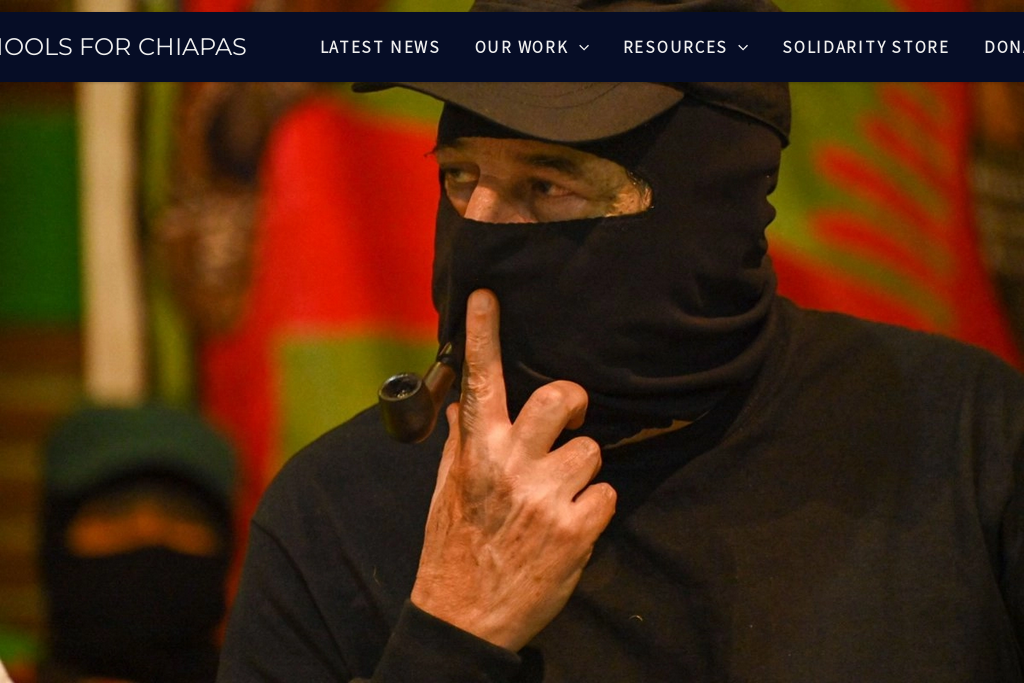
San Cristóbal de Las Casas, Chiapas. In the takeover of seven municipal capitals in Chiapas in the first minutes of January 1994, 4,500 indigenous people of Mayan descent participated, revealed Captain Marcos of the Zapatista Army of National Liberation (EZLN).
“Among the papers and files I inherited from the late Sub-commander Galeano, who in turn inherited them from the deceased, I found the rosters of the units that went out to fight: three regiments, part of what was then called the 21st Zapatista Infantry Division. Each regiment consisted of three battalions, each with 400 combatants including their officers, plus medical personnel, war materiel, communications, and sappers,” he added. In a statement read Wednesday night during the second day of activities at the “Arts Under Siege” workshop (dance, film, and theater) held in San Cristóbal, he noted that “these lists contain the names of each combatant, their real name and nom de guerre, the town, region, and zone they were from, and a next of kin column, to whom notification should be sent in case of death, disappearance, imprisonment, or desertion.”
He added: “If the deceased didn’t lie—and I don’t see why he would have, given that it was his own document—the actions, objectives, logistical plans, and advance routes of each unit were also detailed there, as well as the sequence of initial actions. The existence of four additional reserve battalions was also indicated.” The captain said, “Sub-commander Marcos later confided in me that there were more because many left their communities to accompany us and see what was happening. But let’s stick with the 4,500. You can imagine how many more people, relatives of those combatants, were involved.”
He maintained that “despite the photographic evidence and the military reports from the Federal Army confirming the presence of thousands of combatants, the press, afflicted by the amnesia brought on by the boom years, spoke 30 years after that dawn of only a few hundred combatants. And other experts on everything and knowledgeable about nothing don’t even do that. The infamous Nexos magazine claimed that the Zapatistas numbered no more than 300 and was desperate because the Federal Army hadn’t wiped us out.”
Marcos stated that “the reference to that folkloric anecdote, as a displaced intellectual put it, is relevant, or rather, it depends, because the question isn’t how that was possible—the uprising and a conspiracy involving hundreds of thousands. Racism could be one reason. By that I mean that, since they were Indigenous, there was no need to worry about them.”
He continued: “The question is what those who did that won’t be able to do. Those who did it on January 1st, 1994. What won’t they be able to do? And one answer among many, the one that’s visible now—because with the Zapatistas, things are only revealed when they want them to be—is an anachronistic construction in the middle of the Lacandon Jungle: the infamous operating room named after fallen comrades of the world.”
He recalled that “this is not the first time the Zapatista communities have built a health facility in remote corners of the mountains of southeastern Mexico. There is, for example, the La Guadalupana clinic in the Caracol of Oventic; the Compañera Murcia clinic in the Caracol of Jerusalén; and the La Realidad clinic in the town of San José in that region. But this operating room (which is nearing completion in the Lacandon Jungle) is unique in that it was conceived with the vision, thought, and heart of the people.”
The wonderful thing, he said, “is not only that it brings together the efforts, support, and manual and intellectual labor of individuals, groups, collectives, movements, and organizations from different geographical locations and with different languages, ways of life, backgrounds, histories, cultures, struggles, resistances, and rebellions.”
The captain commented that “just yesterday we received a letter from fellow anarcho-syndicalist organizations in Germany and almost all of unconquered Europe, as well as from the United States and Canada, announcing their support. They have also provided financial contributions, both individually and collectively, here in Mexico.”
He asserted that in the operating room, “they not only work alongside the Zapatistas, non-Zapatista communities, political allies, and former anti-Zapatistas who receive support from counterinsurgency programs of governments of various political hues,” but that “they discuss and agree with the Zapatistas on the uses and needs that the operating room should fulfill.”
‘’What is truly surprising, and what I can’t quite explain’’, he emphasized, “is why politically affiliated communities and indigenous groups, who have closer access to government health facilities with larger budgets, supposedly with specialists and many poorly paid staff, support and participate in this.”
He stated that he has seen the operating room “firsthand, from when it was just overgrown vegetation to the stage of placing the roof. I believe they are now at the stage of installing doors and windows. We hope that photographs and videos of each stage of construction will be presented somewhere in Mexico City next December,” when leaders and supporters will make a month-long visit to meet with groups of mothers and fathers searching for their missing children, among other collectives, and carry out other activities.
Original article by Elio Henríquez, La Jornada, August 19th, 2026.
Translated by Schools for Chiapas.