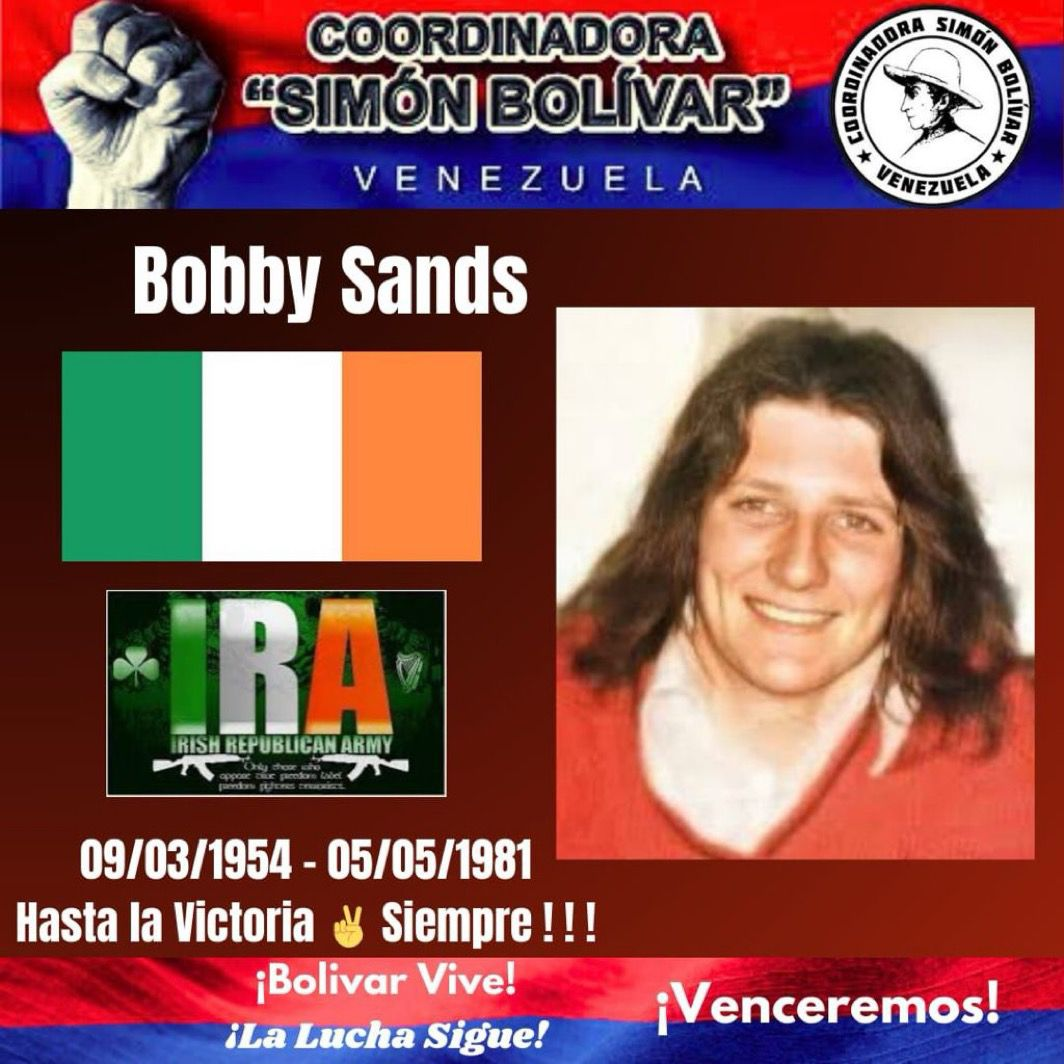
Robert Gerard Sands, pseudonym Bobby Sands was born on March 9, 1954, in Newtownabbey, County Antrim, Northern Ireland, died on May 5, 1981, at the age of 27, in Maze Prison, Down County, Northern Ireland, from starvation, that is, from 66 days on hunger strike, he was a politician, social fighter, revolutionary, British parliamentarian and guerrilla of the Provisional IRA (Provisional Irish Republican Army).
Sands was born into a Catholic family.
In 1972, Sands decided to join the IRA, and in October of that same year he was arrested on charges of possessing firearms.
Then in April 1973 he was sentenced to five years in prison.
He was released from prison in 1976, and immediately resumed his activities within the IRA.
He was accused of being involved in the bomb attack at the Balmoral Furniture Company in Dunmurry in October of that same year, but was not convicted due to lack of evidence.
Sands and at least five other IRA members were accused of taking part in a shootout with the Royal Ulster Constabulary.
Although his active participation in it could not be proven, Sands was convicted of possession of firearms at trial, and sentenced to 14 years in the Maze prison.
In prison, Sands dedicated himself to writing, delving into both journalism and poetry.
In the late 1980s, Sands was elected Commanding Officer of IRA prisoners interned at Long Kesh, succeeding Brendan Hughes, who was taking part in the First Hunger Strike that followed the blanket protest.
The blanket protest was part of a protest movement framed by the Northern Ireland Conflict.
The protest began due to the progressive elimination, as of March 1, 1976, of the status of political prisoners for Republican prisoners.
The prisoners refused to accept these changes, refusing to wear the prison uniform.
The imminent disappearance of the category began to cause friction between prisoners and prison officials.
The protest began on September 14, 1976.
At the end of April 1978, a fight occurred between a prisoner and a prison officer in Block 6.
The prisoner was taken to solitary confinement, and a rumor spread through the wing that the prisoner had been beaten very badly.
On 27 October 1980, IRA members Brendan Hughes, Tommy McKearney, Raymond McCartney, Tom McFeeley, Sean McKenna and Leo Green and INLA member John Nixon began a hunger strike aimed at restoring the prisoners’ political status.
After a fifty-three-day hunger strike, during which McKenna fell into a coma on several occasions and was on the verge of death, the government seemed to recognize the prisoners’ five demands.
In January 1981 it became clear that the prisoners’ demands had not been granted.
On February 4, the prisoners issued a statement saying that the British government had failed to resolve the crisis and declared their intention to begin a new hunger strike.
Bobby Sands was nominated for deputy in the elections and won the seat on April 9 with 30,493 votes.
After Sands’ victory, the British Government led by Margaret Thatcher approved the Representation of the People Act of 1981, which prevented the nomination as electoral candidates of those prisoners serving sentences of more than one year in both the United Kingdom and the Republic of Ireland 🇮🇪.
The strike began on March 1, when Bobby Sands refused to eat, and ended on October 3.
Ten men, including Sands himself, died as a result of the strike.
Bobby Sands would die on May 5, 1981, after 66 days on hunger strike.
Simón Bolívar Coordinator
Rescuing Historical Memory.
Up those who fight! ! !
Without Memory there is no Victory
The only fight that is lost is the one that is abandoned! ! !
Only the fight will make us free! ! !
Sow Memory so that oblivion does not grow
From Venezuela 🇻🇪 Land of Liberators 534 years since the beginning of the Anti-imperialist Resistance in America and 215 years since the beginning of our Independence.
Coordinadora Simón Bolívar
Caracas – Venezuela 🇻🇪.
May 2026.
Coordinadora Simón Bolívar Venezuela, Resumen Latinoamericano, May 7, 2026.