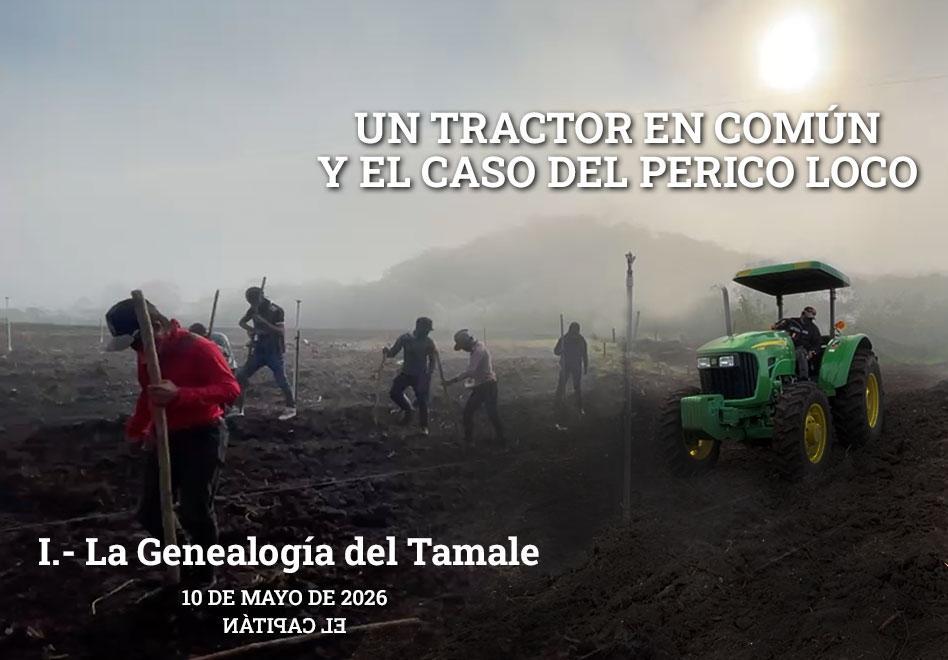
I. The Geneaology of the Tamale.
To the Searching Mothers, with admiration and respect.
I should tell you that I never thought I would see this in my lifetime. This combination of knowledge and practices rooted in traditions from many decades ago, with applied science and technology. Yes, in the countryside. Yes, in the struggle for life.
Subcomandante Insurgente Moisés has explained the process to me:
First, you choose the land. The flatter, the better. Next comes what is called “tumbar y rozar”—that is, using a machete and, sometimes, an axe, you cut down large, medium, and small trees. If it is already land that was once a cornfield, then it is acahual (small trees and plants). If it was pastureland, then there are no trees. You have to wait for it to dry out well, and then comes the “quema,” which consists, as the name implies, of setting the land on fire so that the soil is fertilized with the ash. Next comes clearing, that is, removing stones, logs, branches, and roots. Then comes planting, which is done with a coa (a straight stick, sometimes with an iron tip). The person planting carries the seeds in a small backpack, moving forward little by little, poking the ground with the coa and placing the seed in the soil. Then it’s a matter of waiting for rain. Of course, if the dry season (the hot season), with its strong winds, hasn’t carried the fire beyond the “firebreak,” then we have to organize collectively to go put it out before the fire spreads and reaches the forest… or the villages.
If it rains, that’s good. If it doesn’t rain, that’s bad. And then you have to set off firecrackers in the sky to wake up the clouds and make them pour down onto the earth, where the seed awaits the life that every drop of water carries.
Then after? Wait, and keep an eye on the weather. If all goes well, in about three months there will be corn on the cob, and then dried corn. Then comes the harvest: gathering the ears and piling them in a small shed they call a “troje.” From there, whenever needed, a few ears are brought home, and the whole family (grandparents, parents, and the kids) sits down to shell them. Next comes cooking the corn, with some lime extracted from stones. The lime comes from a special white stone. In some places they call it Poj’ton. It’s heated with firewood and then ground until it becomes a fine powder. If you can’t find it, you can make it from the shell of a river snail. And if you don’t have Poj’ton or a snail, well tough luck, you just have to earn the money to buy the lime.
A compañera explains to me: “Not just anyone can mix the lime with the corn. You need, as they say, the moms. Your mom tells you how much lime to put in the pot with the corn in water. If it’s not just right, it won’t work. And if you add too much, it stings. So you have to calculate it, just as your mom teaches you. Once you grow up, well, you know how to calculate. But it’s not like you measure with centiliters, milliliters, and all that math stuff. It’s that you measure just as your mom teaches you. And you have to mix it well by hand, so there are no little lumps, but just right.
If you don’t learn to do things right, word gets around town fast and people look down on you. And it’s even worse for the mother—people talk behind her back, saying she doesn’t teach her children about corn, that is, about life. So the children have to learn well. As they say, moms need their kids. I think that’s why they scold us so much when we’re little, so we’ll learn. And that’s why moms are always thinking about their kids, and if they’re not around, they look for them. If we didn’t have moms, I think we’d all die on the spot.
-*-
Next, once the corn is cooked, keep grinding it by hand using an old mechanical grinder. If you don’t have one, use a metate and a grinding stone. Then you’ll have the dough ready for tortillas… or tamales. If it’s a celebration, then maybe with cuche (pork), chicken, or turkey. And the recado, of course, which is like the seasoning you put on the meat. If there’s no meat, then beans… or vegetables (yucky). You can also make it with green or red chili peppers, and with sugar. After all that, and if you’re lucky enough that the cook doesn’t leave the tamale undercooked, then you’ll be able to eat tamales. And if it’s undercooked, well, too bad—you still have to eat it because that’s all there is. Of course, you’d better make sure there’s a outhouse nearby.
If it’s a party, there’s dancing. Yes, cumbias. Although later there’s also rock, ska, banda, and that kind of music that makes the young men and women jump around as if they were on top of an anthill. But love—and, of course, heartbreak—tend to blossom and bear fruit with the cumbias. There, the hips promise fevers… and sleepless nights… and rains… and hardships.
-*-
And then? Well, back to where we started. And so on and on, forever and ever. Humanity exists because the earth exists. In other words, you might say that the earth is the mother of humanity. Just imagine if there were no earth—where would you get all the junk food you eat? Without the earth, there is no food, no animals, no air, no rain. There is nothing. That is why we say that land is life.
The peoples and communities of the National Indigenous Congress taught us to say “territory.” In other words, it’s not just the earth itself, but also the water, the forests, the wild animals, the rain, the wind, the sun. Everything. When we say “land,” we mean all of that; but in the cities, they understand land as a piece of land and not as a whole. That’s why the CNI taught us to say “territory.”
-*-
Today’s wars, by the way, are fought to conquer territory. That is why it doesn’t matter how many people are killed or how many buildings, hospitals, schools (with girls inside), and entire neighborhoods are destroyed. Because that is what capitalist war is all about: destroying in order to rebuild later; and depopulating in order to later reorganize the conquered territory. And that is why there are, within humanity, what are called “Guardians” of the earth, that is, of the territory. In other words, they are the offspring of Mother Earth, the Resistance, and Rebellion. And that is why they murder, disappear, and imprison the defenders of the forests. And that is why the problem is not Netanyahu or Trump. Or at least, not only them.
Because with or without them, the Boss Man—the capitalist system, that is—wants to murder people and destroy entire populations. Because it is in those populations and in the hearts of those people, that life lives.
That is how the system was born: by killing and destroying. That is how it grew. And that is how it sustains itself, even as its methods and justifications change. The capitalist system is death. Not just for humanity. But for the entire planet as well. That is why we say that the struggle against capitalism is the struggle for life. And vice versa.
Who understands this best and most deeply? Well, those who live in a territory—that is, on the land. But they do not fight for ownership of the territory; rather, they fight to defend it. And that is why capitalism attacks them, because they stand in the way of its plan.
-*-
I asked SubMoy, “So there’s no more burning?”
“No, we’re showing them—teaching our compañeros and the partisan brothers—that by using this technique, burning is no longer necessary, so the fire doesn’t spread and endanger animals, trees, and people. Plus, there’s no more smoke. And you don’t have to wait for rain or waste fireworks. So, without stopping work on the land, you can take care of it and improve it.”
“And where did the tractor come from?”
“Ah, they’d had it sitting in a shed for years, but they weren’t using it and it was just sitting there falling apart. Then the Commons came to the rescue. The drivers went, fixed it up, washed it, made it look sharp, and moved it to this land that belongs to the Common—which belongs to everyone and to no one.”
“But maybe the day after, there won’t be any fuel for the tractor… or even a tractor.”
“Oh, sure. But we’re learning from our great-great-grandparents and grandparents, who made do with what they had and used their wits. The point is always to take care of Mother Earth.”
A compañero is someone who teaches and has students, mainly Tzotzil and Cho’ol. That compañero is from Puy de Roberto Barrios, and he comes with his group to put what they learn into practice. Because if you don’t apply what you know, it’s all for nothing. In other words, he wants practice. The place where he teaches could well be called “Center for Zapatista Rebel Research, Analysis, and Teaching on Rural Work and the Defense and Care of Mother Earth, Combining the Knowledge of Our Ancestors with Knowledge of the Sciences, Techniques, Arts, and Whatever Comes to Mind and We Invent Based on What We See in Practice” (CIAERZTCDCMTCCNACCTALVAOISVP, for its Spanish acronym).
Nah, it’s not really called that. But they’re going to give it some name. Maybe just as long or even longer—I don’t know.
The thing is, just like with cumbias, what really counts is putting that knowledge into practice. Because you could certainly write books on cumbia theory, explaining hip rotation and the rhythm of the feet and hands using ellipses and parables, differential equations, and asymptotes. But, man, if you don’t practice it, it’ll look like your pants are made of cardboard or that you’ve got a cramp.
-*-
When I saw that the sprinklers were already running and they were planting, I thought, “Now I can die in peace.” I think I said it out loud, because Verónica, who was butting in as usual, said, “Again?!” And, looking at me disapprovingly, she added, “People are getting sick of you dying all the time. Even the women in the villages have already complained to SubMoy that they’re praying for nothing every time they go by.”
“So they’re praying for me?”
“No way! They’re praying for the poor devil who’s going to suffer when you get to hell and start up your mischief.”
Well, but that’s not the point…
-*-
All over the world, stories of resistance and defiance are blossoming. Yesterday, they were called Venezuela. Today, they are called Iran and Cuba. They are always called Palestine. Because there will always be those who refuse to give up, sell out, or back down.
(To be continued…)
The Captain
April-May 2026
souce: Schools for Chiapas