In the second half of June, the Russian army surrounded and broke through into the city of Konstantinovka in Russia’s Donetsk Republic, in the historic Donbas industrial region. The city was strongly fortified by Ukrainian military and paramilitary forces ever since the coup that brought the governing regime to power in Kiev in February 2014. Soon after that date, the new regime launched a civil war against pro-autonomy forces in the Donbas region (future Lugansk and Donetsk republics), in what was then the east and northeast of Ukraine.
The Ukrainian military had been warning for over one month of an impending catastrophe in and around Konstantinovka (pre-2022 population of 70,000). Most of the remaining population heard the news and left. Typically for the Armed Forces of Ukraine, the garrison occupying Konstantinovka did not receive orders to break out of a closing encirclement. The near entirety of the garrison was killed or captured by advancing Russian forces.
Ukrainian military analyst Konstantin Mashovets predicted as early as the beginning of June that Konstantinovka would fall within a month. According to him, the situation there had drastically deteriorated for the Ukrainian Armed Forces as Russian forces broke into the central and western parts of the city while simultaneously advancing into the eastern and southeastern parts.
Dust thrown into the eyes of observers
In a recent interview for the UK Guardian, Kiev regime ‘president’ Volodomyr Zelensky said Moscow is losing its military initiative “day by day” and that any advances of Russian troops are close to being stalled.
The online Strana.ua news publication in Ukraine observed on June 9 that a full-scale disinformation campaign is currently underway across Europe and Ukraine, claiming that a turning point in the NATO proxy war against Russia is occurring in Kiev’s favor. But many politicians and analysts in Ukraine are puzzled by the optimistic claims by Kiev regime and European Union officials, wondering where there is evidence for such claims.
Ukrainian political analyst Ruslan Bortnik believes that talk of any turning point in the war is nothing more than political rhetoric. Former Ukraine foreign minister Dmytro Kubela (March 2020 to Sept. 2024) essentially agrees with Bortnik, even if Kubela has recently been voicing qualified support for Zelensky. Kubela has called the statements claiming that Ukraine has turned the tide on the battlefield “nonsense.”
Kubela is cited on Telegram on June 8 saying, “I don’t really want to be a killjoy, but come November, we will be back to talk of whether or by how much we (Ukraine) will survive the coming winter.” He believes that statements of a halt to Russian military advances are generated by an “attention economy” aimed at generating powerful imagery and arguments. “All turning points are identified in hindsight. That’s why all this talk about a turning point in the war—that Ukraine has turned the tide and will someday storm the Kremlin—is all nonsense,” says the former minister.
Ukrainian military analyst Colonel Konstantin Mashovets, when asked whether there has been a turning point on the front in favor of the Ukrainian Armed Forces, says nothing of the sort is being observed. The Russian army’s offensive continues. “There is no turning point. The enemy has penetrated the Severoslobozhansk direction [northern Sumy region] along a fairly wide strip of the border, advancing five to six kilometers. Is that a turning point? That’s just in one sector. If we look at the Sumy region as a whole, there are numerous such penetrations. The enemy has penetrated the Kupiansk direction [Kharkov region] again,” he explains in a Politnavigator posting to Telegram on June 10.
Yegor Sobolev, a former member of the Ukrainian legislature (Verkhovna Rada) and now commander of a Ukrainian Armed Forces drone unit, admitted during an appearance on a Ukrainska Pravda video blog on June 4 that much information is being withheld from the public “On a personal level, when we’re with our friends, we can discuss everything. But when a soldier starts telling the whole truth out there, potentially being heard by the outside world, that’s wrong, because it demoralizes society and disrupts the army,” Sobolev explained.
The officer explained to the interviewer that he requires his subordinates to remain silent about the real military situation facing Ukraine. It is obvious that in this case, truth and reality have nothing to do with any claimed ‘successes’ of the Ukrainian Armed Forces.
Sobolev acknowledged that so far in 2026, his unit has lost as many men as it did in all the previous years of the war combined. He notes that casualties are rising across all other Ukrainian units.
The rising rhetoric about a “turning point” in the war in Ukraine is also linked to the upcoming NATO summit in Turkey to take place on July 7 and 8. There, according to Western media reports, a decision to provide Ukraine with an additional 70 billion euros in survival funding is expected to be discussed.
According to a June 16 report in Politico.eu, published during the June 15 to 17 summit in France of the G7 countries, US President Donald Trump is also prepared to boost military aid to Ukraine, in the name of ‘increasing pressure’ on Russia to end its war in Ukraine. In exchange, say reports, the Trump regime in Washington wants its allies to assist more with military and economic pressure against Iran and its people.
As reported by Strana on Telegram on June 16, the statement issued in France by the G7 leaders notes that they see a “new momentum” unfolding in Ukraine. Strana writes: … “The G7 leaders stated that they see ‘new momentum’ in Ukraine and noted its resilience and successes on the battlefield in recent months. The G7 also says it is ready to consider expanding licenses for increasing military production in Ukraine and has promised additional support for the country’s energy industry before next winter. Furthermore, summit participants declared their intention to increase pressure on the Russian economy… The section of the statement devoted to Ukraine contains no calls for negotiations, a ceasefire, or a peaceful resolution of the conflict. The document primarily focuses on military support for Kyiv and strengthening sanctions against Russia…”
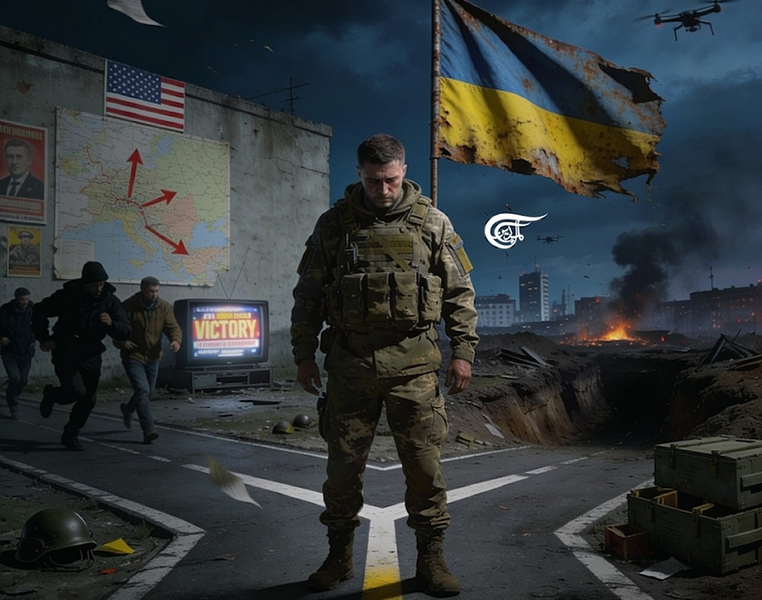
Thus, the trend that emerged near the very beginning of the war in 2022 continues: ‘Victories’ by Kiev’s armed forces are claimed and celebrated, while the Russian army scores actual advances on the ground, steadily no less.
The Ukrainian elite’s dreams of tapping into European funds
Representatives of the Ukrainian political elite are now discussing the renewed prospects of EU accession, from which they expect generous financial injections to come their way. According to the European Commission, EU countries have approved the opening of the first negotiation ‘cluster’ on the accession of Ukraine and Moldova. There are five negotiation clusters foreseen.
The first phase of discussions will focus on ‘justice, freedom, and fundamental human rights’. However, in Ukraine and increasingly in Moldova, there is practically nothing left of such high ideals.
The countries of the European Union have traditionally looked askance at talk of forced military conscription in Ukraine, banning of travel abroad by men of military age, suppression of political opposition, and shuttering of media outlets publishing or broadcasting views critical of those in power.
It is noteworthy that, amidst all the flowery talk of EU membership for Ukraine, a woman with a young child was sentenced to five years in prison in Ukraine for publicly criticizing the government. The court’s ruling cites postings on social media by Natalia Kozachenko accusing Zelensky, the regime he heads, and the war they are waging of causing the needless deaths of so many people. “Doesn’t a concentration camp under the yellow-and-blue national flag really bother you?’, she writes in an open letter, posted to a Telegram page with 105,000 subscribers on June 15.
The woman writes, “Television is under government control; there is no political opposition; bloggers who don’t support this obscurantism are being imprisoned and journalists are forced to flee overseas for their safety. War hasn’t been declared, but elections aren’t being held because there is war. Bot-farm information waves are being passed off as public support and high approval ratings,” the woman’s open letter fumes
In the midst of such spectacle, Ukrainian officials are meeting EU officials cap-in-hand, claiming that freedom and human rights are respected in Ukraine and continuing to blame Ukraine’s Soviet legacy for the political repressions being carried out by the regime.
Ukraine’s unresolved territorial issues
Adding to the regime’s complications is that many in the EU halls of power are wary of accepting into membership a country such as Ukraine with unresolved territorial issues.
The governing regime in Moldova, fresh from a highly contested national election, carries the same ‘baggage’. Its former region of Transnistria (population 350,000) has been an independent entity since 1991, with close economic and cultural/historical ties to Russia and with the presence of more than 1,000 Russian peacekeeping troops. The people of Gagauzia (pop. 105,000), meanwhile, continue striving for autonomy from Moldova. These regions (like Ukraine itself) enjoyed high rates of political, economic, and cultural autonomy during the decades of the former Soviet Union.
The risk for Ukraine is that it may have to recognize new, de facto borders created by Russia’s war. The alternative is to engage in negotiations with Russia, which Ukraine rules out. No one can be satisfied with such uncertainties.
Let us add to the above the situation of the 100,000 or so people of Hungarian descent living in the Transcarpathia region of eastern Ukraine. Strana reported on Telegram on June 16, “Hungary is setting its own conditions for a border agreement with Ukraine.” Hungarian Foreign Minister Anita Orbán has stated that “EU negotiations for Ukraine membership will stop if these fail to fulfill the agreement with Hungary on restoring the rights of the Hungarian national minority in Transcarpathia.”
On June 12, the new Hungarian government elected in early May gave its consent to an opening of the first negotiation cluster in Ukraine’s EU accession process. This follows an agreement reached on June 12 between the Hungarian government and the regime in Kiev to recognize the distinct, cultural (linguistic) and political rights of the Hungarian minority.
Kiev’s poor relations with neighboring, NATO-member Poland, meanwhile, have no similar, easy path to resolution. The Kiev regime has recently taken to officially honoring the WW2-era military formations created as part of a formal collaboration between Ukrainian ultra-nationalist political parties and paramilitary formations with Nazi Germany. The Polish government is demanding an end to this glorification of the past war criminals of the OUN-UPA.
Legislator Maksym Buzhansky asserts that the path to European Union membership will not sit well with many Ukrainians. “Even if [accession] does not happen for decades to come—or not at all—we’ll have to pay right now; the [pre-war] life we were used to will wither away along the way,” Buzhansky believes.
According to him, many in Ukraine have been deluded by European Union promises, believing there will be a “free ride” along the road to attain EU membership. In reality, he says, the ‘free ride’ will inevitably be many times more expensive than thought, with the population paying for it with high import tariffs and more cuts to government social spending.
Buzhansky believes that enthusiasm surrounding the opening of a first cluster of negotiations on Ukraine’s EU membership lies largely with a portion of the political establishment, thus demonstrating once again the gulf between the aspirations of the top and the bottom of Ukrainian society.
Nevertheless, as reported by Strana, Ukrainian authorities are rushing to open negotiation clusters on EU accession in order to convince the public that accession is realistic. Simply put, the Ukrainian political elite is once again pulling the wool over people’s eyes, hoping to boost the morale of a certain, small segment of society that is eager to get its hands on funds from Europe.
According to imprisoned Ukrainian legislator Alexander Dubinsky, Ukraine’s economy is currently a rusty bucket with big holes in it, held by the handle by Western donors. If and when the financial support pouring into the bucket diminishes, the whole bucket will sink.
Under such conditions, the Ukrainian political elite will continue fleecing the population. Citing the IMF’s latest demands upon the regime in Kiev, the elite intends to significantly raise utility rates. An official IMF statement following consultations with the Ukrainian Cabinet of Ministers notes the need to “prepare a roadmap for the gradual liberalization of the energy market and a move away from the current system of subsidized utility rates, which is draining state-owned companies.”
Such IMF-inspired measures will squeeze most of the population dry, while government and state debt will only continue to grow. The fact is that despite all the financial aid from Western imperialism, the Ukrainian economy cannot stay afloat. Among the factors causing this are continued military conscription, a population exodus, and the shift by those remaining in the country to a survival, informal economy.
Resistance to conscription
Resistance to military recruiters in Ukraine has increased significantly in the month of June. Dozens of videos have appeared online showing citizens engaged in physical confrontations with the recruiters, in turn, inspiring yet more people to resist, either on their own behalf or aiding others. The recruiters’ violent conduct when detaining suspected conscription evaders has even prompted complaints by Ukraine human rights commissioner, Dmitry Lubinets. He acknowledges that his complaints are being ignored. He claims that Zelensky is aware of the rising tensions over conscription and does not support the violent methods used by the recruiters (here and here).
One media report on June 10 said there have been more than 3,000 complaints received so far in 2026 by Lubinets, Commissioner of the Verkhovna Rada of Ukraine for human rights. Lubinets acknowledges there are systemic violations of human rights taking place by the recruiters, including the use of force and of balaclavas hiding the recruiters’ faces, as well as the removal of identification insignia by recruiters. They sport military uniforms, but increasingly, the population doesn’t know who or what they are.
Western leaders and media are studiously ignoring the numerous scandals and human rights violations overshadowing military conscription. The Western public may be shielded from such information, but this doesn’t mean violations are not taking place. For example, not a single Western news agency reported on the mass nighttime protest march and clashes with police that took place in Kiev on June 14. (Video here of news report by an Indian news outlet.)
The Western media audience is unaware of the daily attacks against military recruiters taking place across Ukraine. Residents of towns, villages, and city neighborhoods are mobilizing and driving recruiters away using shovels and other makeshift weapons, as in this case and this case. Videos show the approval of so many passersby when military commissars appear and are driven away.
If military recruiters end up in prison, they receive rough treatment from other prisoners. They are typically humiliated, treated like dogs, and labeled ‘hounds of the regime’. Prisoners are handing out ‘rough justice’ to recruiters, and the news is winning sympathy from broader society.
Strana reported on June 10, “Strana‘s sources in the penitentiary system report that humiliation of TCC [conscription] officers is a regular occurrence due to the extremely negative attitudes which inmates have toward them. This is especially true when military commissars are placed in cells with regular prisoners, rather than with law enforcement or military detainees.”
Military recruiters have reported to the Rada that their children suffer from bullying at school. Other children pin insulting signs on their backs and forbid them from removing them under threat of beatings.
Civil unrest is growing in society, at times leading to cruelty and sadism—even toward children. Legislator Anna Skorokhod says that Western countries allegedly see nothing of the sort and steadfastly believe Zelensky’s information, reports Politnavigator on Telegram on June 10.
Skorokhod says, “All countries are in an information vacuum. They don’t understand the realities on the ground in Ukraine. I communicate with my foreign colleagues. I’ve realized that they perceive what the official authorities declare as reality and the will of the Ukrainian people—which is not the reality.” Even when she sends them videos, her colleagues reply that the videos won’t open, being flagged as ‘inappropriate content.’
According to her, people in the West don’t understand that people are being rounded up on the streets of Ukraine. “It comes as a shock to them: how can this be? You’re a democratic country; Zelenskyy said you’d fight to the last Ukrainian, that you’re ready to fight for another two or three years,” Skorokhod expressed.
“All the countries in the world are sitting in an information vacuum. They don’t understand the realities on the ground in Ukraine. I communicate with my foreign colleagues and I have come to realize that they perceive as reality whatever the official authorities declare as reality. They believe the authorities to represent the will of the Ukrainian people, but this is not the case,” says Skorokhod.
source: Al Mayadeen