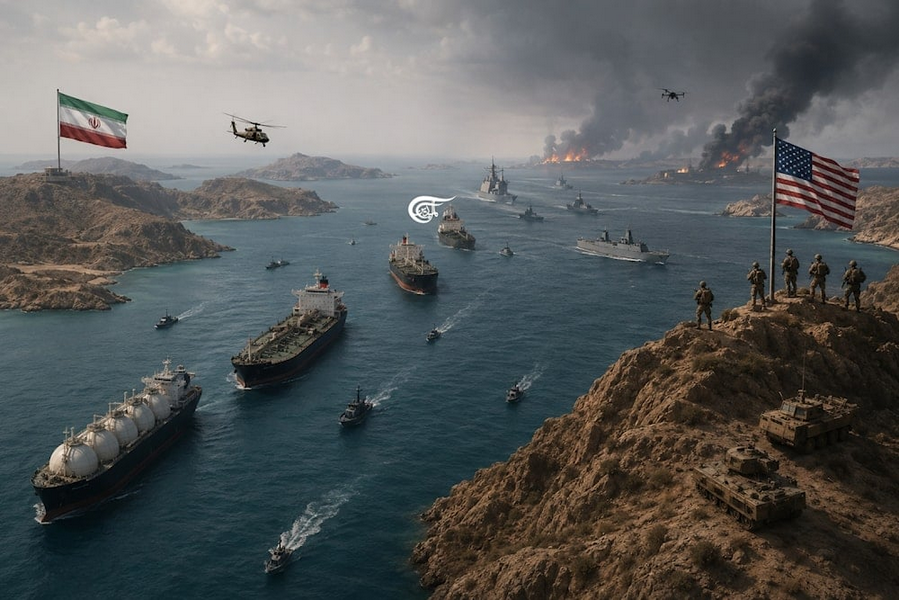
What began as an attempt to destroy the Islamic Republic of Iran has created a problem Washington did not anticipate: the Strait of Hormuz.
The strait, through which 20% of the world’s oil and liquefied natural gas transits, has become a central battlefield of the war. In response to the US-Israeli war, Iran disrupted maritime traffic while the US responded with a naval blockade.
The exasperation surrounding the current reality of the strait is evident not only in Trump’s reason for signing the MOU, but also in his recent remark of “declaring the Hormuz Strait a territory of the United States”. Should a comprehensive consensus be reached between the two coastal states, Iran and Oman, regarding the strait’s management, there is a possibility that the US would decide on employing a strategy it has not thus far: putting ground troops on Iran’s strategically important islands.
Why islands would be targeted
The strategic islands include Qeshm, Larak, Hengam, Hormuz, Abu Musa, and the Greater and Lesser Tunbs. Situated either at the strait’s narrowest point or near its junction with the Persian Gulf, they hold significance in monitoring and controlling naval traffic and offer defensive leverage. The largest is Qeshm, with Hengam to its south. Larak, closest to the strait on the eastern side, acted as a gatekeeper for Iran to control vessel entry and exit while the strait was open during the war—to its north lies Hormuz, which can also aid in gatekeeping.
The Greater and Lesser Tunbs and Abu Musa sit near the junction of the Persian Gulf and the Strait of Hormuz, forming the western entrance to the strait. These smaller islands form a tight cluster, surrounded by shallow waters that force large ships to pass very close, making them easy targets for a positioned military. This gives Iran a major strategic advantage, as the islands can serve as fortified checkpoints to manage or halt transit. It is also what makes them potentially attractive targets for the United States.
Further signifying the strategic importance of Abu Musa and the Greater Tunb and Lesser Tunb is the UAE’s claim over the islands. Since 1992, the UAE has been trying to claim islands that have historically always been Iranian territory. The EU and the US have backed the Arab country in this regard, which can be seen as a desire to shift control of the strategic waterway away from Iran and toward an ally.
What it would take to seize the islands
Firstly, the question is whether or not the US can seize one of the islands in question. According to King’s College London security studies professor Andreas Krieg, the US does possess the capability to seize a small Iranian island with sufficient air, naval, and amphibious power. Krieg estimates the number of personnel needed for a limited operation to be at least 5,000 to 10,000. Former US Pacific Command intelligence chief Carl Schuster has similarly estimated that around 5,000 troops.
The greater problem, however, is not taking the islands. It is holding them.
An invasion by sea would require American forces to bypass Iranian defenses from the mainland and surrounding islands. An airborne assault would expose slow-moving transport aircraft to Iranian missiles and drones. Once American troops landed, they would become fixed targets within range of Iranian missiles, drones and artillery.
As US Democratic Representative Ted Lieu put it, “You don’t get to just take over territory and say the war is over, you got to hold that territory. And that is where a huge problem comes in.”
Can the US hold islands long enough to bring about a change in the reality of the Strait of Hormuz and maritime traffic?
How Iran could fight back
Army spokesman Brigadier General Mohammad Akraminia has warned, “Ground operations provide many more opportunities to damage and inflict greater casualties on the enemy, and our effectiveness and efficiency in this arena will undoubtedly be much higher”.
Asymmetric warfare and guerrilla tactics could include the use of first-person view drones, which have been used effectively by the Lebanese resistance Hezbollah against the Israeli occupation forces. The Iranian Armed Forces said that 10,000 FPV drones have been deployed since the 12-day war last year. Iran can make particularly effective use of these cheap drones to defend itself in the case of a ground invasion.
Reuters also reported weeks ago that Iran is expected to receive shoulder-launched missiles from China. Their mobility allows Iranian forces to quickly move them between islands and coastal positions and would pose a serious threat to US transport aircraft and drones attempting to support amphibious landings.
The Basij, a paramilitary force with over a million active members, could also contribute to defensive and asymmetric operations. Its responsibilities include domestic security, intelligence gathering, and it is ideologically driven. This makes it a formidable force that can use its intimate knowledge of local terrain and rapid mobilization when it comes to ground combat.
Civilian mobilization could also make an American occupation even more difficult. As seen by the tribal chase during the US attempt at a uranium heist near Esfahan, and the over 31 million Iranians who have signed up for the Janfada campaign to defend the homeland, a very likely scenario is an organic popular uprising not just on the islands but also from the coastal areas.
As American political scientist John Mearsheimer has warned, “…many Americans would die…The Iranians would go to great lengths to retaliate and drive those American forces off the beaches”.
From tens to thousands of casualties
Deploying thousands of troops to invade islands essentially means opening the possibility of thousands of American soldiers being killed. So far, the US has only admitted to tens of military casualties as a result of the war on Iran, largely because troops have been positioned in bases across the Persian Gulf states.
That number could multiply significantly once boots are on the ground in Iran. The consequence would be politically catastrophic for an administration already facing criticism from the families of US soldiers.
The war is already without explicit authorization by Congress. The House has passed a resolution seeking to withdraw US forces, while the Senate has also previously attempted to constrain the administration. These votes were cast when the casualty figures were far lower. While the administration has not complied, these votes were cast when the casualties stood at 18. Things change completely when the death toll reaches hundreds, let alone thousands.
A war already opposed by 62% of Americans when it comes to sending ground troops would become indefensible once the troops begin coming home in coffins.
With the midterms approaching and Trump’s job approval at a mere 33%, congressional members would face a choice: continue supporting a lethal and increasingly unpopular war, or pressure the administration to withdraw.
History shows that in the event of intense public pressure threatening re-election, Congress voluntarily restrains presidential war powers. In 1973, Congress passed the War Powers Resolution over President Nixon’s veto, which was a response to the public backlash against the Vietnam War. This would not have happened without massive public pressure. The death of 18 US Army Rangers in Somalia in 1993 triggered congressional action that pushed President Clinton to direct the complete withdrawal of US forces from Somalia.
Thousands of American deaths could produce exactly that pressure. Congress has tools to force the issue, including the War Powers Resolution and its control over military funding. While these mechanisms would not directly force Trump to abandon the Persian Gulf, under sufficient public pressure, they could constrain his ability to continue the operation.
The initial result could be pushing for an end to the ground operation. That could then lead to a larger question about the US military presence in the region. Mearsheimer argues the US cannot go back to the Persian Gulf in a meaningful way given the events since February 28. High casualty figures would trigger a more forceful response from families of soldiers and from US citizens, increasing pressure on Congress to decide a reduction in military footprint in the region.
In other words, withdrawal would be accelerated, not because Congress wants it as part of US foreign policy, but because continued support for the war becomes increasingly difficult to sustain politically. The danger Washington faces is not simply an invasion that could fail. It is an invasion that succeeds tactically while failing strategically.
The ground invasion Washington might consider to reopen the Strait of Hormuz could therefore become the very event that accelerates the United States’ departure from the Persian Gulf.
Roya Pour Bagher
Source: Al Mayadeen