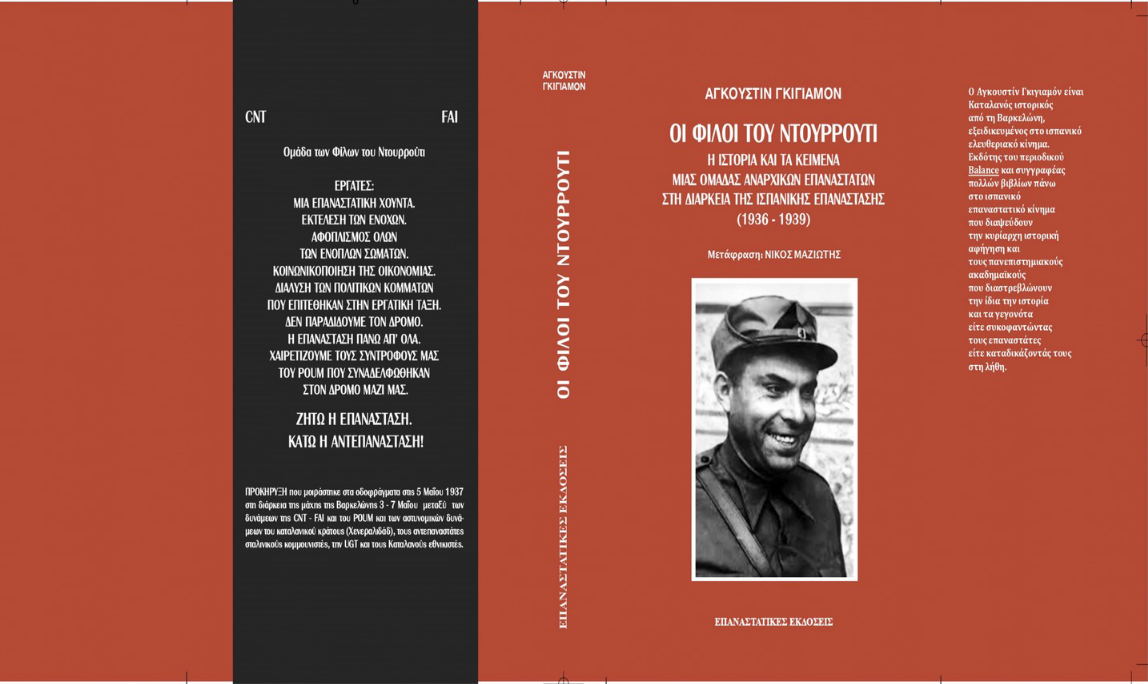
New publication:
“FRIENDS OF DURRUTI – THE HISTORY AND TEXTS OF A GROUP OF ANARCHIST REVOLUTIONARIES DURING THE SPANISH REVOLUTION (1936-1939)” TEXTS OF A GROUP OF ANARCHIST REVOLUTIONARY DURING THE SPANISH REVOLUTION (1936-1939)»
=========================================================================
THE ANARCHIST GROUP THE FRIENDS OF DURRUTI IN THE SPANISH REVOLUTION (1937-1938)
In the autumn of 2024, some comrades of an anarchist collective from Barcelona sent me by post at Domokos prison Agustín Guillemon’s book on the Friends of Durruti. The Friends of Durruti, named after the legendary anarchist Buenaventura Durruti, who was killed in Madrid besieged by the Francoists in November 1936, were a group of anarchist revolutionaries who operated during the Spanish Revolution and the civil war of 1936-39 in Barcelona-Catalonia, and more specifically in the period from March 1937 to February 1938. With the very basic Spanish that I knew – which I had learned without a teacher in Korydallos prison when I was a prisoner in 1998-2001 for another case, not of the Revolutionary Struggle (a bombing attempt at the Ministry of Development in 1997 and possession of weapons and explosives) – and with the help of a Spanish-Greek dictionary, I managed to translate this book that presents the history of this group, which in my opinion is one of the most important in terms of political lessons within the framework of not only the Spanish, but also the global revolutionary and anarchist movement.
Why is the history of the Friends of Durruti important? Because the Friends of Durruti were the most organized group within the Spanish anarchist-anarcho-syndicalist movement that disagreed and strongly criticized the collaboration of the CNT-FAI with the State, whether in Catalonia, with the Generalidad, or with the central Spanish government in which the CNT-FAI participated with 4 ministers. The creation of the Friends of Durruti group had its origins in the opposition of a section of the militiamen of the Durruti Column, specifically the 4th Grouping of Helsa on the Aragon front, who refused to be militarized after the Popular Front state’s decree to militarize the militias in October 1936, something that Durruti himself had opposed. Militarization meant the transformation of the militias and columns that the working class had formed to fight the Franco fascists in July 1936 into parts of a classic army controlled by the state government, the transformation of the militant militiamen and members of the phalanxes into soldiers, the acceptance of the military hierarchy and the military code that existed before July 19, all of which the militants fought and represented Franco’s fascist army. Unfortunately, militarization was also accepted by the leadership of the CNT-FAI and by all the confederal and anarchist phalanxes after a congress in Valencia in February 1937. However, many militiamen of the anarchist phalanxes refused militarization, which was also imposed with the threat that if it was not accepted, they would not be supplied with weapons and ammunition. Several members of the Durruti Column, as well as members of the Iron Column, refused militarization and abandoned the front and returned to the rear. In fact, the members of the Durruti Column of the 4th Helsa Grouping who refused to be militarized returned to Barcelona with their weapons, along with them the leader of the 4th Helsa Grouping, Pablo Ruiz, who had taken part in the two-day Battle of Barcelona on July 19-20, 1936, where the CNT-FAI forces defeated the Franco coup plotters and who had taken part in the attack on the Ataratana camp where Francisco Ascaso was also killed, while he was one of the founding members of the Friends of Durruti. The Friends of Durruti were created on the one hand by members of the Durruti Column who refused the militarization of the militias and returned to Barcelona with their weapons and on the other hand by comrades in the rear who strongly disagreed with the collaboration of the CNT-FAI with the popular front anti-fascist “democratic” state.
The Friends of Durruti argued that the anarchists, the CNT-FAI, should seize power, initially in Catalonia-Barcelona, where they had overwhelming superiority and essentially had power in their hands and on the streets after July 19, 1936, that they should deepen the social revolution with the organs that the workers and peasants had created, the committees of workers and peasants, militiamen, sailors, the municipal-communal committees, and thus impose libertarian communism by abolishing the State and purging the counter-revolutionary elements, the petty-bourgeois parties, the socialists and the Stalinist communists. Their program, which was made public in April 1937, shortly before the Battle of Barcelona on May 3-7, 1937, which began with the attack of the Stalinist communist police forces to seize the Telefónica, which was collectivized and under the control of the CNT-FAI, is summarized in 3 points:
1) The overthrow of the Catalan state and the government of the Generalidad and its replacement by a Revolutionary Council or, as they called it literally, a Revolutionary Junta, which would be a democratically elected body, composed of workers, peasants and militia fighters and would have as its responsibility the conduct of the war against the Francoist fascists, revolutionary propaganda and the purge of counter-revolutionaries in the rear.
2) The management of the economy by the unions, which was the classic position of anarcho-syndicalism.
3) The Free Municipalities that will take over the management of social and political life and will be federally organized at the local, regional and peninsular-national level.
The term “junta” has its origin in the Spanish popular resistance tradition. Juntas appeared during the years of Napoleon’s invasion of Spain (1808-1814) and were created by the resistance movement to the invasion. They have the meaning of a council or committee and there were many juntas in various regions of Spain. They were temporary and informal in nature. However, beyond the formation of the Revolutionary Junta, the program of the Friends of Durruti included the socialization of the economy by the unions, the liquidation of counter-revolutionaries in the rear, the creation of a revolutionary army under the control of the working class, the dissolution of the police forces and the control of public order by the working class -with the Control Patrols in Barcelona-, the maintenance of the Defense Committees that played a key role in the suppression of the coup on 19-20 July 1936 and in the beginning of the revolutionary process and the creation of the institution of Proletarian Justice. Other parts of the anarchist-anarcho-syndicalist movement also agreed with the positions of the Friends of Durruti, such as the majority of the Libertarian Youth and several in the CNT unions and FAI groups. The Friends of Durruti participated in the Battle of Barcelona from 3 to 7 May 1937 against the counter-revolutionary coalition of the Generalidad with the Stalinist communists and the petty bourgeois parties, with a force of 400 well-armed fighters. Then, on 5 May, during the street battles, they issued the proclamation that was distributed at the barricades and gave them fame, in which they demanded the formation of a Revolutionary Junta (Council) that would replace the Generalidad, the execution of those who attacked the Telefónica workers on 3 May and the working class in general, the dissolution of the political parties that attacked the working class and the socialization of the economy.
WORKERS: A Revolutionary Junta. Execution of the guilty. Disarmament of all armed forces. Socialization of the economy. Dissolution of the political parties that attacked the working class. We do not surrender the road. The revolution above all. We salute our POUM comrades who have joined us on the road.
When the proclamation was issued, the higher committees of the CNT-FAI, that is, the collaborationist tendency of the CNT-FAI, denounced the Friends of Durruti through the columns of Labor Solidarity, denounced them as “provocateurs” and later “ordered” their expulsion from the CNT unions and FAI groups. However, beyond the slander about “provocateurs”, the higher committees of the CNT-FAI, defamed them as “Marxists”, which was repeated throughout the confederal press controlled by the collaborationist tendency. The irony of history is that these accusations were directed at the Friends of Durruti by those who collaborated with the bourgeois State and with the Marxist Stalinist communists and socialists and the petty-bourgeois parties.
During the battles of May 1937, the attitude of the leaders of the CNT-FAI, that is, those who collaborated with the State – in the name of “anti-fascist unity” – but also of the “anarchist” ministers, Federica Montseni (Minister of Health), and Juan García Oliver (Minister of Justice), was subversive, that is, they constantly called for a ceasefire and a return to work because a general strike had been spontaneously declared by the Barcelona proletariat, while they prevented strong armed forces from the Aragon front from reaching Barcelona to help the insurgent workers, such as parts of the Black and Red division commanded by Maximo Franco, a member of the Friends of Durruti, and parts of the POUM division.
Although the CNT-FAI base fighters defeated the counter-revolutionary forces and controlled most of Barcelona except for a few buildings in the city center, such as the headquarters of the Generalidad, the subversive attitude of the CNT-FAI leadership, as well as the lack of political will to overthrow the Generalidad and the Catalan state, led the fighters to abandon the barricades without gaining anything. The Battle of Barcelona on 3–7 May 1937 was the last attempt by the revolutionaries and the working class, i.e. the CNT-FAI base, to defend the revolutionary conquests won after 19 July 1936, which were gradually being annulled by the State, whether in Catalonia or in the “democratic” zone of the rest of Spain.
The subversive attitude of the CNT-FAI leadership in the events of May 1937 was characterized as betrayal by the Friends of Durruti in a manifesto-account after the end of the fighting. However, the political and organizational inadequacy of the Friends of Durruti themselves was also demonstrated because they did not have the required political influence on the CNT-FAI base, but neither did they seek to raise the issue of leadership of the CNT or a break with the CNT itself, but they sought the unity of the organization until the end. That is why it was impossible for them to go to the end during the fighting and to direct the fighters to occupy – while they could militarily – the headquarters of the Generalidad and thus overthrow the Catalan state, thus changing the course of history with regard to both the revolution and the war against the Francoists.
In fact, as Pablo Ruiz reported years later, when one of the main members of the Friends of Durruti, Jaime Ballus, proposed during the battle that a column be formed that would meet the units of the Black and Red divisions that were within striking distance of Barcelona and had been prevented from assisting the Barcelona fighters, with the aim of advancing together and completely crushing the Generalidad forces and the counter-revolutionaries, the majority of the fighters at the roadblocks rejected the proposal. The senate-style “patriotism” that existed in the minds of a large number of rank-and-file fighters, the deification of the organization, prevented the CNT leadership from going beyond it even when there were serious disagreements, such as in relation to the issue of collaboration with the State and “anti-fascist” unity with all the counter-revolutionary elements of the Popular Front.
May 1937 was in fact the decisive defeat of the revolutionary process that began on July 19, 1936 and resulted in the definitive overthrow of state power, the triumph of the counter-revolution in which the spearhead was the Stalinist communists, the Communist Party of Spain (PCE), the Unified Socialist Party of Catalonia (PSUC), who sought the dominance of the bourgeois-democratic state by carrying out the orders of Stalin and Soviet agents.
Many years later, Jaime Ballus described May 1937 as the “Spanish Kronstadt”, drawing parallels with the Kronstadt sailors’ uprising in March 1921 against the Bolshevik dictatorship, in an attempt to create a third revolutionary wave that would sweep away the Bolshevik dictatorship and effectively hand power to the soviets. The orgy of repression and terror that followed the events of May 1937, with the murders and prisons full of May Day activists and fighters, also affected the Friends of Durruti. Their offices were closed, their newspaper, The Friend of the People – they took its name from Marat’s newspaper during the French Revolution – was published illegally from the second issue onwards, to avoid censorship, while its main columnist, Jaime Ballus, was repeatedly imprisoned for articles he wrote, such as one against the Stalinist government of Juan Negrin, who took over as prime minister of the Popular Front government after the events of May and was a loyal servant of Stalin and the Soviet Union.
In the end, the publication of Friend of the People became impossible as the Stalinist police raided the printing house where it was being published illegally in February 1938. The last issue of Friend of the People had been published at that time and included the brochure “Towards a New Revolution” which has been translated into Greek more than any other text by the Friends of Durruti. In February 1938, the last gathering of the Friends of Durruti took place. The group’s action was now impossible. The counter-revolution was in full swing and the war against the Francoists had already been decided due to the betrayal of the very “democratic” governments whose main concern was to strangle the revolution and serve the interests of the British, French and Soviet governments, for whom the Spanish Civil War was a pawn on the geostrategic chessboard as they prepared for the upcoming war with Nazi Germany.
The lessons that the Friends of Durruti learned from the experience of the Spanish Revolution can be summarized as follows:
1) The revolution must have total characteristics, that is, it must go to the end with all the consequences, affecting every aspect of social life and not be “half” or incomplete, because otherwise it will face its own destruction.
2) It is necessary to have a revolutionary theory and a specific program, that is, that the revolutionaries know exactly what to do when the right time and the right conditions come.
3) It is necessary to have a unifying coordinating body which will be democratically elected by the working class, the peasants and the fighters and which in the first phase of the revolution will have as its exclusive competence the safeguarding of the revolution, the liquidation of counter-revolutionary elements, the conduct of the war and revolutionary propaganda. This body was the Revolutionary Junta or Revolutionary Council as the Friends of Durruti supported. This body does not interfere with the management of the economy which will be the responsibility of the labor unions, according to the position of anarcho-syndicalism, while the management of social and political life, other than the economy, will be the responsibility of the Free Municipalities which will be federally organized at the regional and national-peninsular level.
The stakes of every social revolution are the seizure of power (not the State), that is, who (social class, movement or political group) will impose themselves, direct the development of the revolution and impose a new regime. This was stated explicitly and categorically by the Friends of Durruti in the Spanish Revolution: “We are extremely unanimous and extremely cowardly in not taking power in Catalonia in such a way as to boycott its exercise by the Valencian Government over the CNT and the FAI in Catalonia and indirectly in Aragon [… ] We could and should have taken power and I am convinced that the Revolution would have followed a different course and so would the war […] (From the text of the member of the Friends of Durruti, Francisco Pellicer, “The Present Hour”, in the newspaper La Noche, April 14, 1937).
Even after the defeat, in 1939, Jaime Ballus, in two articles published in July 1936 and May 1937 in the French anarchist magazine L’Espagne Nouvelle (New Spain), spoke clearly that the CNT should have taken power in 1936 and put the working class at the helm of Spain. […] But the most important problem arose in our own zone. It arose as to who had won. Was it the workers? In that case, the leadership of the country belonged to us. […] The CNT and the FAI, which in Catalonia were the soul of the movement, could have given the July Days their true meaning. Who could stop them? Instead we allowed the communist party (PSUC) to reorganize the opportunists, the right, etc., on the ground of counter-revolution. At such times, the answer would be for one organization to take the lead. Only one could do it: ours […] If the workers had known that they were the masters of anti-fascist Spain, the war would have been won and the revolution would not have suffered from so many deviations […] In the text for May ’37 it said: “The proletariat was at a decisive crossroads. He had to choose between two paths: either he would submit to the counter-revolution, or he would impose his own power which would be the proletarian Power […]
The seizure of power does not mean the seizure of state power or the emergence of a new state power, even if this is called a “workers’ state”, as was the case in the Russian Revolution after October 1917. A social revolution is by nature an authoritarian process, a process of imposition and repression over the social and class enemy. An act where one part of the population imposes itself with arms and violence over another part of the population. An act where one social class imposes itself with arms and violence over another, e.g. the workers, the proletariat impose their will on the bourgeoisie, capital and the counter-revolutionaries. In the Spanish Revolution, the armed confrontation of the workers against the military coup leaders in July 1936 and the violent expropriation of the property of the capitalists and landlords from the workers and peasants and their collectivization were acts of power. The purge and murder of fascists, capitalists, business managers and priests were acts of power. An act of power is or could be the violent abolition of the State, which the anarchists did not do, while they could and had the opportunity to do so in July 1936. An act of power is the imposition of libertarian communism, the program supported by the CNT-FAI, that is, the assumption of the management of social affairs and functions that the State had before July 19, 1936, by the democratic bodies of the workers and peasants, the committees in every factory, business, village, neighborhood, militia battalion, ship, the municipal-communal committees throughout the “democratic” zone, that is, in half of Spain, where the Franco coup had been suppressed, and they had exercised de facto local power.
The question of power, that is, who has the power and who directs the development of things, had been raised from the very beginning of the Spanish Revolution, from July 20, 1936, when the anarchists, the CNT-FAI became dominant in Barcelona and Catalonia, and not only, when they defeated the Franco coup plotters. And in fact, apart from having de facto power, it was also offered to them on a plate by the head of the Catalan semi-autonomous state (Generalidad), Luis Cobán, when he called the leading cadres of the CNT-FAI to the presidential palace after the end of the battle, and was willing to resign if they wanted, and declared to them that they, the CNT-FAI, had the right to govern since they had defeated the fascists. However, the leading cadres of the CNT-FAI preferred to keep the president of the Catalan state in his position, not to abolish the State, thus slowing down the imposition of the revolution and libertarian communism, while in the name of anti-fascist unity they separated the war against Franco from the revolution, to collaborate with all counter-revolutionary elements (bourgeois-petit-bourgeois parties, socialists, Stalinist communists), they collaborated with the bourgeois State itself, initially participating in the government of Catalonia (Generalidad) while later with 4 ministers they participated in the central Spanish government in Madrid.
The Friends of Durruti, especially in the 1938 pamphlet, “Towards a New Revolution,” severely criticized the CNT for its “counterrevolutionary” stance: “The CNT was completely devoid of revolutionary theory. We had no specific program. We had no idea where we were going. We had plenty of lyricism, but when it came time for action, we did not know what to do with the masses of workers or how to give substance to the popular outburst that took place in our organizations. Not knowing what to do, we handed over power on a plate to the bourgeois and the Marxists […] And even worse, we gave the bourgeoisie time to breathe, to return, to transform itself and to behave like an invader. The CNT did not know how to respond to its role. It did not want to promote the revolution with all its consequences […] When the entire existence of an organization is exhausted in proclaiming the revolution, then it has the obligation to act when favorable circumstances arise, and in July, they did. The CNT was supposed to play a leading role in the country, giving the finishing blow to everything obsolete and archaic. In this way, we would have won the war and saved the revolution. In practice, however, it did the opposite. It collaborated with the bourgeoisie in state affairs, at the very moment when the state was collapsing. It supported Cobánys and his gang. It gave the kiss of life to an anemic, panicked bourgeoisie.”
The Friends of Durruti explicitly and categorically argue that the CNT-FAI should have taken power in Catalonia-Barcelona from the very beginning, initially, in order to impose the power of the workers’ committees, Defense Committees, supply, militias, etc. That is, to put the working class and the proletariat in the leadership of the country by purging the counter-revolutionary elements. Their slogans were: “All power to the Trade Unions”, “All power to the working class”. This in no way means a situation similar to that imposed by the Bolsheviks in Russia after October 1917, where in reality they did not impose the dictatorship of the proletariat, nor the power of the soviets, but imposed the dictatorship of a new state power, a bureaucratic class that they themselves manned.
There is a serious misunderstanding within anarchism, both then and now. This misunderstanding consists in identifying the concept of power with the State and that the aim of anarchism is “the destruction of all kinds of power”. This position has been proven by facts and from a historical point of view to be unrealistic and condemns anarchism to not being considered as a realistic social proposal, that is, a proposal for the management of social affairs and functions. It also condemns anarchism as a non-revolutionary current, as some opposing statists, e.g. Marxist-Leninists, claim. It condemns anarchism to be simply a protest current or at most an insurrectionary current. But rebellion is one thing and revolution is another. If anarchism, the international anarchist movement, wants to evolve today and shape a realistic social proposal to create a truly free society based on self-organization, self-management, solidarity, mutual aid, without a State and without social classes, then it must understand that a revolution naturally raises the issue of imposition and power against the opponent, the State and Capital and all counter-revolutionary elements. Whoever does not seize power leaves it to his opponent to seize and strangle him. Whoever does not understand this, does not understand what revolution is.
June 2026, Domokos Prisons
Nikos Maziotis, convicted for the action of the armed anarchist organization Revolutionary Struggle