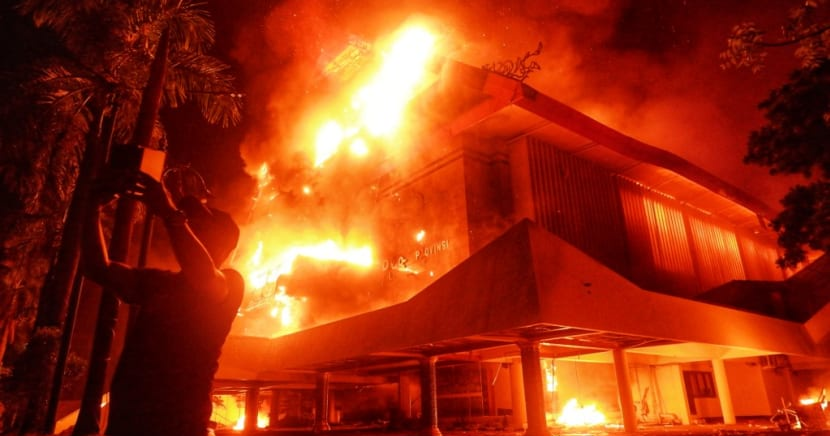
1. Last August, a widespread social uprising erupted in Indonesia. It began with demonstrations protesting tax hikes and pay raises for politicians. When the police killed the first person, the uprising escalated on August 28, and police stations and parliament buildings were set on fire, while politicians’ homes were looted. Can you say something about the conditions that led to the revolt at the end of last year?
Comrade A: Like any uprising, the one last August came from a ton of frustration that had been building up for ages. It started because during Jokowi’s second term, a lot of corruption finally got exposed. Then when Prabowo became president, the politicians got even ballsier — they were basically mocking everyone like, “If we wanna do this, what are you gonna do about it?” Add to that the deep hatred toward the police, who are corrupt as hell institutionally, plus tons of unfinished cases like the Kanjuruhan stadium disaster where over a hundred football fans died a few years ago.
In the last couple of years, especially on TikTok (which is huge among regular and lower-middle class folks), there were way more posts full of hate toward the police than before. The final spark? The government decided to raise DPR (the Indonesian parliamentery) members’ salaries right in the middle of all that anger. Then during the protests, an online driver got run over and killed by a police tactical vehicle. Boom — perfect recipe for chaos.
2. How did the revolt unfold and how did it develop? How did people organize themselves? How did you personally experience it?
I already covered some of this in the first answer. I wasn’t on the streets myself, but I heard from folks who were right in the middle of it. People didn’t really organize in any structured way — it was still too early and the whole thing happened too fast. Most folks just coordinated the next place to burn, with a bunch of adventurous types hopping from one burning spot to another. TikTok helped a lot too, with people live-streaming short clips of the riots in real time.
3. Our impression was that anarchists threw themselves headlong into the revolt from the very beginning and were very active. What role did anarchists play in the revolt? What were the anarchist initiatives and focal points?
Some anarchists were busy with propaganda on social media, but they didn’t directly provoke the riots. So honestly, anarchists didn’t start this — they just got caught up in the flow. This was a real spontaneous mass uprising.
Anarchism itself is still pretty new in Indonesia. There are some anarcho-syndicalist groups that have been around for a while, but I don’t really know how involved they were. The more insurrectionary anarchists did join the street actions though. It’s still too early to talk about any specific anarchist focus points in the August uprising.
4. To what extent was the revolt connected to the Gen Z uprisings in Nepal, Morocco, Madagascar, and other countries? Were people aware of the other uprisings, and did that provide them with additional motivation?
We gotta thank social media for this one. A lot of Gen Z in Nepal straight up said they were inspired by Indonesia’s August uprising. But in my opinion, they actually took it further than we did here. In Indonesia, the uprising fizzled out pretty quick because the government played it smart — they pushed a narrative against the rioters by targeting middle-class influencers who are scared of chaos. That worked really well and convinced most protesters to calm down and switch to more moderate stuff, like student demands (which I think were kinda silly and went nowhere). That basically killed the momentum.
5. How was the state able to suppress the revolt? Why did the uprising end?
Already answered in number 4.
6. How do anarchists discuss and reflect on their experiences and participation in the uprising? Do you see mistakes or missed opportunities? How have anarchist discussions changed since the revolt?
Since quite a few insurrectionary anarchists got arrested and are still dealing with legal stuff, there hasn’t really been much reflection — or at least I haven’t seen it. I’m actually trying to piece one together myself, but the info is still pretty raw and messy.
7. How did anarchists come to be labeled the state’s number one enemy, and how can we imagine the repression that followed the revolt?
This has been building up gradually for a while. From what I’ve seen, the “anarchists are the enemy” narrative got really loud after May Day 2018 in Yogyakarta. Some anarchist protesters painted “Kill the Sultan” graffiti and it caused a huge backlash — there was a serious hunt for the people who did it. Then came a big May Day 2019 demonstration in Bandung where lots of young people wore all black, waved black and red flags with the circled-A, and around 600 of them got arrested. There wasn’t any real riot, just some vandalism, but that’s when the head of the Indonesian police first publicly said there’s a new enemy called “anarcho-syndicalists.” After that, the state started pushing the idea that anarchists (not just the old communist scare) are now public enemy number one.
8. What is the current situation like? What challenges are you facing? How has the situation changed since the revolt?
One thing is clear: the police made a special long-term program (part of their 10-year plan) to go after groups they see as threats to security and order. They didn’t name names, but it’s obvious anarchists are on that list.
Not much has really changed since the uprising. Life went back to normal, the government is doing the same old shit. The only difference is a lot of people — especially middle class and above — are way more pessimistic about trusting the government. You can see it all over social media.
9. Although there are many anarchists in Indonesia and many texts about the revolt have been translated, we sometimes feel that we still feel distanced from the struggles and experiences here. What do you think anarchist internationalism needs today to make solidarity, discussions, and connection alive and strong?
I think the real work has to start here in Indonesia — how anarchists deal with this situation, learn from the August uprising, and figure out what to do next. Without that, whatever people outside Indonesia do (no matter how good the solidarity is) won’t make a big difference. It’s not on you guys abroad. We have to sort out our own problems first before expecting help from outside.
10. Do you have anything else to add?
In short, we gotta admit that social media played a huge role in this August Uprising. From spreading hatred toward the police, showing off all the corruption by officials, sharing info about the next riot spots, targets for burning and looting, inspiring people in other countries like Nepal, to how the uprising was eventually calmed down and life went back to normal — everything revolved around social media.
Thanks for all the attention and solidarity from Europe so far. In case you need to know more detailed on some issues I’ve raised in my answers above, just let me know.
–
Comrade B:
1. Last August, a widespread social uprising erupted in Indonesia. It
began with demonstrations protesting tax hikes and pay raises for
politicians. When the police killed the first person, the uprising
escalated on August 28, and police stations and parliament buildings
were set on fire, while politicians’ homes were looted. Can you say
something about the conditions that led to the revolt at the end of last
year?
Demonstrations like this are not something unique here, especially when
they end in loss of life. In fact, such outcomes often reinforce the
misleading narrative that protests which turn violent are pointless and
counterproductive—a view frequently echoed by social media influencers.
Ironically, although many of them initially express support, once the
uprising begins to disturb their comfort and bourgeois sensibilities,
most are quick to condemn it. What stood out yesterday was the
spontaneity across different groups, transcending divisions of race,
culture, and religion. The issue became vertical in nature—something
that does not usually happen. Regardless of whatever conspiracy theories
are being pushed by the uninformed, it is clear that the moment laid
bare the state’s political infrastructure and exposed just how fragile
the structures of power really are.Poverty remains the central,
undeniable issue, particularly for the younger generation, whose outlook
is increasingly cosmopolitan, yet marked by deep frustration and a
future that appears increasingly bleak. Moreover, with the advancement
of information technology, these realities can spread rapidly and can no
longer be concealed. Old ideologies have, in essence, lost their
relevance—not only Leninism, but also classical anarchism, which is
deeply Eurocentric.
2. How did the revolt unfold and how did it develop? How did people
organize themselves? How did you personally experience it?
Honestly, no one really knows exactly how all of this began. But what
had been building up for a long time was a deep exhaustion with politics
as usual. There’s a widespread feeling across all levels of society that
politicians have become servants of the wealthy, and that corruption has
reached an almost absurd level. When you see things like extreme tax
hikes alongside government officials openly flaunting their enormous
salaries, it creates a kind of boiling point. And all of this spreads
very quickly through social media.
In terms of organization, it’s hard to pinpoint exactly how it happened.
What’s clear is that social media played a huge role. The movement
didn’t follow the usual pattern—it was spontaneous, horizontal,
informal. It didn’t look like the typical “organized protest,” which is
often just political theater staged by opposition parties. This time,
people were tired of that. You had students, online drivers, and many
other parts of society organizing themselves in ways that were
completely unpredictable to the authorities. The state was genuinely
overwhelmed. What we saw was more like anarchy in action—not in the
traditional ideological sense, which often feels rigid or outdated, but
something much more alive and dynamic.
I’m not glorifying technology, of course. It’s a double-edged sword. But
there’s something important to learn from it. If you look at history,
major upheavals have always been tied to the dominant technologies of
their time. Without the printing press, something like Paris 1871
wouldn’t have happened. The same goes for Paris 1968 and the global
student movements of the 1960s—those were made possible by the
concentration of young people in universities, which itself was driven
by capitalism’s need to produce skilled workers. But that’s also where
the contradiction lies. Universities bring young people together and
expose them to real issues affecting their lives. At the same time, they
train people to think in fragmented ways—separating issues,
specializing, and ultimately internalizing the false promises of
prestige, career success, and bourgeois values. That tension has been
there for a long time.
Even events like August 2025 were quickly contained using technology,
which shows both its power and its limits.
Personally, I was surprised by everything that happened. I felt a mix of
emotions—part of me felt like maybe something was finally shifting.
Coordinating with friends from high school and people in different
regions was actually exciting. There was a real sense of shared energy.
In a country as complex as this archipelago, what happened felt like a
kind of catharsis. And honestly, even when I was interrogated by the
anti-terror unit—with their almost “CIA-style” approach—I couldn’t help
but laugh to myself. It was clear they didn’t really understand what had
actually happened in August. This is blatant proof that we can really
destroy this social relationship of techno-industrial civilisation.
3. Our impression was that anarchists threw themselves headlong into the
revolt from the very beginning and were very active. What role did
anarchists play in the revolt? What were the anarchist initiatives and
focal points?
Well, on a smaller scale, there are definitely insurrectionary anarchist
elements—people who try to sharpen contradictions through direct
confrontation. That’s not to dismiss other tendencies, but many of them
tend to romanticize Spain in 1936 and keep insisting they’re
“pro-violence,” as long as it’s properly organized. A lot of that ends
up sounding like empty talk. I mean, if they actually followed through,
I’d respect that. But in reality, those circles often get stuck in
interpersonal issues. They claim to stand with workers, yet act more
like church missionaries, and they’re deeply absorbed in cancel culture.
Honestly, many of these so-called anarchists today resemble 19th-century
Christian puritans. They go out of their way to distance themselves from
spontaneous acts against authority, as if they’re worried it might
damage the image of anarchism. I find it frustrating and laughable.
Ideology, to me, isn’t particularly useful. But what’s ironic is that
when anarchist prisoners begin to receive broader public sympathy, these
same groups suddenly insert themselves into the moment. Certinly
laughable.The truth is, those who present themselves as “organized
anarchists” often struggle to connect with people who are actually out
on the streets. And yet, anarchism today is widely adopted precisely
because of its flexibility, its informality, and its rejection of
conventional politics.
At some point, we need to move beyond these outdated ideologies—and
beyond the armchair theorists who do little more than repeat their
so-called libertarian socialist texts. And I just remembered—one day
before I was arrested, those same anarchist circles were busy blaming
the insurrectionary elements for the looting of malls and for the
casualties. But in reality, some of those who died were journalists and
protesters who were simply in the wrong place at the wrong time. My
condolences to them.
4. To what extent was the revolt connected to the Gen Z uprisings in
Nepal, Morocco, Madagascar, and other countries? Were people aware of
the other uprisings, and did that provide them with additional
motivation?
I think I already answer this on question 1 and two. They were quite
similiar even though it is clear we are diferent in terms of geogrphical
and historical point of view.
5. How was the state able to suppress the revolt? Why did the uprising
end?
I’ve already talked about this, but I’ll add something—because the
irony is hard to ignore. Some social media figures—and even some people
who call themselves anarchists—were quick to blame those involved in the
looting. Not just blame them, but even help the police by pointing out
certain individuals, based on unclear issues, and sharing their photos
online like they were doing police work.
So you start to wonder—what’s the difference between them and the system
they claim to oppose? It’s strange how some “anarchists” suddenly become
very supportive of police and prisons the moment things get
uncomfortable. There’s also this need to look morally right all the
time. Some people seem more interested in gaining attention than
actually understanding what’s happening. Snitching becomes a way to look
good. And this kind of social control is very real. You can see it
especially with people whose comfort is disturbed. Middle-class people
who get upset because they can’t go to malls. “Radical” artists who
suddenly struggle when their funding disappears, so no more exhibitions
or trips to Europe. It shows what really matters to them.
In the end, it’s not really about ideology. People from any class, if
they have a bourgeois mindset, will panic when their daily comfort is
threatened—when the lifestyle and image they rely on might disappear. So
insurrections don’t stop just because power is too strong. A lot of the
time, they stop because people are afraid of losing their comfort at the
expense of millions of peple who barely have any roof and something to
fill thieir stomach.
6. How do anarchists discuss and reflect on their experiences and
participation in the uprising? Do you see mistakes or missed
opportunities? How have anarchist discussions changed since the revolt?
I’m not part of the so-called anarchist movement here nd I dont want to
be one. From what I know, there isn’t much to it. It’s mostly just a
small number of people who engaged i this discussion—some calling
themselves anarchists, egoists, or nihilists. At the same time, others
in the so-called movement seem more focused on building their image for
international organizations, just so they can become members, rather
than doing actual local organizing. I’m not saying everyone is like
that. There are also people who are active on the ground and involved in
real organizing, but they aren’t obsessed with labeling themselves as
anarchists. In short, as far as I know, there hasn’t really been any
serious discussion about August.
7. How did anarchists come to be labeled the state’s number one enemy,
and how can we imagine the repression that followed the revolt?
I think that since Leninism and its variants have already died—like
Lenin’s preserved body—anarchism has become the only real opposition to
the social relations of the state and capitalism. After the
insurrection, of course, many of us are already on the radar of the
authorities.
8. What is the current situation like? What challenges are you facing?
How has the situation changed since the revolt?
Not much has changed, except that the widespread anger toward the police
and the government is still very much present across society. Other
outbursts are likely to happen in the near future. The challenge, of
course, is the double-edged sword: technology.
_-_-_-_-_
Comrade C:
1
The main triggers of the protests in late August were poverty and the
increasingly evident process of impoverishment. The outrage stemmed from
plans to increase the salaries and allowances of members of the House of
Representatives (DPR) amid widespread public outcry over tax hikes.
Initially, the protests were confined to social media, but a video of
lawmakers dancing during a session, along with a statement by one Member
of Parliament describing the protesting public as “the most stupid
people in the world” sparked mass demonstrations on August 25, 2025.
On the night of August 28, Afffan Kurniawan, an online ride-hailing
driver was killed after being run over by a Police vehicle. This became
the boiling point of the public’s anger. Long before this,
dissatisfaction with the government and the police had actually been
building up for a long time due to the government’s foolish policies and
statements that easily went viral on social media. Affan’s death
triggered an outburst of public emotion and sparked the imagination that
power could be destroy. Riots then broke out from 29 August to 1
September, as an outpouring of anger through acts of violence and
looting.
2
The uprising has spread rapidly since August 29, reaching various cities
outside Jakarta—including areas previously unknown for having a strong
tradition of resistance. Its scale and intensity have created a ripple
effect across many other regions.
The ability to make Molotov cocktails is no longer limited to certain
groups. At the same time, anarchist discourse—particularly the
individualist/egoist variant—has also been growing in a number of cities
and has contributed to shaping the insurrectionary atmosphere. Affan’s
death served as a key catalyst, but what stands out is the widespread
mass response that occurred without centralized coordination.
The police then highlighted six Instagram accounts accused of being
involved in funding the riots. I am the administrator of one of those
accounts. These accounts had previously been active in voicing radical
criticism of social alienation, and in calling for total rebellion
against authority. I myself am not an individualist or an egoist, but I
support insurrectionary political tactics. They are sensible tactics. I
believe all anarchists, regardless of their ideological variations,
should adopt insurrectionary tactics. It is an effective way to make the
leap out of the psychological prison or prison of fear created by the
humanist morality of the citizenry. It is a way to feed the imagination
and desire. And because most anarchists tend to stigmatize such tactics,
they could do little more than be passive spectators when the August
riots took place. To be honest, most anarchists here are cowards.
I don’t mean to suggest that the August riots were the result of control
by a specific group, because the dynamics on the ground indicate that
the outbreak of violence was more an accumulation of public anger that
found its momentum.
3
I take issue with the assumption underlying your question that many
anarchists are active in uprisings. In fact, most of them are actually
the ones putting out the fires. It is true that many anarchists have
been actively raising people’s political awareness. They initiate
discussions, set up study groups, built unions, collectives and
subcultural communities, take part in demonstrations, and so on. But
political awareness alone is not enough to spark an uprising. All the
activities I’ve mentioned are often merely a repetition of what
anarchists have done before.
4
Many of the uprisings known as the Gen Z uprisings in various countries
took place after the August riots in Indonesia. So there wasn’t much
additional motivation for Indonesians. But thanks to news about those
Gen Z uprisings, some democracy activists I know have started to open up
to the idea of exploring anarchism. That’s all I know.
5
The movement’s overall inaction in response to the demonstrations and
riots contributed to the suppression of the August uprising. It should
be noted that these riots began with demonstrations on 25 August by
ordinary people, such as the unemployed, the online motorcycle taxi
community, high school students, and the people who were not affiliated
with any particular movement organisation. Generally, these groups were
underestimated and considered “politically clueless”. Most of their
protest posters were poorly designed. And for that very reason, the
illiterate middle-class activists mocked and labelled the demonstrations
of 25–26 August as an “intelligence operation”. Thus, from the very
beginning, these activists constructed a narrative that fragmented the
movement into factions, making them prone to fighting amongst themselves
and fostering mutual distrust.
As tensions escalated, particularly following Affan’s death, the anger
of ordinary people was then quelled by middle-class activists shouting
“Don’t vandalize public property,”, “Don’t be anarchists”, “Don’t be
provoked”. Meanwhile, social anarchists, rather than openly advocating
civil war, were instead busy clarifying on social media that “anarchism
isn’t always about violence” in an attempt to market anarchism and win
public sympathy. Such propaganda might be appropriate, but only in the
right circumstances. When riots break out, such propaganda actually
creates public confusion about anarchists and fuels a situation where
rioters become easier to identify and are subsequently judged for
posting on their social media about how wonderful the riots are. And
that is exactly what happens.
It is precisely situations like these that explain why there was no
significant resistance when wealthy activists suddenly arrived on 1
September with a series of nonsensical demands known as ‘17+8’. And from
that moment on, the fire was completely extinguished. So it is clear
that the first thing to extinguish this uprising was the humanism of the
activists and the anarchists, who lacked analytical insight. They failed
to see those “wild” and violent rioters as potential allies.
Consequently, they failed to affirm and expand the August uprising into
a “celebration of life” amidst a lifeless spectacle of society.
As soon as the anger began to subside, the police began making arrests,
spreading disinformation, and carrying out surveillance. Many anarchists
actually helped spread that disinformation as well. The result was
predictable: the individualists/egoists became the scapegoats. Some of
them were accused of being snitches by social anarchists who didn’t even
know each other. So, of course, the police exploited the anarchists’ own
stupidity.
6
Not much has changed. Everything has more or less returned to the way it
was. Most anarchists are plagued by persistent paranoia. Even as late as
January 2026, people were still debating the snitch status of the
‘chaos-star’ prisoners, rather than reflecting on last August’s riots.
So not much has changed, except that anarchism has become more popular.
Now the A symbol and the ‘chaos-star’ are printed on T-shirts and
displayed everywhere.
7
I think that’s the logical consequence. Anarchists reject the legitimacy
of the state, and the state will obviously respond to that. The first
thing they do is construct an image of anarchism as a threat to “public
order” while simultaneously making it a useful “ideological enemy” to
justify control, security, and the perpetuation of authoritarianism. The
second step is mass arrests based on absurd charges that are expanded
and obscured. This is usually accompanied by infiltration and the
production of public narratives to delegitimize anarchism. The purpose
of this kind of repressive imagination is to shut down the social
possibilities opened up by every uprising—such as spaces of solidarity,
alternative ways of life, and collective courage. In other words,
post-uprising repression works to restore a sense of fear while closing
off the horizon of political imagination, so that what has happened is
no longer conceivable as something possible.
8
Last August’s uprising revealed many things that had remained hidden
under “normal” circumstances. It exposed the contradiction between the
system’s claims and reality, demonstrated the limits of collective
patience that had been exceeded, exposed the true face of power and its
mechanisms of domination, whilst also uncovering the latent potential
for collective action within society; at the same time, the uprising
also proved that the seemingly stable order is actually fragile and
dependent on compliance, and that the meaning of the event itself is
always contested through various competing narratives. But more
importantly, it reveals the fact that the left-wing movement and the
majority of anarchists are a pseudo-opposition.
9
What is needed is the translation of relevant texts. Not just past
anarchist theory and practice, but also bringing local experiences into
the global discourse—whether it’s ways of organizing, ways of
confronting state repression, or ways of responding to apathy or
fragmentation in each locality. I think many anarchists here have been
doing this since the early 2000s. But now it’s relatively rare. I’m not
exactly sure why that is.
Furthermore, direct relationships also need to be cultivated. Many
connections today are one-way: reading, watching, and following. We need
correspondence, or perhaps even visits. The point is to build an
internationalism that is not merely mediated by social media and
algorithms. I think it’s important to be able to understand each other’s
specific conditions, to avoid shallow universalism, and to avoid an
overly romanticized ethic of solidarity regarding struggles in other
places.
_-_-_-_-_-_
–
Palang Hitam International
source: Anarchist News