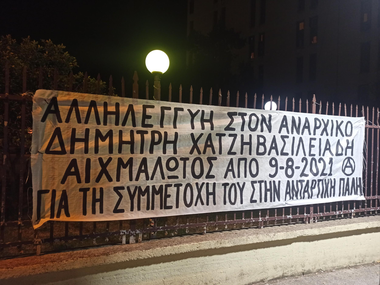
Excerpt from the statement of Dimitris Chatzivasileiadis at the event of the newspaper Apatris on 25/6/2026 at the Evangelismos Squat:
“For the first time, I am publicly informing you that almost two years ago the Supreme Court decision was issued for my appeal against part of the decision of the second instance court. I received the decision with a year’s delay due to a mistake by the lawyer. I had appealed the part of the conviction for my membership in the OEA, because any objective documentation of the existence of an organization under the terms of the 2nd paragraph of 187A and my participation in these conditions was missing. Be careful, under the terms of their own law, not under the political terms of the OEA itself. And especially for the organizational terms, not for the ideological terms of the 1st paragraph. I had offended them with a political memorandum that I had filed in court and published. Very briefly, I filed an appeal to the Supreme Court, denying the false objective cover of the written decision of the court. It will be understood in a moment. With the appeal, the responsibility for the contradiction of political subjectivism and objectivism was transferred to the highest institutional echelon.
The Supreme Court’s decision was dismissive. I recently merged the two sentences that keep me in prison. The final result was the most unfavorable that could have been. My total sentence is 21 years, that is, one year above the ceiling that applies to offenses until 2025. [With the current provisions, the comrade will enter the leave entitlement phase in April 2028 and the suspension entitlement phase in August 2029].
By the way, I want to mention comrade Larry Armao, who assisted me in the appeal to the AP, but did not have time to complete his fluent contribution. He was the only lawyer I have found and was truly a fellow activist.
The AP decision has two characteristics. One is the concept of potential danger. It is not an innovation in jurisprudence. However, I think, for the first time it is formulated so clearly that the danger is not required, not only to have been confirmed, but also to have been manifested as such objectively. It does not matter whether there was a real danger during the period of the act and until its prosecution. As long as it was possible for the danger to arise at some point. Specifically, perhaps no one has been in danger to date from the weapon kept by an anarchist, but the fact that someone holds a weapon and has political intentions that may lead to its use raises the political risks described in the ideological terms of the 1st paragraph of the special counter-revolutionary law.
The second characteristic of the decision is that it overrides the decision of the 2nd instance, in terms that absolutize judicial arbitrariness. For example, the ballistics investigation document that certifies that another weapon was used in the expropriation at the mini casino and another was the weapon stamped with the OEA, is characterized as insignificant and passable, even though the 2nd instance had ruled that it was the same weapon, in order to document that in 2019 the OEA was active as a legally sufficient set of acting persons. The AP put another stone in the spirit of its two decisions, on the coup and on the political crime. Political subjectivity is an objective condition and an insurmountable one.
Let us analyze it a little. The inherently expansive relationship between objectivity and political risk has catalytic consequences for the law of the bourgeoisie. In the shadow of the permanent state of emergency, the pseudo-common foundations of bourgeois ideology, which until recently mediated class domination and terrorism, dissolve themselves. When the social subject is freed from the bourgeois ideological conventions of silencing the class conflict and the historical continuity of the revolution-counter-revolutionary struggle, it recognizes that political subjectivity stems primarily from the resisting subject itself, which breaks the rules of the dominant class. The presence of resistance forces the state and its judges to consider not short-sightedly, only according to immediate dangers, but mainly according to potentially escalated states of emergency. The expansion of the relationship between the objective presence of resistance and the potential for danger is reflected as a contradiction between objectivity and subjectivity in law. Counter-revolutionary prevention requires legal forms suitable for everything. Legal totalitarianism is a derivative of revolutionary social dynamics. It inevitably expands the power of judicial political subjectivism, because it is obliged to constantly respond to the potential, not generally to the not yet realized, but to the even worse for the state, which arises from every realized resistance. The specter of revolution, which takes shape from the persistence of subversive struggle, has led bourgeois law to suicide. We have declared an irreconcilable war and have forced the bourgeois state to abandon its ideological veils and its political mediations in the class struggle.
All the judicial proceedings of the OEA – Cholargou case invested in a false objectivity for the substantiation of the charges. Why? In the second instance, there was a brief regression from false objectivity to manifest subjectivity. In the public trial process, the judges pretended to cleanse the landscape of legal objectivity from its shabby presumptions. This was of course imposed by the presence of the guerrilla truth, forcing them to invest in the public ideological confrontation in the veil of legal objectivity. Thus, the judges were forced to recognize the political concepts that the guerrilla discourse put forward, to the point of speaking of a potentially just armed struggle, but one that was untimely in the conditions of Greek democracy. However, the purging of objectivity from its false evidence led to a contradiction in terms of the court’s purposes. They should have convicted me for my participation in the OEA, with the sole evidence being my own statements, which in order to be sufficient would have to exceed the objective conditions required by the 2nd paragraph. A deafening recognition of the absolute power of political subjectivity. So, after the end of the public debate, the written decision returned to false objectivity through the ridiculous scenarios that had been formulated by the security counter-insurgency transmission and the decision of the first instance. Note, this is not about the separation of subjectivity and objectivity. The subjective assessment of the dynamics of resistance, of the potential danger based on its objectively manifested power, is attempted to be hidden behind a legal objectivity and these efforts give the political subjectivism of the judges an even more authoritarian face, completely ridiculous, on a trajectory of escape from all truth. So why do they insist on legal objectivism? Because of the ideological dominance of the revolutionary struggle, in the moral-social and political field. Legal formality remains a field of negotiation of political conflict, the field of state power, but now the arbitrariness of political expediency has completely taken over it. The decision of the Supreme Court explicitly subordinates reality to the principle of the moral authority of the judge and, as a consequence, the self-evident morality of the state. Ultimately we return to the objectively self-evident, the political possession of objectivity is based on the possession of weapons. It is valid on both sides of the class-political struggle.”