Abstract
The intelligence and counterintelligence operations that facilitated the 25 June 2006 capture of Gilad Shalit marked one of the most significant successes achieved by the Palestinian “Joint Operations Room” to that point. The operation—precipitated by the 9 June 2006 murder of twelve-year-old Huda Ghalia, alongside her father and five siblings while the family was enjoying an excursion on Sudaniyya Beach near Beit Lahia in northern Gaza—famously resulted in the “Wafa al-Ahrar” (“Loyalty to the Free”) exchange, in which over 1,000 prisoners associated with Hamas, Fatah, PIJ, PFLP, and DFLP (amongst others) were freed, including charismatic leaders who went on to spearhead the resistance, such as Yahya al-Sinwar, Rawhi Mushtaha, Tawfiq Abu Naim, Husam Badran, Jihad Yaghmur, Ali al-Amudi, and Zi’ad ‘Awad, to name but a handful. Although much scholarly attention has been devoted to the five-year negotiation process and the resistance’s ability to clandestinely move Shalit, evading the occupation’s capture and detection, there has been a dearth of English-language analysis of the actual intelligence and counterintelligence preparations. Indeed, not only did the 2011 prisoner exchange inform the 7 October operation’s objective of conducting a comprehensive prisoner exchange, but so too did the military preparations and intelligence gathering, thereby justifying a close analysis based on the resistance’s witness accounts and archival texts.
0. Introduction
On 25 June 2023, the Izz al-Din al-Qassam Brigades published an article by Palestinian political commentator Izzat Jamal; in retrospect, the short piece clearly anticipates the 7 October 2023 “Tufan al-Aqsa” operation and includes the following telling title: “After 17 years since [Gilad] Shalit’s capture, capture remains a live option.”[1] Jamal’s commentary is worth translating and reproducing in full:
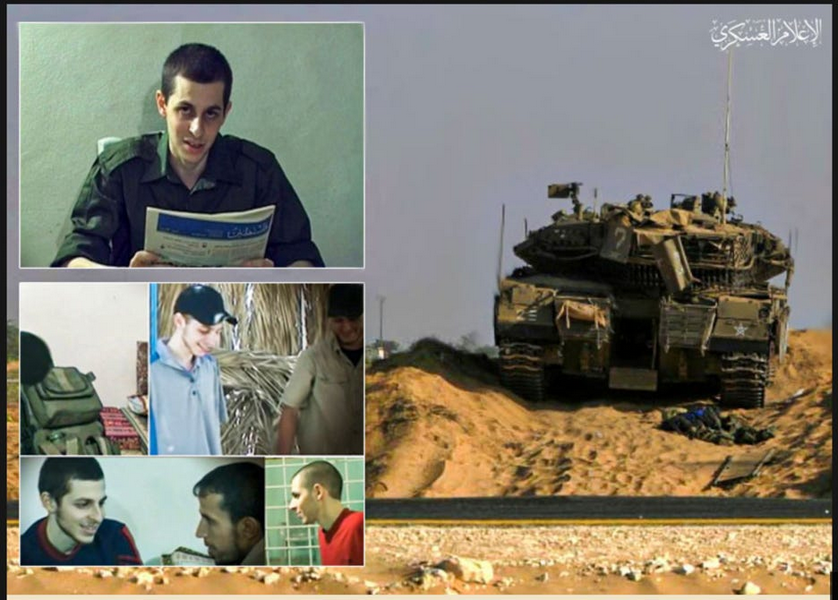
At dawn on 25 June 2006, six months after Hamas won a majority of seats in the Palestinian Legislative Council, the Izz ad-Din al-Qassam Brigades, along with the Nasser Salah ad-Din Brigades and Jaysh al-Islam, carried out one of the most significant raids in the history of the conflict with the occupying entity. The groups undertaking the attack successfully crossed the separation wall and infiltrated our occupied territory east of the Gaza Strip through a pre-prepared tunnel. They stormed one of the fortified positions established by the enemy army to harass and monitor the residents of Gaza, known as the “Red Tower” position, where the fighters were able within a few minutes to destroy a Merkava tank and an armored personnel carrier and carry out an assault on the tower. They returned to the Gaza Strip with the captured soldier, Gilad Shalit, whom they had extracted from the heart of his armored vehicle. They left behind a number of dead and wounded enemy soldiers and officers, leaving the enemy stunned by the shock and surprise.
In the years that followed, Hamas and the Izz ad-Din al-Qassam Brigades managed a series of complex operations involving concealment, negotiation, and the conclusion of a major national agreement known as Wafa al-Ahrar (Loyalty of the Free). This deal represented a significant and unprecedented national victory for the Palestinian people, as it was the first time a prisoner exchange had been conducted from within the occupied territories. The resistance brought joy to all Palestinians, both inside and outside Palestine, by including them in the deal, and proved that the sincere will of truth is stronger than the arrogance of the occupying enemy.
The Wafa al-Ahrar prisoner exchange deal underscored a crucial truth: the liberation of Palestinian prisoners, especially those serving long sentences, the sick, and those serving life terms, can only be achieved through the capture of Israeli soldiers and officers. It demonstrated that the occupying enemy understands only the language of force, and only through force will it retreat and release our Palestinian people from its prisons. For this reason, the Palestinian resistance has carried out a number of heroic operations targeting the capture of occupation soldiers. The most prominent of these operations were those conducted in the West Bank and Gaza, such as the settler-capture operation in Hebron in 2014 by Qassam Brigades members Amer Abu Aisha and Marwan al-Qawasmi; the capture of soldier Oron Shaul east of Gaza and officer Hadar Goldin east of Rafah during the ‘Israeli’ aggression on Gaza in the same year; and the subsequent capture of Avera Mengistu and Hisham al-Sayed, along with numerous documented attempts that did not end with the Battle of Saif al-Quds in 2021.
The resistance, and the Qassam Brigades in particular, considers the capture of soldiers a crucial strategy, devoting significant attention to it and making it a cornerstone of their fighters’ combat doctrine. This has been evident in the few media appearances of prominent leaders of the Qassam Brigades’ military council, as well as in combat training exercises and military maneuvers conducted, whether in the “Mighty Pillar” exercises involving all factions combined, or during the training exercises of the Izz ad-Din al-Qassam Brigades.
This clearly indicates that the option of capturing ‘Israeli’ soldiers and officers remains a viable and potent strategy, given the intransigence of successive occupation governments and their failure to manage this issue, which constitutes a persistent weakness for them, as evidenced by the years that have passed since their soldiers and officers were captured and held in the Gaza Strip. Refusing to comply with the Palestinian resistance’s conditions for releasing the prisoners of the Wafa al-Ahrar deal as a prerequisite for any negotiations, and demonstrating intransigence, will be the greatest incentive for launching new capture operations. These operations may differ in time and place, but their goal will undoubtedly be the liberation of prisoners from the prisons of the oppressive entity. At the same time, the resistance and the Qassam Brigades insist on not revealing the fate of the captured Zionist soldiers they hold except at a price. What strengthens the possibility of carrying out new capture operations is the tendency of the occupation entity and its fascist government to mistreat prisoners in prisons, reaching the point of executing a number of prisoners, such as the martyred leader Khader Adnan. This is in addition to the unprecedented restrictions imposed on female and male prisoners, which have included gains that prisoners had won over decades of struggle with the prison administration. The escalating aggression against Palestinian prisoners in the prisons of the occupying entity compels the Palestinian resistance leadership to stand up to its religious and national responsibility, striving diligently and tirelessly to break the will of the occupying enemy and force it to release the prisoners from the prisons, no matter the cost. The heroic prisoners who spent the prime of their lives behind bars; they deserve it, and no price can equal their freedom.[2] (emphases added)
Indeed, The Palestinian resistance’s “Dispelled Illusion” (Amaliyyat al-Wahm al-Mutabaddid) operation, which culminated in the capture of occupation soldier Gilad Shalit, remains one of its most important accomplishments. On the one hand, the consequent Wafa al-Ahrar, or “Loyalty of the Free,” prisoner exchange born from the Shalit exchanged freed 1,023 Palestinian prisoner and conceptually galvanized the 7 October 2023 operation, directly informing the latter’s modus operandi (and eventual Tufan al-Ahrar exchange). On the other, the Loyalty of the Free Agreement facilitated the return of charismatic figures from the Izz al-Din al-Qassam brigades who possessed huge symbolic political capital and intelligence prowess, such as Yahya al-Sinwar, Rawhi Mushtaha, Tawfiq Abu Naim, Husam Badran, Jihad Yaghmur, Ali al-Amudi, and Zi’ad ‘Awad, to name but a few. Important figures like Husam Badran, who had been a commander within the al-Qassam Brigades in the West Bank and would later form the Hamas Office of National Relations (HONR) and had spent fourteen years in the occupation’s prisons (and was a cellmate and close friend of Sinwar), were released. Jihad Yaghmur, a Hamas operative who participated in the abduction of murder soldier Nahshon Waxman in 1994, was also released in Shalit deal. These returns were factors that not only decreased the external leadership’s influence over the Al-Qassam brigades.
There is, however, another, more subtle link between the Gilad Shalit operation and Tufan al-Aqsa—one that involves intelligence and counter-intelligence collection efforts. This proves to be immediately apparent once one considers the structural similarities between the two operations—not least of all the fact that both involved various resistance groups working together to execute an ambush capture operation. Indeed, as an interview with Khalid Abu Hilal, a resistance fighter from al-Ahrar—a resistance faction that was, at the time of the “Dispelled Illusion” operation, was close to Hamas—“Hamas wanted the Shalit operation to be a national undertaking, not purely Hamas. They had just formed a government; it was a political calculation”; these sentiments were echoed by Muhammed Abdel (Abu Abir) of the Popular Resistance Committees (PRC).[3] Relatedly, Tufan al-Aqsa involved myriad resistance factions working together under the aegis of the “Joint Operations Room,” including the Izz al-Din al-Qassam Brigades (Hamas), Saraya al-Quds (Palestinian Islamic Jihad), Omar al-Qasim Brigades/National Resistance Brigades (DFLP), Abu Ali Mustafa Brigades (PFLP), and al-Aqsa Martyrs Brigades.[4]
Before homing in on the intelligence aspect, it is worth summarizing the facts of the capture. On 26 June 2006, resistance soldiers belonging to al-Qassam and the PRC—alongside two Jaysh al-Islam members[5]—helped capture the occupation soldier, Gilad Shalit, killing two soldiers in the process.[6] The resistance published a communique articulating that the operation was prompted by the Zionist occupation’s 9 June 2006 murder of twelve-year-old Huda Ghalia, alongside her father and five siblings while the family had been enjoying an excursion on the Sudaniyya beach near Beit Lahia in northern Gaza.[7] The resistance was able to hide Shalit, evading the occupation military’s detection for the full breadth of tortuous negotiations. Eventually, as aforementioned, a total of 1,027 Palestinian prisoners were released in the Shalit exchange, which transpired in two stages: 477 prisoners were freed on 18 October 2011 and 550 on 18 December 2011. Amongst those freed were 307 Hamas members, 399 Fatah members, 27 Palestinian Islamic Jihad members, 74 PFLP members, 26 DFLP members, and 194 affiliated with other organizations (or unaffiliated).[8]
Turning now to the intelligence collection: the preparations for Shalit’s capture were planned from 23 until 25 June 2006. What precisely this involved has, however, not received significant scholarly attention, though much has been written about the subsequent negotiations.[9] Nevertheless, this is a critical oversight: Hamas invested heavily in systematic intelligence work, initiating sustained forward surveillance patrols along the frontier its military apparatus processed and evaluated the collected information. This facilitated what was, by all accounts, a mightily impressive capture and motivated the Tufan al-Aqsa gambit. By better understanding this, we can also come to better appreciate the operational and conceptual strictures of Tufan al-Aqsa.
I. Intelligence.
In April 2006, Hamas installed the PRC’s founder, Jamal Abu Samhadana, as the interior ministry’s chief oversight official and as head of the Executive Force, a policing body formed in Gaza amid the struggle over control of the security services that followed the January 2006 legislative elections. At roughly the same time, PRC members state that Samhadana, together with members of the Qassam Brigades, began excavating a tunnel intended for a large-scale capture operation inside occupied Palestine; however, he was martyred in an airstrike by the occupation’s military on 8 June 2006, before the plan could be carried out. Less than three weeks later, Samhadana’s tunnel was put to use when operatives from al-Qassam, the PRC, and Dughmush’s splinter faction, Jaysh al-Islam, carried out the abduction of Shalit. Two occupation soldiers were killed in the operation, along with two Palestinian militants, one of whom belonged to Jaysh al-Islam, which declared its existence the following day. According to International Crisis Group’s 30 October 2010 interview with Khalid Abu Hilal in Gaza City, it was reported that, per the leader of al-Ahrar, a militant faction close to Hamas during this period, Jaysh al-Islam’s role was minimal, and “Hamas wanted the Shalit operation to be a national undertaking, not purely Hamas. They had just formed a government; it was a political calculation.”[10] This broad-spanning undertaking thus found Hamas’ military wing, the Izz al-Din al-Qassam Brigades, developing an intelligence program that extended to other resistance faction.
The Military Council of Qassam Brigades assigned the resistance group’s field command the task of identifying an occupation target for a soldier-capture operation intended to secure the release of Palestinian prisoners held in the occupation’s prisons. Following surveillance and reconnaissance across the operational axes and sectors of the Gaza Strip, planners settled on an operation against an occupation military position in the eastern Rafah sector near Karam Abu Salem. This area was described as lying deep within the occupation’s defensive perimeter and fully its control, as it was situated near several military posts and armored observation towers.[11] These crossings were understood as especially significant because they had repeatedly served as entry points for invading forces and for the infiltration of special units. At this stage, the immediate objective was defined as the capture of the occupation’s soldiers while minimizing the danger to the assault force.
The operation was conceived as serving purposes beyond the seizure of a prisoner. It was intended to demonstrate to al-Qassam’s fighters that direct confrontation with occupation’s soldiers was feasible only if preceded by sufficient planning. The scope of the operation consisted in cultivating an offensive program that could be reiterated in future resistance operations.[12] The resistance also sought to showcase the capabilities of Palestinian fighters despite their limited means and to reduce, insofar as possible, the advantages provided by the occupation’s military technology, including camera systems and thermal-imaging radars. Critically, the operation would also serve as training for the participating units who, the Qassam Brigade’s leadership thought, would spearhead larger future operations. It also prompted Mohammed al-Sinwar and Mohammed al-Deif founding Qassam’s “Shadow Unit,” which was responsible for securing the capture of soldier Gilad Shalit and holding him captive for five years; come the Tufan al-Aqsa operation, the “Shadow Unit” would again be responsible for overseeing the prisoners of war. [13]
After the plan was approved, orders were issued for its implementation in the field, together with instructions to provide all necessary personnel, materiel, and support requirements in other sectors and fronts, including missiles and rockets. A training site was then selected according to criteria intended to prevent detection by aerial surveillance, and the training program was completed under those conditions. The assault team was fixed at seven members of the resistance, a number described “as the absolute minimum.”[14] Although twelve fighters were said to be the ordinary minimum for an operation of this kind, the smaller number was adopted in order to reduce the likelihood of heavy casualties during what was understood to be a bold penetration deep into enemy-controlled territory.
The required weapons and equipment were assembled in detail. Each fighter received a rifle in good condition, six magazines, 200 rounds of ammunition, and three defensive grenades manufactured by al-Qassam. Every member of the assault team also carried two explosive breaching charges intended for fortress doors, likewise manufactured by al-Qassam, as well as a Yassin launcher with two missiles, a communications device linking each fighter to command through a method described as innovative and used for the first time, and a specially designed explosive charge for each shield. The fighters were additionally supplied with military uniforms of that occupation’s military; these included specially designed load-bearing vests for the chest and back, footwear intended not to leave footprints, and protective supports for the elbows, knees, and ankles in order to facilitate crawling through the tunnel and rapid movement during the attack.[15]
Each fighter also received a lightweight backpack for carrying his equipment through the tunnel so that all participants could reach the exit in a single movement without becoming exhausted before the attack began.[16] This arrangement was meant both to keep weapons and uniforms free of dust, thereby reducing the danger of weapon malfunction, and to prevent the enemy from deducing that the assault had been launched through a tunnel. Plastic restraints were also included, both for binding prisoners and for tying the hands of dead bodies in order to mislead the enemy.
The tunnel itself occupied a central place in the operational design. The plan called for its entrance to be sealed immediately after the assault team emerged, while still allowing for the possibility of reusing it if the enemy failed to discover it. The fighters were instructed to leave the exit rapidly after securing it from the outside in case nearby ambushes were present. At the same time, planners judged that the enemy would likely discover the tunnel by following the attackers’ trail and would then destroy it either from above or by demolishing the shaft itself. On that basis, they concluded that there was no value in mining the tunnel or stationing fighters near its entrance, a judgment derived from earlier responses recorded by the resistance.
Training was developed to cover all aspects of the objective and all plausible scenarios the assault team might encounter. The emphasis fell on both individual and collective core skills, including the destruction of an armored personnel carrier, a tank, and a fortified gate using specialized explosive devices tailored to each type of target. According to the account, the device used against the tank later caused the occupation’s military to believe that the vehicle had been struck by an advanced anti-tank round, since it created a hole approximately half a meter wide near the rear edge of the turret and penetrated into the interior. The resulting incendiary blast reportedly reached the engine at the front of the tank and nearly destroyed the command compartment, immediately killing the tank commander’s assistant, a corporal seated on the right side.
Missiles and mortars also formed part of the preparatory phase. They were assigned functions of support, preparatory fire, deception, and concealment of the operation’s true purpose from the occupation’s military field command. For two days before the attack, the occupation’s positions and outposts along the occupied strip, as well as nearby settlements, were shelled. This, according to the account, led the the occupation’s side to interpret the activity as another episode of routine rocket fire. An observation balloon positioned above the Karam Abu Salem crossing was reportedly withdrawn and redirected toward the Beit Hanoun/Erez area because rocket-launching activity had been detected there. This redeployment allegedly enabled the assault team to move with greater precision over exposed terrain during both the attack and the withdrawal.
As the zero hour approached, repeated visits were made to the tunnel, which was completed and reinforced internally. The occupation military’s positions selected as targets were monitored continuously for several days and nights, and they were filmed on video. The footage was then analyzed in order to study the behavior of the occupation’s soldiers at and around the positions throughout the day, as well as patrol patterns in the areas adjacent to the electronic fence. On the basis of these preparations, the final details of the operation were settled, and the zero hour was set for after the dawn prayer on 25 June 2006.[17]
The field battalion commanders then moved into the operational area to begin the final phase of execution. The assault team was isolated for two days under strict instructions and was then received at a concealed location serving as the final assembly point before movement toward the front line opposite the fence. Only at this stage, less than twenty-four hours before the attack, were the participants informed of the nature of the mission, the target to be attacked, and their individual responsibilities. A video covering the battle sector was shown to them, although the exact route to the target remained concealed. The presentation explained the attack points, the routes of approach for the different groups, and the withdrawal route. Each participant then described his own role in detail before the group and was allowed to ask questions. Films and diagrams were used to explain the structure of the targets and the routes leading to them. The route to the operational area, which the fighters were only made aware of after they entered the tunnel, itself remained secret.[18]
After these preparations, the participants were photographed in full equipment and their final wills were read both collectively and individually. Before dawn, they performed night prayers and the prayer of need. Early in the morning they were transported, together with all their equipment and under a series of security precautions, to the designated point where the tunnel entrance was located.[19] There, each participant examined his assigned portion of the tunnel and visually surveyed the surrounding area through a specially prepared aperture.
Before the team entered, the field command inspected the full length of the tunnel to ensure that lighting and ventilation were functioning properly. The fighters’ bags were then moved in reverse sequence from the far end of the tunnel in order to avoid congestion at the exit, since the passage was wide enough for only one man at a time. The resistance’s team guide descended first to the end of the tunnel carrying some equipment and supplies in preparation for sealing the entrance during the operation, and then returned after checking the tunnel’s reinforcements and the winch motor. The assault team spent the remainder of the day reading the Qur’an, engaging in dhikr, resting, and checking their equipment. The bags were then packed, numbered, and arranged at the tunnel entrance in reverse order so that each fighter would find his own bag at the appropriate point upon arrival. Once a fighter reached the exit, the guide would hand him his equipment, fit it onto him, assemble his weapon for immediate use, and direct him to his assigned sector. Each fighter was then to emerge rapidly, assume a prone combat posture, engage any nearby ambush if necessary, and protect the rest of the team until all had exited. The guide would then seal the tunnel entrance carefully, while the rear guard concealed the traces outside it as far as possible before moving to a position suitable for intercepting reinforcements.
Throughout the day the resistance monitored the occupation’s position, closely watching it for any unusual behavior that might suggest that the enemy had sensed danger, although no such indication was perceived. At 2:00 a.m., after prayer, the resistance’s assault team entered the tunnel in the order in which the fighters were to emerge at the other end. The tank unit went first because its objective was the farthest away and because the tank was regarded as the key point upon which the site and any reinforcements depended. The armored unit near the tower and close to the fence followed second, with the mission of confronting the armored vehicle used to detect infiltrators. Third came the tower unit, consisting of Muhammad Farwana and Hamid al-Rantisi. The rear guard went last.[20]
The team moved through the tunnel while reciting supplications and preparing for combat. The distance traversed was about 450 meters, which the fighters covered on their hands and knees in roughly half an hour. They performed the dawn prayer inside the tunnel, and before they emerged, two rescue, support, and medical teams were directed to an area near the withdrawal line, where they had already been concealed among the trees since the previous evening. Military media personnel were also assigned to selected positions after receiving the necessary guidance, indicating the importance attached to documenting the operation.[21]
Once the dawn prayer had been completed at the tunnel’s end, the guide distributed the fighters’ equipment and the men exited one by one, assuming combat positions immediately upon emergence. At that moment, the guide noticed a jeep manned by the occupation’s military parked by a group of trees in the opposite area, with no visible movement around it. The guide briefly considered undertaking a diversion ambush whereby one of the fighters would attack the jeep and capture its occupants, but the decision was made to adhere to the original objective. The resistance’s command later assessed that the vehicle likely belonged to an ambush unit positioned some distance from the fence in order to catch infiltrators, although this account leaves open the possibility that the occupation’s military members who were manning the jeep had simply fallen asleep among the trees or that the jeep had been left empty as a decoy.[22]
After the entire team emerged, the guide directed each two-man unit toward its target, while the rear guard proceeded separately. At that point the attackers discovered that the occupation’s side had illuminated the entire area with powerful searchlights, effectively turning night into daylight. Despite this, command ordered the fighters to rely on speed and concealment and to continue, since retreat was judged impossible. Moving along the lines of forest trees bordering the agricultural fields and using the walls of the outer towers for cover, the units advanced toward their targets. Meanwhile, the guide filled previously prepared bags with sand and stacked them at the tunnel entrance. He had intended that the last man conceal the traces outside the exit with a tree branch, but because the danger of detection under the searchlights had become too great, the rear guard omitted that step and moved immediately to his assigned position. The guide then withdrew from the area entirely after confirming that all drilling equipment and traces from the surrounding preparation sites, apart from the tunnel and its immediate vicinity, had already been removed the previous day.
Each unit advanced while remaining in constant contact with the operations room and reporting what lay ahead. When all units had reached their objectives, they were ordered to remain concealed until the tank unit arrived. The signal for launching the assault was the detonation of the explosive charge placed against the tank, since the tank represented both the most dangerous and the farthest target. When the tank unit reported that the area was calm and that no suspicious movement was visible, it was ordered to proceed according to the agreed first plan. The fighters emplaced the charge, and a powerful explosion followed, sending flames and black smoke high into the air. At that point all other units were ordered to attack.
After the assault began, the armored unit discovered that the armored vehicle had been moved during the night into earthen berms for protection against anti-tank missiles. Command therefore ordered implementation of a second plan. The fighters detonated the vehicle’s fuel tank, climbed onto its roof, and emptied their weapons and equipment into its openings. The account states that they then saw the charred remains of six bodies on the seats inside. Because they were unable either to take a prisoner or retrieve a body from the armored vehicle, they were instructed to withdraw quickly. Before doing so, however, they were ordered to breach the electronic fence nearest their position by firing a Yassin missile and then detonating an explosive charge at one corner of the barrier. Although each fighter carried wire cutters, these were ultimately unnecessary. After creating the breach, the two fighters crossed the fence, crawled beneath the barbed wire behind it, and then ran across open ground.[23]
At the same time, the tower unit advanced toward a tall concrete tower described in the plan as an intelligence tower. After destroying and breaching the control room at its base, they signaled their success to the operations room and then moved on to a second tower, a concrete structure enclosed within a metal framework intended to deflect anti-armor missiles and shells. They stormed and destroyed the guard room at the base of that tower as well and again reported success. Having completed this task, they were then ordered to climb to the top of the tower and destroy the room located there, which controlled the cameras mounted above. The unit ascended the internal stairway with the understanding that a movable stair connected the top room to the roof, which functioned as a bunker armed with a machine gun and equipped with multiple cameras, and that soldiers stationed there would likely take shelter in designated hiding places upon hearing the attackers approach.[24]
While storming the upper section of the tower and maintaining contact with the operations room, the unit was fired upon by an occupation soldier who emerged from hiding. One of the two fighters was shot in the chest and began to weaken. When this was reported, the operations room ordered the pair to withdraw immediately and leave the site, instructing the uninjured fighter to assist his wounded comrade by any means possible. The uninjured fighter then reported that the wounded man had lost all strength and could no longer continue. At that point, the operations room judged that the unit would be unable to withdraw. It therefore ordered the two men to take cover behind concrete blocks, withdraw from their previous position, and ready their grenades for the imminent arrival of reinforcements, since surrender was ruled out. The command staff simultaneously sought to steady them by reminding them of the spiritual reward that awaited them.[25]
The situation was then reassessed, and a further order was issued: regardless of their condition, the two fighters were to climb once more to the top of the tower and use the medium machine gun located there to prevent reinforcing patrols from approaching the barbed wire, since the safety of the five fighters escorting the prisoner had become more important than the survival of the two men pinned down at the tower. According to the account, the two fighters climbed the tower a second time despite their wounds and attempted again to storm the upper room. They were met with renewed fire from a concealed occupation soldier and both were struck down. The final sounds reportedly heard in the operations room were takbir, the shahada, gunfire, a person speaking Hebrew, and the sound of something being dragged across the ground before communications ceased. The two dead are identified as Hamid al-Rantisi of the al-Nasser Salah al-Din Brigades and Muhammad Farwana of Jaysh al-Islam.
The operation nevertheless continued. The two members of the tank unit, having detonated the tank and thereby initiated the broader attack, climbed onto the vehicle and threw hand grenades and fired bursts into it through its openings. After this, those remaining inside were forced to emerge. One soldier came out through the turret hatch apparently without intending to fight, despite the presence of personal weapons inside the tank. One of the attackers attempted to shoot him but experienced a weapon malfunction, which he quickly corrected before informing the operations room that a soldier had exited. By this point enemy reinforcements were still arriving from the rear, and command could not yet be certain that the rear guard had fully succeeded in blocking them.
The soldier who emerged first was then hit by gunfire and collapsed back into the turret opening with his head protruding from the hatch. The account states that he was later identified as the tank commander, a lieutenant. Another soldier then emerged and was immediately shot and killed. The final surviving soldier remained inside, shouting in Hebrew, before raising his hands in surrender and crying out, “I want my mother… I want my father.” The tank unit informed the operations room that this soldier was “white like Europeans,” and the account states that the standing instructions were to capture only white occupation soldiers of European origin. On that basis, command ordered that he be taken prisoner. The two fighters kept their rifles trained on him and ordered him to move ahead of them.
When the attackers reached the barbed-wire fence separating Gaza from the territory occupied in 1948, the captive soldier, terrified by the situation, assisted them in lifting the wire so that he could crawl beneath it, followed by the two fighters. He then ran ahead of them, his body language reportedly suggesting that he was pleading to be spared and taken along. The group reached a secure area inside the Gaza Strip parallel to the fence and informed the operations room that they had arrived safely with the prisoner.
The operations room then ordered the extraction unit to move immediately to retrieve the assault team from the designated point, and the fighters were quickly evacuated by vehicle from the entire area to a secure location near the operations room, where they provided an initial verbal debriefing. The prisoner, meanwhile, was escorted out of the area to another sector. A support unit equipped with medium machine guns had earlier been ordered to distract the towers once they came under attack and, if necessary, to counter any helicopters that might intervene. After the success of the operation, however, the support unit’s continued presence in the area became a liability because of the risk of later air intervention, although the withdrawal of the assault group was completed before the support elements left their own positions. Other sectors were then ordered to halt artillery and rocket fire against points along the occupied strip.
The command personnel in the operations room conducted an initial debriefing with the tank and armored teams. Afterward, the fighters changed into clean clothes, ate breakfast, and were evacuated from the Rafah area with instructions to avoid attracting the attention of any residents. Once they had reached another part of the sector, they each returned home as normal without carrying anything with them.[26]
A particularly important role in the operation was assigned to the rear guard. During the planning and briefing stages, this role had been emphasized as essential to preventing the enemy from regaining the initiative after the initial strike and from quickly grasping the situation and taking sudden countermeasures before the full withdrawal of the assault team. Despite the seriousness of the task, responsibility for protecting the rear of the three attacking units and cutting off reinforcements coming from deep inside occupation-controlled territory was assigned to a single fighter with previous experience. According to the resistance’s own archival accounts, he engaged approximately six enemy patrols full of soldiers using only the limited weapons he carried, confronting each patrol with a different weapon and causing all of them to flee. According to this account, soldiers abandoned their vehicles in panic and dispersed in all directions. Once the operations room confirmed that the tank and armored units had withdrawn safely, it ordered the rear guard to withdraw through the same breach.[27]
Following this, a signal was sent to the Battalion Command Council, which immediately issued new instructions. One of its staff officers, accompanied by a mobile unit from the Qassam Special Forces, moved to the location where the prisoner was being held. There, the prisoner’s clothes were replaced and he was thoroughly searched. He was given water and food and, according to the account, strict orders were in force not to subject him to physical harm or verbal abuse, in conformity with Islamic law. The resistance’s witness narrative states that the prisoner requested to be turned over to the Red Cross and assigned a registration number so that his family would be informed, in accordance with instructions allegedly given to occupation soldiers in such circumstances. The request was refused, and he was told instead that he would return safely only if the occupation leadership released large numbers of Palestinian prisoners.[28]
The prisoner was then transferred in a camouflaged vehicle under the guard of the Special Brigades to another concealed site prepared in advance, and the area was cleared of all traces of either the captive or the fighters’ activity. The shelter prepared for him was described as fully equipped to resist any rescue attempt and to be destroyed if the site itself came under attack. The guards also provided him with underwear and soap and informed him that he was expected to maintain personal cleanliness and keep the area clean daily or else lose certain comforts. The account states that he complied.
The source concludes that the occupation’s side was stunned by the speed with which a supposedly critical anti-infiltration sector had been struck. The plan had estimated that the full operation would require ten minutes, but the mission was reportedly completed in eight. The account claims that the occupation army subsequently held local sector commanders responsible and dismissed a number of officers. After the fighting ceased, communications between the occupation’s soldiers at the site and their command had broken down, and a command team arrived to make an initial assessment. Other forces gathered up the soldiers who had fled from supporting patrols during the fighting and collected the dead. A technical team then examined the losses across the site, collected physical evidence, and prepared a detailed analysis of the attackers’ actions.
An armored force reportedly entered the area, crossed through the gate in the electronic fence, and bulldozed land and farms on the opposite side for more than 500 meters. A tracking unit then discovered the tunnel entrance, after which the occupation army demolished both the entrance and the tunnel’s entire route. The account also states that the occupation’s military investigated why the checkpoints and armored units in the sector had been so slow to transmit radio warning of the attack. According to the narrative, the only immediate response from the surrounding towers had been to activate orange warning lights at their tops, and al-Qassam’s observers saw all of the towers along the eastern occupied strip illuminate those orange lights as soon as the explosions were heard and seen.
In its broader interpretation, the operation was directed not merely at a military position but at the occupation’s system of military, security, and political decision-making as a whole. The narrative argues that the attack humiliated the occupation’s army, undermined its claims of deterrence, and demonstrated that the military units entrusted with defending the Gaza envelope and “green line” settlements could not protect itself from a small group of Palestinian resistance fighters. It further states that the occupation’s military responded with repeated bombardments and incursions under the name “Summer Rains,” while the Palestinian side developed a subsequent plan titled Wafa al-Ahrar (“Loyalty of the Free”) and continued operations along selected axes. The subsequent five years are presented as a period in which the Palestinian people and the resistance sustained heavy sacrifices while demonstrating substantial security, intelligence, and negotiating capacities, culminating in the release of 1,050 Palestinian prisoners, many of them serving life sentences or very long terms, in exchange for Gilad Shalit.
II. Counterintelligence
Following an initial assessment, the planners of “The Vanishing Illusion” operation identified the southern stretch near Kerem Shalom as the most advantageous location for the operation. Acting under directives from Raʿid al-ʿAtar and Muhammad Sinwar, field commanders conducted on-the-ground reconnaissance, while observers compiled detailed data on terrain features opposite the targeted IDF position.[29]
The timing of the raid was not incidental. It was scheduled for the overnight hours between Saturday and Sunday, a window that Hamas likely calculated would coincide with reduced The occupation’s troop levels and diminished alertness over the weekend. The attackers appear to have anticipated that early Sunday morning—after the Sabbath—would present especially favorable conditions. Some of the resistance’s accounts further suggest that Hamas understood the routine tank procedures undertaken by the occupation’s military, including the tendency of soldiers to use the rear hatch instead of the turret to minimize exposure to snipers, which in turn shaped the method of abduction.[30]
In the final lead-up, operatives worked continuously to record and photograph the occupation military’s positions in the area. Commanders and assault team members scrutinized these materials to map approach routes, plan withdrawal paths, and study the behavioral patterns of soldiers as well as patrol cycles along the fence. A Hamas operative, Mustafa Muʿamar, had earlier filmed multiple sites around Kerem Shalom at the direction of Muhammad Abu Shimallah, submitting the footage upon completion.
Shortly before the mission, Ahmad al-Jaʿbari reportedly told the assault unit that the soldiers at the objective were asleep in their quarters, reflecting a high degree of familiarity with the occupation soldiers’ routines. He also anticipated a severe military response by the response and therefore intended to conceal Shalit until the initial retaliation subsided before entering negotiations.
Events unfolded largely in line with that expectation. However, an additional abduction carried out by Hizbu’llah on 12 July 2006 along the Lebanese border with occupied Palestine redirected a substantial portion of the occupation’s military focus northward, potentially reducing the scale or duration of operations in Gaza. Al-Jaʿbari’s projections were informed in part by earlier responses by the occupation’s military to Hizbu’llah 2000 capture of soldiers.
After his capture, Shalit was interrogated for military intelligence. A specialized unit assembled by al-Jaʿbari—composed of individuals proficient in Hebrew—managed his detention and facilitated communication. Consistent with later practices seen in the Tufan al-Aqsa operation, members of the assault team were not informed of the precise mission details until immediately prior to execution, when they were shown the tunnel and briefed on their objective.
The tunnel itself had been excavated clandestinely to evade the occupation’s detection. Throughout construction, forward observers monitored the occupation’s troop movements to maintain operational secrecy, while internal oversight ensured that the diggers did not inadvertently expose the project. The excavation relied on rudimentary methods to avoid the noise signature of heavy machinery, and debris was removed gradually—often at night—to prevent visible accumulation. Reports indicate that laborers, possibly drawn from Hamas and the Popular Resistance Committees in northern Gaza, were relocated south and isolated from their families for months until the operation concluded.
Conclusion
On 23 June 2006, two days before the operation, the occupation’s military apprehended Mustafa Muʿamar, who possessed detailed knowledge of the plan.[31] Despite intensive interrogation, he disclosed information only incrementally, and the most critical details emerged only after the abduction had already taken place, rendering them operationally useless for prevention.
Immediately after the capture, Shalit was transferred to a concealed location and required medical care. A Hamas medic was brought in under strict conditions—his head covered to prevent identification of the site. During the initial weeks of captivity, Shalit was guarded by two individuals whose communications were tightly restricted; they relied exclusively on a courier connected to al-Jaʿbari for contact with the outside world.
Security oversight of the detention fell to Raʿid al-ʿAtar and Muhammad Sinwar, while a regional intelligence unit monitored all movement in the area and relayed continuous updates to Hamas leadership under the pretense of protecting a senior figure. Personnel assigned to the vicinity were closely affiliated with al-Jaʿbari and belonged to the military wing.
Hamas simultaneously tracked the occupation military’s reconnaissance efforts, including aerial surveillance, drones, and observation balloons, and intensified scrutiny of suspected collaborators. Individuals displaying unusual behavior—such as loiterers or beggars—were placed under observation amid concerns that the occupation was deploying diverse intelligence-gathering methods to locate Shalit.
To manage this threat, Hamas activated a specialized unit tasked with identifying and interrogating collaborators. In one reported case, a woman from Khan Yunis collected medical waste daily from al-Najjar Hospital, allegedly in search of material linked to Shalit, and delivered it to a handler from Deir al-Balah. Under questioning, the woman admitted her actions but claimed ignorance of their purpose. After her release, Hamas surveilled her meeting with the handler, apprehended him, and obtained a confession that he had transferred the materials to the occupation’s intelligence via the Kisufim crossing.
Interrogations of such collaborators revealed that many recruits originated from the Rafah area, prompting Hamas to concentrate surveillance efforts there. This pattern suggested that the occupation’s intelligence may have believed Shalit was being held in that region, at least for a period.
Operational compartmentalization was extremely strict. Al-Jaʿbari reportedly refused to disclose details about Shalit even to Hamas’s political leadership. Ismail Haniyeh, who sought to meet the captive, was denied access. Hamas implemented extensive countermeasures to preserve secrecy, again presaging how Tufan al-Aqsa’s preparations would remain shrouded from even the Hamas political bureau.[32]
That Shalit remained concealed for nearly five years within the confined geography of the Gaza Strip—without the occupation’s forces locating him—demonstrates the effectiveness of Hamas’s counterintelligence practices, disciplined security protocols, and detailed understanding of the occupation’s surveillance capabilities and their potential threat to the organization. The effectively of these practices was again evinced by the effectivity of the resistance’s concealing the prisoners of war that it took on 7 October 2023.
The initial communique published by the al-Qassam Brigades reads as follows:
In the name of Allah, the Most Gracious, the Most Merciful. {So you did not kill them, but Allah killed them. And you did not throw when you threw, but Allah threw, that He might test the believers with a good trial from Himself. Indeed, Allah is All-Hearing, All-Knowing.}
Military Statement Issued by the Martyr Izz al-Din al-Qassam Brigades, the Al-Nasser Salah al-Din Brigades, and Jaysh al-Islam
In response to the cries of the child Huda Ghalia, and in retaliation for the blood of the martyred leaders:
Operation “The Dispelled Illusion”
A crushing blow to the enemy, and a final, unequivocal message to halt the aggression
O sons of our mujahid Palestinian people, O masses of our Arab and Islamic nation:
Today, the Zionist illusion that it can break the will of the Palestinian people and their valiant resistance, or force them onto a particular path, is collapsing. It collapses before the steadfastness and determination of the gallant mujahideen and their unbreakable resolve. These mujahideen sought the help of Allah Almighty and prepared themselves to confront the enemies of Allah, so they might make them drink from the same cup from which our innocent civilians and the leaders of the resistance have drunk.
The full details of the operation carried out this morning, Sunday, 29 Jumada al-Awwal 1427 AH, corresponding to June 25, 2006 CE, are as follows: the targeted site, described as “the support and protection positions belonging to the Zionist army,” was a military intelligence site extending approximately one kilometer. The operation began at exactly 05:15 with preliminary shelling and diversionary fire targeting the Zionist garrisons at the Sofa and Karm Abu Salem crossings using mortars and machine guns, as shown in the video footage distributed to the media.
The operation then entered its execution phase, carried out by the “behind-the-lines landing unit,” a joint unit formed by the Martyr Izz al-Din al-Qassam Brigades, the Al-Nasser Salah al-Din Brigades, and the Jaysh al-Islam. The unit eliminated the site’s entire crew, leaving them dead or wounded. It also completely destroyed a Merkava 3 tank and an armored personnel carrier, and eliminated their crews. The military intelligence site itself was partially destroyed.
The following were martyred in this qualitative operation:
The operation was executed swiftly and according to a meticulous plan, by the grace, guidance, and protection of Allah, and after prolonged intelligence and security work by the resistance. We affirm that this morning’s strike was devastating, by the grace of Allah, despite the enemy’s lies and its attempts to conceal its losses.
The enemy understands clearly that the resistance could have carried out a series of martyrdom and bombing operations inside its cities and population centers. Instead, it chose this time to strike this fortified military complex, which we penetrated by the grace of Allah and through our own will and determination. The operation serves as a final and unequivocal message to the enemy leadership: spare civilians from its hateful fire and confine the confrontation to the heroes of the resistance and its defeated soldiers.
This message is directed first and foremost to the butchers of children: the enemy’s prime minister, minister of war, and chief of staff, all of whom remain consumed by the legacy of those who came before them and find no way to prove themselves except through a succession of massacres that would make even Hulagu Khan blush.
This operation came in response to the cries of the child Huda Ghalia. We, the Martyr Izz al-Din al-Qassam Brigades, the Al-Nasser Salah al-Din Brigades, and the Jaysh al-Islam, dedicate this operation to the brave prisoners, especially Commander Sheikh Ibrahim Hamid, and to our female prisoners who seek help from Allah Almighty and from people of honor and courage.
We also dedicate it to the Palestinian people, united in the face of the enemy, and to the steadfast Arab and Islamic nation standing firm against pressure. We dedicate it as well to the mujahideen throughout the world, for the battle is one even if the fronts are many. We further dedicate it to the families of the innocent martyrs, foremost among them the Ghalia family, and to our martyred leaders Fawzi Abu al-Qara, Hassan al-Madhoun, Abu Youssef al-Qouqa, Jamal Abu Samhadana, and Khaled al-Dahdouh.
(We will announce further details later.)
It is jihad: victory or martyrdom.
The Martyr Izz al-Din al-Qassam Brigades
The Al-Nasser Salah al-Din Brigades
Jaysh al-Islam
Sunday, 29 Jumada al-Awwal 1427 AH, corresponding to June 25, 2006 CE
The post-operation assessment report published by the al-Qassam Brigades reads as follows:
The “Shattered Illusion” Operation—The Capture of Soldier Gilad Shalit
Type of operation: Capture.
Location of the operation: The Zionist military post “Kerem Shalom” south of the Gaza Strip.
Date of the operation: June 25, 2006.
Enemy casualties: Two soldiers killed, others wounded, and the capture of soldier Gilad Shalit.
Operation Details
The mujahideen of the Martyr Izz al-Din al-Qassam Brigades, the Al-Nasser Salah al-Din Brigades, and Jaysh al-Islam successfully carried out Operation “The Shattered Illusion,” which took place on the morning of Sunday, 29 Jumada al-Awwal 1427 AH, corresponding to June 25, 2006 CE. The operation targeted support and protection positions belonging to the Zionist army on the eastern border of the city of Rafah.
The operation began at exactly 05:15 with a preliminary barrage of mortar fire to engage the Zionist garrisons at the Sufa and Kerem Shalom crossings, followed by the actual operation carried out by the assault unit, which infiltrated the site through an underground tunnel and positioned itself behind enemy lines. The unit divided into several groups, each tasked with striking specific targets, as follows:
First Group: It detonated the Merkava tank that was providing protection and support at the site. The attack on the tank resulted in the death of two members of its crew and the wounding of another, while one soldier was captured alive by Al-Qassam.
The second group: destroyed the troop carrier, killing its entire crew; however, the enemy, as usual, attempted to conceal its losses and downplay them by claiming that the troop carrier had been placed at the site for camouflage purposes.
The third group: It partially destroyed the military intelligence post (the Red Tower) and then engaged in a firefight with the soldiers manning the post; during this clash, the martyrs Muhammad Farwana and Hamid al-Rantisi were martyred.
The mujahideen who stormed the site then withdrew and returned to their bases, protected by the care of the Merciful, after having executed the operation with complete precision; most importantly, they returned with a precious prize that, from that moment on, revived the hope of freedom for the heroic prisoners.
Results of the Operation:
First: Direct Results:
1-Casualties: The mujahideen captured the Zionist soldier “Gilad Shalit” from inside his tank. The operation also resulted in the deaths of the tank commander and his assistant, in addition to six others being wounded.
2- Material losses: During the operation, an upgraded Merkava Mark III tank was destroyed, as well as an armored personnel carrier, in addition to partial damage to the military intelligence site (the Red Tower).
3- Security losses: This operation inflicted a severe security setback on the enemy. In its wake, sharp disputes erupted between the Zionist security agency, the “Shin Bet,” and the Zionist army regarding the intelligence failure that accompanied the operation—specifically, the factions’ ability to dig the tunnel used in the raid without the enemy detecting it and destroying it prior to the operation.
Second: Indirect Consequences:
1- The completion of the “al-Hara’ir” deal: This deal, brokered by a German mediator, involved the occupation authorities releasing 20 Palestinian female prisoners and three prisoners from the Syrian Golan Heights in exchange for a one-minute video of the captured Israeli soldier.
2- Completion of the “Wafa al-Ahrar” deal: This deal was brokered by Egyptian intelligence; the total number of prisoners released in the deal was 1,027, and it was carried out in two phases:
• Phase One: Included 477 prisoners, of whom 315 had been sentenced to life imprisonment and the rest to long prison terms, in addition to 27 female prisoners, five of whom had been sentenced to life imprisonment.
• Phase Two: 550 prisoners were released two months after the first phase, in accordance with criteria that included, most importantly, that the released prisoners not have been detained on criminal charges.[33]
[1] Izzat Jamal, 17 Years After Gilad Shalit’s Capture, Capture Remains an Option,” Qassam.ps, 25 June 2023; retrieved online (8 June 2026): https://shorturl.at/InnrV
[2] Ibid. Relatedly, Hamas political bureau member Mahmoud Mardawi referred to the Shalit exchange and compared it to the then expected Tufan al-Aqsa exchange; see: Elham Abdel Aziz, Interview with Mahmoud Mardawi, Cairo24, 24 January 2024; retrieved online (8 June 2026): https://www.cairo24.com/1944171
[3] International Crisis Group [hereafter: ICG] interview, Khalid Abu Hilal, Gaza City, 30 October 2010. A PRC leader had a similar assessment, though one that gave more weight to the PRC. ICG interview, Muhammad Abdel-Al (Abu Abir), Gaza City, 31 October 2010. In ICG, “Radical Islam in Gaza, Middle East Report No. 104,” 29 March 2011, p. 8n72.
[4] “The attack by Palestinian armed factions on Israel on 7 October,” Human Rights Watch, 17 July 2024; retrieved online (31 May 2025): https://www.hrw.org/ar/news/2024/07/17/questions-and-answers-hamas-led-armed-groups-october-7-2023-assault-israel ; “It’s not just Hamas… Find out about the leading resistance factions in Palestine,” Al-Jazeera, 27 November 2023; retrieved online (31 May 2026): https://shorturl.at/t79ws.
[5] Shortly thereafter, Jaysh al-Islam became sympathetic with al-Qaeda’s Salafi-jihadi ideology. In ICG, “Radical Islam in Gaza,” op. cit., Hamas cleric and Palestinian Legislative Council (PLC) member Marwan Abu Ras remarks that: “At that time when we cooperated with them [viz., Jaysh al-Islam], and we kidnapped Shalit, it wasn’t clear that they carried any affiliation with al-Qaeda. This came out after … and then we cut off any relations with them.”
Jaysh al-Islam subsequently kidnapped two journalists working with Fox News and one working for the BBC, and developed deep enmity towards Hamas leading to an armed conflict between the two groups. For more on these developments, see: “Radical Islam in Gaza,” op. cit., pp. 8-11. As the ICG report reviews on p. 8:
Jaysh al-Islam came to prominence during the chaotic interval following Hamas’s 2006 electoral victory. Hamas found the group useful at first. But as it revealed its sympathies with al-Qaeda, it became a liability, and Hamas, after taking over Gaza, swiftly took action against it. Jaysh al-Islam was formed by members of the Popular Resistance Committees (PRC), one of Gaza’s larger militant factions, around the end of 2005. It is led by Mumtaz Dughmush, a former member of the PA’s Preventive Security Organisation who for years allegedly had been contracted for militant operations by both Hamas and Fatah. He comes from one of Gaza’s larger and more powerful clans, which controlled the Sabra neighbourhood of Gaza City until Hamas took it by force in September 2008. A Hamas official claimed Dughmush was deranged, illiterate and obsessed with Abu Musab al-Zarqawi, the deceased leader of al-Qaeda in Iraq.
[…]
But seven weeks after Shalit’s capture, it seized two journalists working with Fox News (U.S.), called for the “liberation of Muslims detained in American prisons” and forced the hostages to convert to Islam before letting them go. Hamas said it had received assurances that similar acts would not recur. The following year, after its March 2007 capture of Alan Johnston, a British reporter for the BBC, Jaysh al-Islam demanded the release from UK custody of an al- Qaeda-affiliated Palestinian-Jordanian cleric, Abu Qatada al-Filastini (Omar Mahmoud Othman), whose recorded sermons were found in a Hamburg apartment rented by one of the 11 September 2001 hijackers, Muhammad Atta.
[…]
Jaysh al-Islam’s fortunes changed once Hamas took over Gaza, during Johnston’s third month of captivity. One of the new government’s first acts was to issue an ultimatum to Johnston’s captors When the ultimatum was ignored, Hamas arrested a Jaysh al-Islam leader and alleged veteran of the war in Afghanistan, Khattab al-Maqdisi (Ahmed Mazlum), reportedly the orchestrator of the kidnapping and the brains behind Dughmush. Jaysh al-Islam retaliated by kidnapping several Islamic University students.83 The following day, the Executive Force arrested fifteen of Dughmush’s kinsmen and laid siege to his home in Gaza City, securing Johnston’s release. Relations between the two groups deteriorated further over succeeding months, reaching a breaking point the following year. In the wake of three bombings that occurred on 25 July 2008, police entered the Dughmush quarter […]
The ICG report, op. cit., p. 9n76 adds that:
Jaysh al-Islam said that in place of Abu Qatada, one of two prisoners in Jordanian detention could be released: Sajida al-Rishawi, an Iraqi woman sentenced to death in the suicide bombing of a Jordanian hotel, and Abu Muhammad al-Maqdisi (‘Isam Tahir al-Barqawi), a Jordanian cleric of Palestinian origin widely read by Salafi-Jihadis and once a mentor to al-Qaeda in Iraq founder Zarqawi.
Also see: Timeline: Steve Centanni and Olaf Wiig’s Ordeal”, Fox News, 28 August 2006; “Profile: Abu Qatada”, BBC, 26 February 2007; “Kidnapped BBC man’s fate hangs on clan feud”, The Guardian, 1 July 2007; “Participant in mediation efforts to Al-Quds al-Arabi: Kidnappers will keep their weapons. Johnston’s release deal: Fatwa, personal concessions, and weapons instead of money to use in resisting occupation”, al-Quds al-Arabi, 5 July 2007; “9 Students of Islamic University Kidnapped by ‘Army of Islam’ in Gaza”, Palestinian Centre for Human Rights, 3 July 2007; “The hard-liners accuse Hamas of ‘launching a war on Salafism’”, al-Quds al-Arabi, 19 September 2008.
[6] Majd Abuamer, “Gaza’s Subterranean Warfare: Palestinian Resistance Tunnels vs. Israel’s Military Strategy,” Studies in Conflict & Terrorism (online first, 5 May 2025); retrieved online (28 June 2026); retrieved online (28 June 2026): https://doi.org/10.1080/1057610X.2024.2347843 ; also see Al-Qassam Brigades’ report at: Izz al-Din al-Qassam Brigades, “The ‘Shattered Illusion’ Operation—The Capture of Soldier Gilad Shalit,” n.d.; retrieved online (28 June 2026): https://shorturl.at/d5w6a
[7] “Palestine: Photographer of the Gaza Beach Massacre Recounts Details of the Crime,” 6 December 2006, al-Jazeera; retrieved online (26 May 2026): https://shorturl.at/CR9Px.
[8] Addameer Prisoner Support and Human Rights Association, “The prisoner exchange deal in numbers,” 18 October 2011; retrieved online (30 March 2026): https://addameer.ps/publications/october-2011-prisoner-exchange-deal.
[9] The most comprehensive account is Mohsen Mohammad Saleh, Shalit: Min ‘Amaliyyat “al-Wahm al-Mutabaddid” ila Safaqat “Wafa’ al-Ahrar [Shalit: From the “Dispelled Illusion” Operation till “Devotion of the Free” Deal] (Beirut: al-Zaytouna, 2012).
[10] ICG, op. cit., p. 9; also see ICG’s interview with Muhammad Abdel-Al (Abu Abir), Gaza City, 31 October 2010, paraphrased on the same page.
[11] “al-Waim al-mutabadad…usturat al-daqaʾiq al-thamaniyyah,” al-Risalah, 25 June 2020.
[12] Ibid. Cf. “Kshelakhu et gilad – hashihzur hamale [Gilad Shalit – A Complete Reconstruction of the Kidnapping,” Channel 10, 17 May 2011; retrieved online (27 June 2026): www.youtube.com/watch?v=znYpvU4IHbs.
[13] “National Memory: He Led the Al-Qassam Brigades After Al-Deif: Who Is Mohammed Al-Sinwar?” Ultra Palestine, 29 December 2025; retried online (26 May 2026): https://shorturl.at/psJLs .
[14] “16 years since its execution: Details of the 8 minutes of Operation ‘The Vanishing Illusion’ (Wahm al-Ahar) and the capture of Shalit”, Safa, 25 June 2022; retrieved online (30 March 2026): https://shorturl.at/AjWqg.
[15] Sliman al-Shafaʿi, Aviva Shabi, and Roni Shaked, Hashavui: Mabat me-ʿAzah [The Captive: A View from Gaza] (Tel Aviv: Yedioth Ahronoth/Sifre Hemed/Miskal, 2009), 44, 118-119.
[16] “Kshelakhu et gilad,” op. cit.
[17] ʿAdnān ʿAbd al-Raḥmān Abū ʿĀmir, Daḥr al-Muqāwamah lil-Iḥtilāl ʿan Qiṭāʿ Ghazzah: Bidāyat Hazīmat al-Mashrūʿ al-Ṣahyūnī [Resistance’s Expulsion of the Occupation from the Gaza Strip: The Beginning of the Defeat of the Zionist Project] (Beirut: Bāḥith lil-Dirāsāt, 2007); Muḥammad Abū Ṭayr, Sayyidī ʿUmar: Dhikrayāt al-Shaykh Muḥammad Abū Ṭayr fī al-Muqāwamah wa-Thalāthah wa-Thalāthīn ʿĀman min al-Iʿtiqāl [My Master ʿUmar: Memories of Shaykh Muḥammad Abū Ṭayr in the Resistance and Thirty-Three Years of Imprisonment], ed. Bilāl Muḥammad Shalash (Beirut: Markaz al-Zaytūnah lil-Dirāsāt wa-l-Istishārāt, 2017).
[18] ʿAlāʾ Jamāl al-Najjār, Ruʾyah Ḥawla al-Amn al-Qawmī al-Filasṭīnī: al-Mafhūm, al-Taḥaddiyāt, al-Furaṣ, Subul al-Taʿzīz [A Vision of Palestinian National Security: Concept, Challenges, Opportunities, and Means of Enhancement] (Doha: Markaz al-Jazīrah lil-Dirāsāt, 2024).
[19] Ibid.
[20] Fatḥī ʿAbd al-Qādir Sulṭān and Muḥammad Rajab Salāmah, al-Mikhlab al-Damawī: al-Shīn Bīt (al-Shābāk), Jihāz al-Amn al-Dākhilī al-Isrāʾīlī [The Bloody Claw: Shin Bet (Shabak), the Israeli Internal Security Service] (Amman: al-Ahliyyah lil-Nashr wa-l-Tawzīʿ, 2002).
[21] “Kshelakhu et gilad,” op. cit.
[22] Ibid.
[23] Ibid.
[24] Ibid.
[25] Al-Qassam Brigades, “The ‘Shattered Illusion’ Operation,” op. cit.
[26] Ibid.
[27] Ibid.
[28] Ibid.
[29] Al-Qassam Brigades, “The Shattered Illusion: The Myth of the Eight Minutes,” Parts 1 – 8, 25 June 2024; retrieved online (28 June 2026): https://shorturl.at/76Y1y.
[30] Al-Qassam Brigades, Press Statement, 18 March 2009; retrieved online (28 June 2026): https://shorturl.at/lGIYz.
[31] Netanel Flamer, The Hamas Intelligence War against Israel (Cambridge, Cambridge University Press, 2024), pp. 148-149.
[32] The resistance also operated covertly, avoiding engagements with outside organizations. When the occupation attempted to deliver eyeglasses to Shalit through the Red Cross, Hamas rejected them over fears that they contained tracking technology. Ibid.
[33] Al-Qassam Brigades, “The ‘Shattered Illusion’ Operation,” op. cit.
Mujamma Haraket
source: Mujamma Haraket Substack