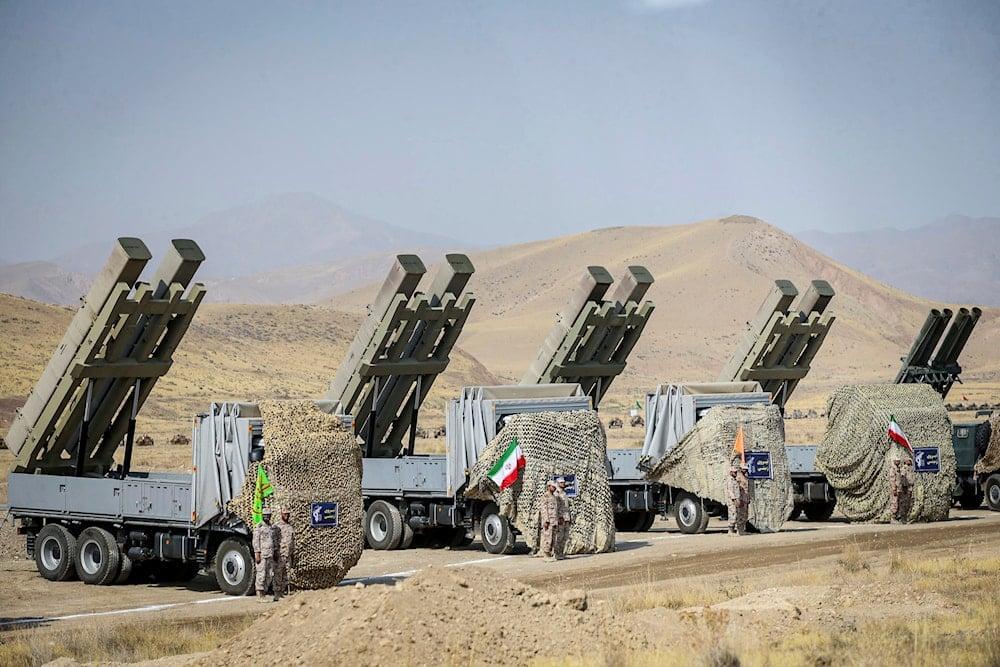
Iran’s Islamic Revolution Guard Corps (IRGC) announced on Saturday that it had targeted a depot housing US unmanned surface vessels (USVs) in Bahrain and struck the country’s main artificial intelligence center, adding that both sites were destroyed during the 17th wave of its “Nasr 2” operation.
According to the IRGC’s Statement No. 25, the operation was launched in response to overnight US strikes that it said targeted several bridges in Iran, killing and injuring civilians.
IRGC strikes on US military and technological assets in Bahrain
The IRGC said its forces struck a US depot storing unmanned surface vessels in Bahrain, revealing that a large number of the vessels were destroyed by fire.
It also announced that multiple ballistic missiles and dozens of drones targeted Bahrain’s main artificial intelligence center, alleging the facility had been used to assist US forces in selecting targets for attacks on Iran. The IRGC said the site was “completely destroyed.”
Iran warns of broader campaign against US-linked infrastructure
In its statement, the IRGC warned that any further US attacks on Iranian bridges or transportation infrastructure would be met by strikes against the “most important industrial, information technology, and artificial intelligence assets” belonging to companies with American shareholders across the region.
The statement added that Tehran would target “the most valuable investments” of US companies in countries hosting American military bases, regardless of their location.
The IRGC also declared that all regional states hosting US military bases are “partners” in US war crimes.
Regional operations expand beyond Bahrain
The latest announcement comes as Iranian military operations have widened across the region amid the continued collapse of the June Memorandum of Understanding and ceasefire.
Earlier on Friday, the IRGC announced that it had targeted the US special operations command at the al-Tanf garrison in southeastern Syria in a surprise operation. The announcement followed reports from the Syrian Observatory for Human Rights citing local sources that an attack had occurred in the al-Tanf area of Homs province, where the US-led coalition maintains a military presence despite announcing a force repositioning last November.
Iran also said its retaliatory operations targeted the AL-Azraq Airbase in Jordan, Al-Udeid Airbase in Qatar, and US military sites in Bahrain and Kuwait. Saudi Arabia was also attacked for the first time.
Iranian Navy reports missile strike on vessel in the Indian Ocean
Separately, the Iranian Army announced that its Navy launched a land-to-sea cruise missile against a vessel belonging to the “aggressor enemy” in the northern Indian Ocean.
According to the military, the strike formed part of the 13th phase of Operation “Sa’eqa” (“Thunderbolt”) and forced the vessel to withdraw after causing panic among its crew.
The announcement comes as US forces have continued concentrated aggression against southern Iran over recent days, prompting Tehran to expand military operations against US military bases, assets, and naval deployments throughout the region.
As the confrontation enters its second week, both sides continue to exchange strikes while diplomatic efforts remain deadlocked, with Washington insisting on negotiations under the pressure of its blockade and Tehran maintaining that talks cannot resume until military operations cease and sanctions are lifted.
Iran issues new warning
Iran’s approach has shifted following renewed US attacks, military adviser Major General Mohsen Rezai said, warning that continued strikes would move the Iranian armed forces beyond deterrence and reciprocal responses.
“The policy of ‘war and negotiations together’ has completely ended,” Rezai warned, adding that Iran’s strategy is now based on “decisive deterrence” and an “eye for an eye” response to missile attacks.
“If the attacks continue during the next two days, the Iranian armed forces will move beyond the stage of deterrence and reciprocity,” he warned. “The armed forces will move to the stage of ‘attack and complete destruction.'”
Strait of Hormuz will not be managed by US
According to the top military official, the Islamabad understanding no longer exists “neither in name nor in practice,” accusing the United States of committing a second violation of the agreement by encouraging ships to cross the Strait of Hormuz illegally and without Iranian oversight.
Iran, he added, would confront the scheme of unlawful navigation in the strategic waterway, saying the closure and control of the Strait of Hormuz serves two objectives: safeguarding national security and protecting the security of the global economy.
Rezai rejected US proposals for joint management of the strait, warning that such an arrangement would amount to Washington controlling a major global energy route.
He further argued that allowing US participation in managing the waterway would give Washington influence over global oil prices and could trigger a wider confrontation with major powers, including China and Russia.
Tehran’s non-negotiables in potential talks
“If negotiations begin, I expect that America wants to write a new understanding with new amendments,” Rezai said.
Rezai also identified two issues he described as non-negotiable in Iran’s confrontation with the United States: Tehran’s legal claims and demand for full compensation over damages, as well as retribution for the killing of the martyred Leader of the Islamic Revolution, Sayyed Ali Khamenei.
Navy approach zero hour
Iran says all US military movements and equipment in regional waters are under the full surveillance of the country’s naval units, warning that American forces are moving closer to the “zero hour” of a potential Iranian operation.
The Islamic Revolution Guards Corps (IRGC) Navy issued the warning in a statement on Friday amid a sharp escalation of tensions in the Persian Gulf between following US acts of aggression on Iranian civilian sites and Iran’s retaliatory operations against the US bases in the region.
“The movements and equipment belonging to the terrorist American army are being closely monitored by Iran’s naval units,” it said, while releasing an image showing US naval vessels under watch.
“The Americans are drawing closer every moment to the zero hour of the Iranian armed forces’ operation against CENTCOM [US Central Command] naval units in the region’s waters,” the IRGC added.
The IRGC Navy did not provide further details about the nature or timing of any potential operation but issued a brief warning directed at US forces, saying: “Wait for it …”
The IRGC statement comes despite repeated claims by the United States that it has completely destroyed Iran’s naval capabilities, infrastructure, vessels and military assets since the outbreak of the US-Israeli military aggression in late February 2026.
Iranian authorities have rejected such claims, emphasizing that their naval forces remain fully operational and continue to monitor and patrol regional waterways, including the Strait of Hormuz.
Tehran has also announced that its military capabilities, including those of the Navy and the IRGC Navy, remain intact despite US attacks.