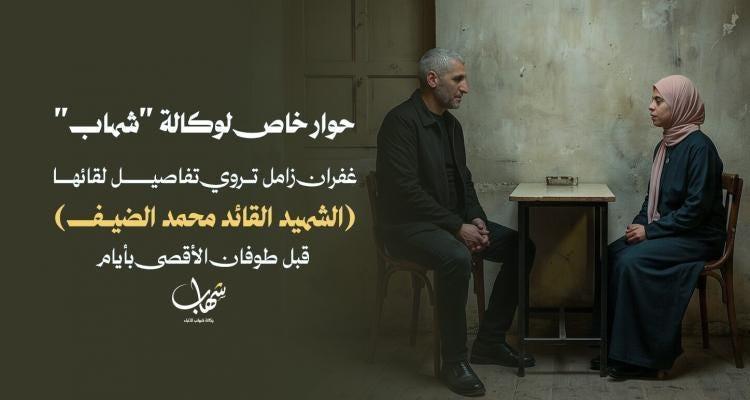
Translator’s note: The following essay recalls an interaction that the prisoner rights activist Ghufran al-Zamel had with Mohammed al-Deif several days prior to the launching of Tufan al-Aqsa. Al-Zamel is a Palestinian former prisoner and well-known figure within resistance circles; she is also the wife of the imprisoned Qassam Brigades commander Hassan Salameh. In 1996, Salameh was arrested in Hebron after being wounded by the occupation forces. Palestinian prisoner organizations note that he had previously spent approximately two years in Israeli prisons before his current imprisonment. In 1997, Salameh was sentenced to 48 life sentences, one of the longest sentences imposed on a Palestinian prisoner. In my 2025 article, “The Prisoners Faction of the Islamic Resistance Movement (Hamas): A Case Study on Awad Sulami, Zaher Jabarin, and Hassan Salameh,”[1] I have detailed his arrayed resistance work and prison literature writings. Notably, Salameh was given the third-highest sentence among prisoners serving life terms, after Abdullah al-Barghouti and Ibrahim Hamid. Salameh was subjected to two solitary confinement terms that cumulatively totaled approximately 14 years. His isolation only ended following a hunger strike that he and his imprisoned comrades spearheaded in 2012. In 2010, he married Ghufran al-Zamel, herself a released prisoner.
—
Al-Zamel has become a prominent public advocate for Palestinian prisoners, frequently conveying Salameh’s letters, speaking to the media, and campaigning on behalf of prisoners held in solitary confinement. She is originally from Nablus in the northern West Bank and, prior to her arrest by the Palestinian Authority, worked for the Gaza-based newspaper, Filastin (فلسطين).[2] In 2009, the Palestinian Authority summoned al-Zamel for questioning several times because of her work at the newspaper. Zionist occupation forces arrested al-Zamel during a pre-dawn raid on her family’s home in al-’Ayn (Ein Beit al-Ma’) refugee camp near Nablus on 29 August 2009.[3] She was taken directly to Petah Tikva interrogation center and interrogated for two full months because of her journalistic work, all the while being denied her legal right to meet with her lawyer.[4] She was then held at Hasharon (Telmond) Prison and, during her imprisonment, she became the Hamas women’s movement representative inside the occupation’s prison system. She also met prominent Palestinian women prisoners, including Ahlam al-Tamimi, whom she credits with helping initiate her correspondence with Hassan Salameh. Apparently Salameh initially refused al-Zamel’s bid for marriage, not wanting her to tie her future to someone serving multiple life sentences; per al-Zamel’s recounting, it was al-Tamimi who persuaded him to reconsider. Al-Zamel was released on Monday, 7 June 2010, after completing her ten-month sentence. In 2018, she completed a master’s degree and subsequently began her doctoral studies, although travel restrictions have complicated her academic work. She is currently based in Gaza.
Muhammad Haniyeh, the author of this piece, is a Palestinian journalist from the Gaza Strip affiliated with the Shehab News Agency.
Al-Deif: Ghufran al-Zamel Tells Shehab About Her Meeting with the ‘Shadow Man’ Days Before the ‘Al-Aqsa Flood’[5]
by Muhammad Haniyeh, translated from Arabic to English by Mujamma Haraket
It was a few days before the “Al-Aqsa Flood” that Ghufran al-Zamel received a call asking her to come to specific location in the Gaza Strip to meet someone who wanted to convene with her. She had only recently arrived in Gaza, the place that Hassan Salameh most ardently yearned for and regarded as a true treasure.
[Ghufran al-Zamel:] “I arrived, and they introduced me to Mohammed al-Deif, known as ‘al-Hajj al-Kabir’ [the Great Pilgrim]. I couldn’t control myself that day. I couldn’t hold back my tears, and I cried in front of him for half an hour.”
Deif had been Hassan Salameh’s comrade and the last person to bid him farewell before Salameh honored the path of the fallen martyr Yahya Ayash, trekking to the West Bank to spearhead the “Sacred Revenge Operations.”
“It’s the very same voice!”
Ghufran recounted to the Shehab News Agency the details of her meeting with the martyred commander Mohammed al-Deif, chief of staff of the Martyr Izz al-Din al-Qassam Brigades, about two weeks before the launch of the al-Aqsa Flood. “I couldn’t believe I was seeing him, nor did I even believe he was alive.” To dispel her doubts, the first thing she asked him was, “Speak.” She wanted to hear his voice. Indeed, it was the very same voice that we have all heard in those rare recordings that have occasionally been broadcast in the media.
“I responded to him, ‘Oh, it’s the same voice we have heard—so it’s not dubbed or sound effects.’” Al-Deif was surprised by Ghufran’s reaction. She then frankly responded to him, “Don’t be so surprised. You don’t know what Muhammad al-Deif means to us. We thought you were dead, and that Hamas had kept your name and your shadow alive to live on as a legend. We, too, live on through your voice and your long shadow.”
The first few minutes of the exchange passed as she closely watched his movements and listened to him speak. He tried to break the ice with her, joking about her husband and his companion on his path of resistance, Hassan Salameh. Ghufran recounted him [to Shehab] as “precisely the person ‘Israel’ would fear; you couldn’t find anyone in the world with such humility, humanity, honesty, kindness, and spontaneity—all of which were evident in his words and conversation.” Ghufran sighed and then said, “Such a person is impossible to replicate.”
An Iron Memory
Al-Deif’s memories with Hassan Salameh from the days of the First Intifada dominated the beginning of their meeting. He redolently recalled the West Bank, which he had visited at the time.
“He remembers the names of the villages, cities, and the streets of every city. I was stunned by the accuracy of his descriptions and his memory. This al-Deif, who is always so busy and has gone through so many horrors, remembers every detail of the places he has visited,” said Ghufran al-Zamel. She added, “He told me about Hassan, how they lived together, the operations they carried out together, and their memories of when the ‘Israeli’ army patrols chased them throughout Khan Yunis. He spoke about his unflagging love for Hassan and how deeply he misses him.”
Al-Deif continued to keep abreast of even the most minor details in Hassan Salameh’s life. Al-Deif told al-Zamel: “I was so happy when I learned about your engagement from inside prison. I follow his news and the details of his life, and I know how much this engagement changed Hassan. I also follow your travel and how far you’ve gotten with the house.”
Yes, this was the very same al-Deif, preoccupied with the Qassam Brigades and his cause, who, despite it all, was also attentive to the details of his comrades. He still remembered Hassan, “the persistent one,” and conveyed that all the years in prison could not have changed him. Al-Deif then detailed his various experiences with Hassan, including how Hassan insisted on that fateful day [in planning the “Sacred Revenge Operations”] that he wanted to undertake a martyrdom operation to avenge the blood of Yahya Ayash. Al-Deif did not grant him permission.
Al-Deif Confronts Soldiers Face-to-Face
As for his memories of being pursued in Khan Younis alongside Hassan, al-Deif recalled them as if they were unfolding right before him. He detailed how, on one occasion, the occupation jeeps tailed them, and they fled to a house. The soldiers then raided the house, but Hassan managed to escape through a back door, while Abu Khalid [al-Deif] remained inside. When the soldiers entered, they asked him about the protesters who had thrown stones at them. Al-Deif pointed them in a different direction, and they never realized it had been al-Deif who they had been looking for. Al-Deif then recounted another incident. One day, an ‘Israeli’ jeep had chased him and his companion Hassan, so they took a car that was parked on the road and escaped in it, before later returning it to its rightful owner.
Tracing the Finest Details
Hassan was the focus of the conversation, and, smiling as he did so, al-Deif recounted memories that took him back to the moments he was narrating, as if they had transpired only yesterday. Al-Deif raised his eyebrows as he described how he received the news of Hassan’s engagement from inside prison. “He’s crazy, he’ll do anything,” al-Deif said with a beam. Ghufran conveyed that he was surprised that Hassan had made such a decision despite his life sentence, noting that al-Deif had added, “That day I said, ‘Ghufran came into Hassan’s life at just the right time, as God had prepared you for one another.’”
She continued, observing how “Al-Deif followed all of Hassan’s news from inside prison. Every letter Hassan wrote reached him, as did everything Hassan published in the media. He knew Hassan wouldn’t be satisfied with any of our answers to the questions he asked about, including the various deals and the cause of liberation. Indeed, he was ‘the persistent one,’ always trying to learn every detail of what was going on.”
“I was happy when I learned about your decision to buy land and build a house on it in Gaza,” al-Deif remarked to Ghufran. He then told her about one of the most painful moments of his life, when he read Hassan’s book about his isolation and solitary confinement. “I was pained by every word Hassan wrote and lived,” al-Deif replied.
He continued, speaking of how much he missed Hassan and of his hope of seeing him free. As Ghufran broke down in tears, al-Deif tried to comfort her, saying “I’m sure he would have called you a thousand times by now, and in a little while he’d be calling everyone in Gaza looking for you.” He said this to Ghufran after they had spent hours together, making the joke even though he knew Hassan had no access to a phone.[6]
Ghufran asked al-Deif for a photograph with Hassan, and he obliged out of affection for him. “I asked al-Deif for a photograph with him, and he obliged out of love for Hassan. Although I was not able to keep the photograph, I had the honor that day of meeting al-Deif and taking a photograph in which he wished Hassan could have been with us,” she reflected.
The Mission that Shocked al-Deif
She continued, “At the end of the meeting, I asked him, ‘When will the time come for people to see Muhammad al-Deif? When will he reveal his face?’ The question seemed to take him by surprise. After a moment of reflection, he said, ‘On the day there is reason for it, everyone will know me.’ Then he asked, ‘How important is it for people to see my face?’, expressing his surprise that people held him in such extraordinary light. At that moment, I responded to al-Deif’s astonishment by saying, ‘On the Day of Liberation, and on the day you lead us in prayer at al-Aqsa, God willing, and the whole world will see you.’ Al-Deif smiled and fell silent.”
All of Gaza is Waiting for Him
Al-Deif entrusted Ghufran with a message for his companion in resistance: “Give him my regards and tell him that all of Gaza is waiting for him.” He then ended with one final request, pleading that she not tell Hassan about the meeting until a few days had passed. He knew she would not keep such a great secret from him, and he knew that his friend, “the persistent one,” would keep asking about her long absence and why she had not been using her phone.
[1] Mujamma Haraket “The Prisoners Faction of the Islamic Resistance Movement (Hamas): A Case Study on Awad Sulami, Zaher Jabarin, and Hassan Salameh,” Substack, 25 November 2025; retrieved online (16 July 2026): https://mujammaharaket.substack.com/p/understanding-social-reproduction.
[2] “‘I Waited 16 Years for Him and Never Saw Him in My Life’: The Wife of al-Qassam Prisoner Hassan Salama Reveals the Details of Their Marriage,” Al Jazeera Mubasher, 4 March 2025; retrieved online (16 July 2026): https://shorturl.at/ZlyzR. “IOF Soldiers Arrest Seven Palestinians Including Young Woman,” Palestinian Information Center (PIC), 29 August 2009; retrieved online (16 July 2026): https://english.palinfo.com/o_post/IOF-soldiers-arrest-7-Palestinians-including-young-woman/. “Friends of Humanity Demands Israel to Release Ghoul and Zamil from Its Jails,” Palestinian Information Center (PIC), 7 September 2009; retrieved online (16 July 2026): https://english.palinfo.com/o_post/Friends-of-humanity-demands-Israel-to-release-Ghoul-and-Zamil-from-its-jails/.
[3] “The Story of the Fiancés Ghufran and the Prisoner Hassan: Two Decades of Waiting,” Al Jazeera Arabic, 27 August 2025; retrieved online (16 July 2026): https://shorturl.at/NOl2Y. “Ghufran Ghalyan Saad Zamel,” Not Numbers: Palestinian Women Political Prisoners, Palestinian Women’s Committee / Women of Palestine; retrieved online (16 July 2026): https://womenfpal.com/uploads/documents/2022/november/aseerat-en.pdf
[4] “Wedding on Hold: Palestine, Politics and Prison,” Al Jazeera World, 1 May 2019; retrieved online (16 July 2026): https://www.aljazeera.com/program/al-jazeera-world/2019/5/1/wedding-on-hold-palestine-politics-and-prison/.
[5] Originally published as: “When I Met Mohammed al-Deif: Ghufran Zamel Tells Shehab About Her Encounter with the ‘Shadow Man’ Days Before al-Aqsa Flood,” Shehab News Agency, 16 July 2026; retrieved online (16 July 2026): https://shorturl.at/LLZJ8.
[6] Translator’s note: The phone is here is the nexus of joke that is reintroduced in the conclusion, where both parties recognize that Hassan Salameh has no means of accessing said phone, but it figures as a lighthearted motif nevertheless. The phone figures as the centerpiece in the exchange between al-Deif and Ghufran Al-Zamel but the context does not neatly translate into English.
Mujamma Haraket
source: Substack