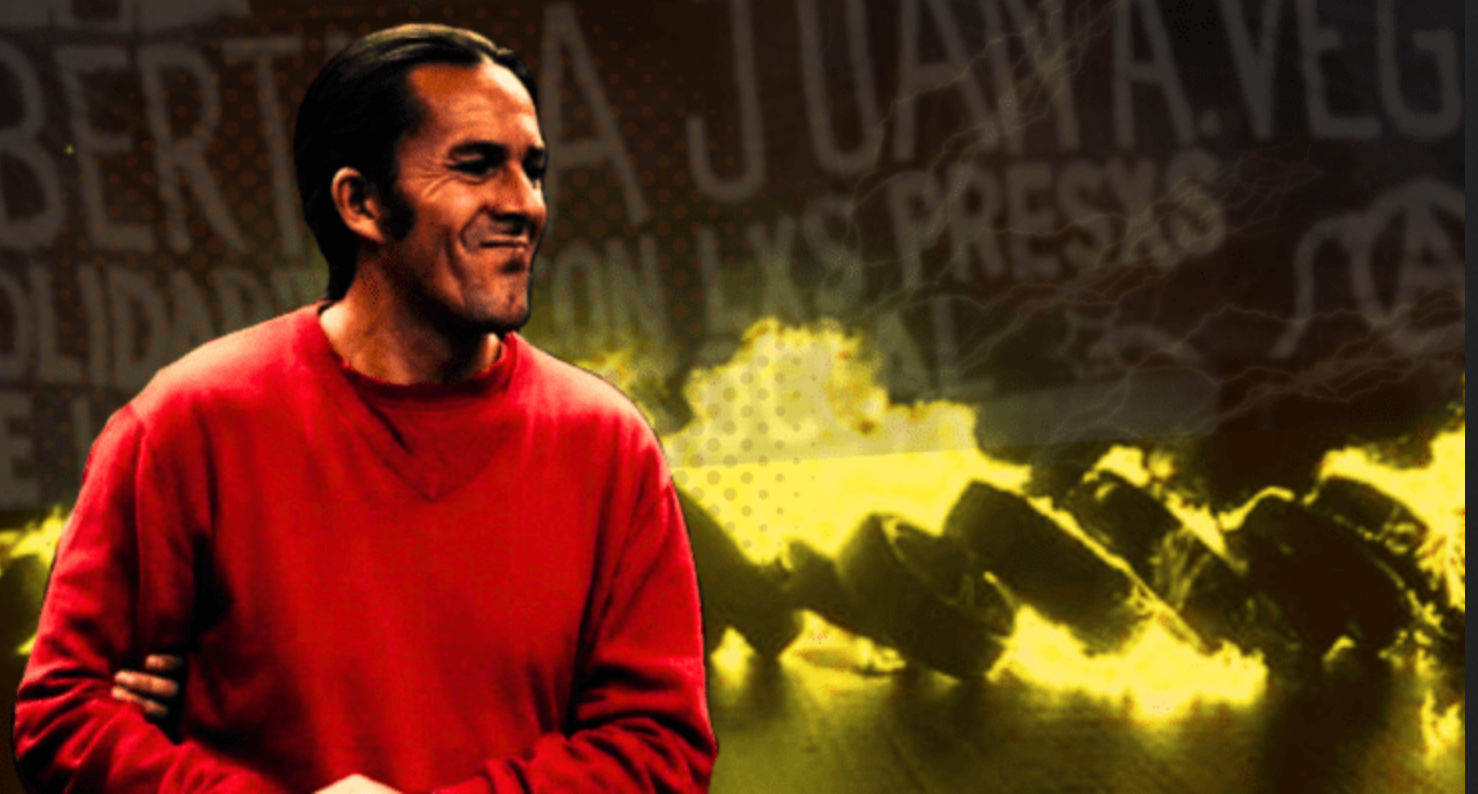
It was around February of this year that our brother and comrade Juan Aliste Vega began to experience the first episodes of pain—mild at first—in his left hip. True to his character, he lived with this minor discomfort, but he never normalized it; he knew it was an abnormal pain.
As time passed and the pain intensified, the unusual situation transformed into a worrisome one, so naturally, he sought medical attention at the La Gonzalina prison hospital in Rancagua. Without much success in this initial visit, he was given and prescribed medications such as paracetamol and tramadol. Juan was not satisfied; the pain persisted, the root cause remained unclear, and his daily life was significantly disrupted because the pain naturally led to serious mobility issues. We witnessed his concern and persistence during this period. Juan has never been a complainer, and his unfortunately long time in prison has given him a deep understanding of his body, crucial for remaining resilient in a hostile and uncaring environment.
The day came when Juan could no longer move and had to be rushed to the prison hospital. After a series of negligent acts, X-rays, and unhelpful doctors, he was sent back to his cellblock with painkillers and IV fluids. Something was wrong; we all knew it. A second emergency trip to the hospital that same afternoon was necessary, and a new X-ray analysis revealed possible septic osteoarthritis in his hip. Due to the urgency of his condition, he was transferred to the Rancagua Hospital, where he received strong antibiotics. That same night, he returned to his cellblock.
From that moment on, Juan could only move with crutches. His daily life was severely disrupted. The antibiotics only solved part of the problem; the pain persisted, something was still there. Despite how adverse the situation became in his daily life, we were fortunate enough to be able to support him and thus try to lessen, even if only a little, the burden on his shoulders. These were, and are, the kinds of care and concern we believe should always be shared among comrades, beyond any code of conduct imposed by the prison environment. Revolutionary affection must always prevail over individualistic apathy.
The culmination of this critical situation, which initially led to his hospitalization in the unit, was due to a pain that was more intense than “normal” and once again left him unable to move. Only then did the hospital administration decide to admit him for further evaluation.
We haven’t seen him since that day.
Despite the pain and the complexity of his situation, our comrade has always remained strong and determined to face everything that has been thrown at him. This attitude has always characterized him, ever since, as a teenager, he decided to confront the dictatorship as part of the Lautaro Youth Movement and later, as an independent subversive, relentlessly fighting predatory capitalism and those who uphold it. He has also demonstrated this strength during the nearly 30 years he has spent in prison for two different reasons and in different contexts. During these years, he has not hesitated to participate in various anti-prison movements, mobilizations, and strikes, writing solidarity texts, advocating for the freedom of another comrade, contributing to the groups fighting in the streets, fighting for the dignity of those who visit us, and battling in every corner of this space of confrontation, making it a symbol of the anti-prison struggle.
For more than two months, Juan has been hospitalized at the Penitentiary Hospital of the former Santiago Penitentiary, where he has access to better care, palliative treatments, and, above all, greater closeness and contact with fellow inmates and family.
His condition is extremely serious: multiple diagnoses have revealed a cancerous tumor in his left hip with metastases in various parts of his body.
Aware of the severity of his condition, Juan, as expected, is determined to fight. His messages are of resistance and strength, of struggle and dignity. And we hope that the outpouring of solidarity on the streets will reflect this same sentiment. Because it is essential to connect the world from the outside and from prison. Because it is necessary to live up to Juan Aliste’s legacy and act accordingly.
Francisco Solar Domínguez
Joaquín García Chancks
La Gonzalina Prison – Rancagua
July 2026