I. The geopolitics of barbarism in prehistory
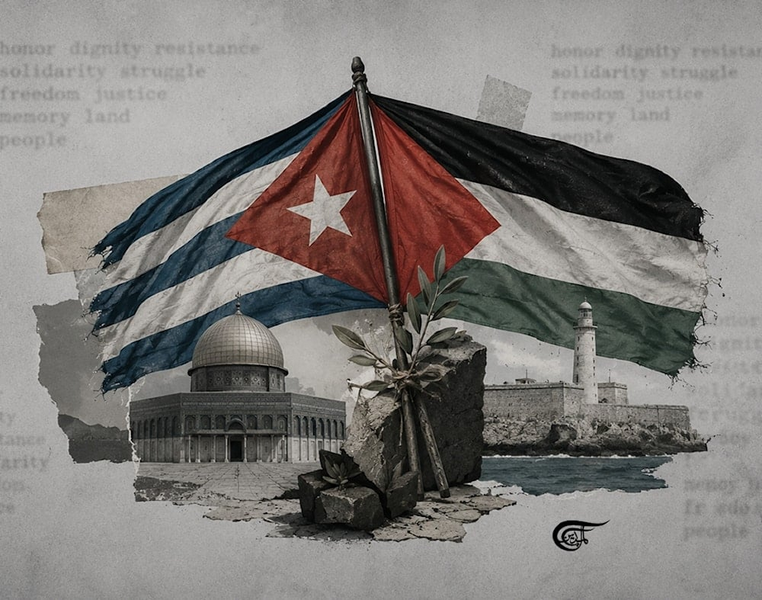
There are gestures in history that transcend diplomatic anecdote to inscribe themselves in the epic of peoples. One of them, perhaps among the most eloquent, occurred in September 2014, when hundreds of Palestinians marched through the streets of Gaza waving photographs of Fidel Castro alongside those of Hugo Chávez and Nicolás Maduro. It was not an act of foreign propaganda; it was popular recognition of a solidarity that knew no borders or geopolitical calculations. In that moment, the Gaza Strip and the Island of Cuba met on a plane beyond geography, in the realm of shared history: the history of peoples who have been dispossessed, besieged, and attacked, and who nevertheless resist.
Fidel Castro, a keen reader of the work of Karl Marx, used to recall that humanity, despite its technological advances, has not yet emerged from prehistory. For Marx, the true history of humanity would begin with the end of the exploitation of man by man; before that, everything is prehistory, a long and bloody prologue of barbarism, wars, and dispossession. Fidel assumed this category and made it his own, applying it to nuclear dangers, resurgent fascism, and above all, to the suffering of oppressed peoples. In 2010 he wrote: “We are living an exceptional moment in human history… which Karl Marx brilliantly described as prehistory”.
The identification between Cuba and Palestine is not recent, nor a concession to the political correctness of the international left. It is a founding principle of the Cuban Revolution, an ethic of solidarity that Fidel Castro elevated to the category of doctrine and that his successors have maintained as an immovable pillar of the island’s foreign policy. As President Miguel Díaz-Canel has reiterated, it is an “immovable stance of the Revolution, driven by its leader Fidel.”
The title of this article is not rhetorical. It proposes that as long as there are peoples subjected to genocide, as long as the international community looks with indifference upon the annihilation of an entire population, as long as international law is violated with impunity with the backing of hegemonic powers, humanity will not have emerged from its prehistory. It will not have reached that stage of civilization in which life, dignity, and justice are truly protected as universal values. Cuba’s solidarity with Gaza is, in this framework, a conscious attempt to accelerate the transition from prehistory to history.
II. Historical parallelism forged in the crucible of anti-imperialism
To understand the root of Cuban solidarity with Palestine, it is necessary to go back to the very origins of the Cuban Revolution and the worldview that inspired it. Since the triumph of 1959, Cuba conceived of itself not as an isolated island, but as a link in a global chain of anti-colonial and anti-imperialist struggles. The experience of US domination, the Platt Amendment, military occupation, foreign economic and political control, forged in the revolutionary leadership a particular sensitivity toward other peoples suffering analogous forms of oppression.
Fidel Castro traced this parallelism explicitly and recurrently. He saw in the struggle of the Arab world against imperialism the same character as Cuba’s struggle against US hegemony: both were national liberation wars against an oppressive power. This vision was not a mere formal exercise; it was the basis of a foreign policy that placed internationalist solidarity at the center of its action.
Cuba’s stance on the Palestinian question has roots even before the triumph of the Revolution. In November 1947, when the United Nations General Assembly debated the Partition Plan for Palestine that would give rise to the “State of ”, Cuba was one of the thirteen countries that voted against it. The prestigious doctor Ernesto Dihigo, the Cuban representative, argued then that the Balfour Declaration “completely lacks legal value, since the British Government offered in it something it had no right to dispose of, because it was not its own.” That position, which denounced the violation of international law and the dispossession of a people, anticipated by more than a decade the line that the Cuban Revolution would make its own.
Once the Revolution was in power, Fidel articulated this vision with crystalline clarity in his speech before the UN General Assembly on October 12, 1979, in his capacity as president of Cuba and of the Non-Aligned Movement. There, he declared: “For the Non-Aligned Countries, the question of Palestine is the core of the Middle East problem. Both form an integral whole, which cannot be solved separately.” And he added: “The basis of a just peace in the region begins with the total and unconditional withdrawal of Israel from all occupied Arab territories, and entails for the Palestinian people, the return of all their occupied territories and the recovery of their inalienable national rights, including the right of return to their homeland, to self-determination and to the establishment of an independent State in Palestine.”
It was not an opportunistic stance or a tactical calculation. As Fidel himself declared, revolutionaries “give themselves totally to a cause, to their ideas, to their noble objectives, without expecting anything in return.” The Palestinian cause was, from the beginning of the triumphant Revolution, “a cause of Fidel and of Cuba.” It was not a geopolitical calculation, but an ethical conviction that saw in the struggle of the Palestinian people the same justice that animated the struggle of the Cuban people.
III. Genocide, fascism, and prehistory
Fidel Castro was one of the first world leaders to describe the situation in Gaza and the occupied territories as “genocide.” His intervention before the UN General Assembly in 1979 was not only a historic moment for its content, but also for its audacity and clarity. In a context in which the Nazi Holocaust was still an open wound in humanity’s conscience, Castro drew a comparison that, for many, was disturbing:
“We repudiate with all our strength the ruthless persecution and genocide that Nazism unleashed in its time against the Hebrew people. But I cannot recall anything more similar in our contemporary history than the eviction, persecution, and genocide that imperialism and Zionism are today carrying out against the Palestinian people.”
Fidel described the Palestinians as a people “stripped of their lands, expelled from their own homeland, scattered throughout the world, persecuted, and murdered,” and elevated them as “the living symbol of the greatest crime of our era.” This declaration, which resonated forcefully in the halls of the UN, was received with indignation by the Israeli delegation, which considered it a grave violation of all accepted norms of conduct and an obscene comparison. Time has proven the Cuban leader right: what for some then seemed a rhetorical hyperbole is today an almost literal description of the reality Gaza lives.
The figures of horror speak for themselves. Since October 7, 2023, the genocide in Gaza has left more than 73,000 Palestinians dead, mostly women and children, and more than 174,000 wounded. More than 21,500 children have lost their lives due to Israeli attacks. The destruction is almost total: around 90 percent of Gaza’s civilian infrastructure has been razed, and the United Nations estimates that reconstruction will cost around 70 billion dollars. Dispossession, siege, and famine have become the daily reality of a population trapped between the sea and military might.
But Fidel did not limit himself to moral denunciation. He precisely identified the geopolitical mechanisms that perpetuated the conflict, pointing to the United States as the main obstacle to a just and lasting peace. He asked rhetorically: “Can anyone be surprised that the Conference of the Non-Aligned Movement was forced, for reasons that arise not from any political prejudice but from the objective analysis of the facts, to point out that U.S. policy plays a fundamental role in preventing the establishment of a just and complete peace in the region, by aligning itself with Israel, supporting it, and working to obtain partial solutions favourable to Zionist objectives?”
This denunciation was not an isolated event. Over the years, Fidel maintained constant vigilance over the Palestinian situation. At the World Conference against Racism in Durban, South Africa, in 2001, I personally was able to hear his energetic denunciation of how the genocide of the Palestinian people was taking place “before the astonished eyes of the world.” In 2014, already retired, he wrote a column in the newspaper Granma entitled “Palestinian Holocaust in Gaza,” where he condemned the “macabre genocide” and warned that “a new and repugnant form of fascism is emerging with notable force.” In that text, he asked: “Why does the government of that country believe the world will be insensitive to this macabre genocide committed today against the Palestinian people?”
Here the concept of prehistory acquires its crudest dimension. For Fidel, fascism, genocide, and war are not anomalies or isolated excesses; they are the natural expression of a humanity that has not yet overcome the logics of exploitation and domination. In 2010, reflecting on the dangers threatening the species, he wrote that we live “in prehistory” and that the challenge is to “leave it behind.” And in 2015, in one of his last public reflections, he explicitly linked the fight against fascism, which for him had a contemporary face in Zionist aggression, with the need for humanity to abandon that stage of barbarism: “The 27 million Soviets who died in the Great Patriotic War, he wrote, did not do so for socialism alone, but for the right to emerge from prehistory.”
From this perspective, the genocide in Gaza is not just another regional conflict; it is a symptom that humanity remains anchored in prehistory. It is living proof that civilization, understood as respect for life and human dignity, remains an unfulfilled promise. And Cuba’s solidarity with Palestine is not a sentimental gesture, but a practical contribution to that task: pushing the human species out of its prehistory.
IV. Active and tangible solidarity
Fidel Castro’s and Cuba’s solidarity with the Palestinian cause was not purely rhetorical. It translated into concrete and sustained actions over time, ranging from diplomatic recognition to professional training and the reception of refugees. This practical dimension distinguishes Cuban solidarity from mere declaration of principles.
Diplomatic recognition, rupture with ‘Israel’, and relations with the PLO
Cuba was one of the first countries to recognize the Palestine Liberation Organization (PLO) when it was founded in 1964. In September 1973, during the Non-Aligned Summit in Algiers, Fidel Castro announced the unilateral rupture of diplomatic relations with Israel. The following month, the Yom Kippur War broke out, and Cuba sent military advisors to Syria. The decision to break with “Israel”, which made Cuba one of the first countries to take that measure, consolidated its alignment with the Palestinian cause and placed it on the side of the Arab countries in the Middle East conflict.
The relationship with the PLO was consolidated in November 1974, when Yasser Arafat visited Cuba for the first time. He was received at José Martí Airport with full honours of a head of state, even though Palestine was not yet officially recognized as a state. Arafat was decorated with the National Order of Playa Girón, one of Cuba’s highest distinctions, reserved for those who have “excelled in the struggle against imperialism, colonialism, and neocolonialism.”
That visit consolidated the official Palestinian relationship with Cuba and led to the opening of the first PLO office in Havana. Cuba raised the status of this representation to embassy level on June 12, 1982. Subsequently, on November 16, 1988, one day after the official proclamation of the State of Palestine, Cuba immediately recognized it. Arafat visited the island on eight occasions, personally invited by Castro. In one of his letters to the Commander-in-Chief, Arafat expressed: “It was with deep emotion that we saw yesterday in the international news agencies the image of Your Excellency with the Palestinian flag on his shoulders, leading a popular demonstration of solidarity with the struggle of our heroic people.”
Training of cadres and educational scholarships
One of the most significant forms of solidarity was the training of Palestinian cadres in Cuba. The island trained members of the PLO and granted thousands of scholarships to young Palestinians to pursue higher education on the island. This educational cooperation dates back to 1982, when, learning that thousands of Palestinian children had been orphaned in another war initiated by “Israel”, Fidel Castro communicated to Arafat the decision to receive 500 of them to study in Cuba.
This tradition of solidarity has continued to this day. In September 2024, the Cuban government offered 200 scholarships for young Palestinians to complete undergraduate and postgraduate studies on the island over the next five years. Currently, around 240 Palestinians are studying Medicine in Cuba. Recently, the University of Medical Sciences of Havana graduated 53 Palestinian doctors, along with other professionals from 73 nationalities. President Miguel Díaz-Canel has met with these young people, reaffirming the island’s commitment to their training.
The Latin American School of Medicine (ELAM), founded by Fidel Castro, has been a key instrument of this solidarity. There, doctors from all over the world have been trained, including numerous Palestinians, who have returned to their land to care for their compatriots, victims of repression and siege. As demonstrated by the trajectory of students like Jenen Alzwarah, a young Palestinian woman who managed to leave Gaza thanks to a scholarship to study Medicine in Cuba, these opportunities represent not only professional training but a lifeline in the midst of tragedy.
Solidarity without counterpart
For Fidel Castro, support for the Palestinian cause was not a tactical concession or an act of propaganda, but a fundamental principle of the Cuban Revolution. This principle was based on the conviction that revolutionaries must support just causes without expecting anything material in return. Castro formulated this idea clearly when referring to Cuban support for Angola, but the principle was applicable to all liberation struggles, including the Palestinian one.
This ethic of solidarity constitutes a pillar of Cuban foreign policy. Following the escalation of the conflict in Gaza in October 2023, the Cuban government reaffirmed its “immovable stance of the Revolution, driven by its leader Fidel.” President Miguel Díaz-Canel has repeatedly recalled Fidel’s words on Palestine, underlining their validity in the face of the “massacre committed by the Zionist army in Gaza.” On Palestinian Land Day, Díaz-Canel cited the leader of the Cuban Revolution: “Never has the Palestinian cause seemed more just than in contrast to the repulsive brutality of its adversaries.”
This stance has not varied with the passage of time or with the change in Cuban leadership. It is part of a legacy that transcends Fidel Castro and has become a constitutive element of Cuban revolutionary identity. Solidarity with Palestine is inscribed in a broader narrative of struggle against imperialism and oppression, a narrative that places Cuba on the side of the “wretched of the earth” and, therefore, on the side of those who fight to pull humanity out of its prehistory.
V. Gaza in the Cuban imagination: A mirror of one’s own history
Cuba’s identification with Gaza is not merely political or ideological; it also has a deeply human and affective dimension. Cubans, who have experienced economic blockade and aggression from a neighbouring superpower, see in the Gaza Strip a mirror of their own history. They see a heroic people besieged, beleaguered, and subjected to brutal violence, who nevertheless resist with dignity.
Today, that mirror has become clearer and more painful than ever. In January 2026, President Donald Trump signed an executive order declaring a “national emergency” and designating Cuba as an “unusual and extraordinary threat” to the national security of the United States. On that basis, he established an unprecedented oil stranglehold on the island. The measure, which threatens to impose tariffs on any country that trades oil with Cuba, has had devastating consequences. On May 1, 2026, a new executive order introduced secondary sanctions in the energy sector, deepening the stranglehold. In seven months, barely one tanker docked in Cuban ports, and authorities have confirmed that there is “absolutely nothing” left of diesel and fuel oil on the island. Public transportation is paralyzed, food trucks stop circulating, harvests are lost in the fields, hospitals and water plants are left without power, and the population enters a cycle of blackouts that already exceed 20 hours daily in many localities.
In this year marking the centenary of Fidel Castro’s birth (1926-2026), the relevance of his thought and his denunciation becomes more evident than ever. President Miguel Díaz-Canel has denounced that the United States is “suffocating” the island with the “genocidal energy blockade,” and has pointed to the flagrant contradiction of those who, like Secretary of State Marco Rubio, deny the existence of the blockade while ignoring the executive orders signed by his own president and successive secondary “sanctions.” “It is surprising that a senior official of the US Government publicly declares that his Government does not apply an energy blockade against Cuba, that he does not know what is stipulated in the executive order of his own president”, Díaz-Canel stated. Foreign Minister Bruno Rodríguez has continued to elaborate: “He has chosen to lie. He contradicts the president and the White House spokesperson,” and recalled that Rubio knows very well the damage caused to the Cuban people by the oil stranglehold that he himself proposed to his president.
The offensive does not stop at the energy blockade. On July 20, 2026, the State Department published a one-hundred-page report titled “Cuba: The Capital of 21st Century Communism,” which accuses Havana of being the world center of the extreme left, espionage, and decades of influence in Latin America and the United States. Marco Rubio, the Secretary of State, has declared that Cuba is a “threat to national security” of his country and has announced that the Trump administration is waging an “unprecedented economic war” against the island. In an interview with Axios, Rubio warned that there will be no “escape valves” for Cuba: “Every time they create a new mechanism to try to evade the stranglehold, we simply block it.” And his most explicit threat, one that echoes the worst times of the Cold War: “They cannot expect us to leave.” “Without a doubt, this situation is not going to disappear in the next two and a half years,” he stated, and predicted that, when this administration ends, Cuba will be “on an irreversible trajectory toward a different future.”
In other words, Marco Rubio has promised to pursue Cuba to the end. This is not a metaphor. It is the explicit confession of a purpose: total asphyxiation, relentless persecution, the denial of the right to exist of a people that has dared to defy the empire. This is the “new and repugnant form of fascism” that Fidel Castro warned about in 2014, now applied with all its crudeness against the island.
The international community has begun to raise its voice against this escalation. People have also expressed their solidarity: in different latitudes, social organizations, political movements, and ordinary citizens have condemned the stranglehold on Cuba and demanded an end to sanctions, establishing a bridge of brotherhood with the Cuban people who resist. On August 6, 2026, United Nations human rights experts condemned the US measures against Cuba and urged the international community to act quickly to prevent the island from becoming a “silent Gaza.”
“The humanitarian consequences are already becoming a full-blown crisis that threatens the rights to health, life, food, and development,” they denounced. The special rapporteurs, including George Katrougalos and Zaina Jallad, warned that “food must never be used as an instrument of political pressure” and that “measures that deliberately deprive a population of the means to survive violate the most basic guarantees of the right to life.” The Security Council and the General Assembly themselves should address these threats as a matter of international peace and security, the experts added.
This identification between the suffering of Gaza and that of Cuba, which UN experts have made explicit by coining the term “silent Gaza”, has also manifested itself in gestures of popular solidarity. In Cuba, various mass organizations, institutions, and students have continuously expressed their solidarity with the Palestinian people and demanded an end to Israeli aggression.
Fidel Castro, in his reflections on Gaza, described the enclave as a place where almost two million human beings live “between the desert, the sea, and the military might of a Middle Eastern country”. This image of a people trapped between hostile geography and military power resonated with Cuba’s own experience of living in the shadow of an imperial giant. Today, that resonance is deeper than ever: Cuba is also a besieged people, assailed by an energy blockade that seeks its suffocation, and threatened by an official who has made the persecution of the island his personal mission.
VI. Emerging from prehistory: The great challenge of peoples
Fidel Castro inscribed the Palestinian cause in the same narrative of struggle against imperialism and oppression as the Cuban Revolution, creating an ethical and historical bond that transcends geography. This bond is not exhausted in rhetorical denunciation, but is materialized in concrete actions of solidarity that have endured for more than six decades.
When Fidel spoke of prehistory, he was not referring to a distant past; he was referring to the present itself. In his reflections of 2015, commemorating the centenary of Lenin, he affirmed that the work of Marx and Lenin would mark “the passage from prehistory to the history of humanity.” Also that year, warning of the nuclear danger, he stated that an atomic war would be “the last of the prehistory of our species.” In another of his speeches to students, he said, with his characteristic irony, that it is the United States that “must transit from prehistory to history and from empire to the trash heap.”
What does all this mean applied to Gaza and Cuba? It means that the genocide in Gaza and the energy stranglehold on Cuba are not accidents, nor isolated conflicts, nor even tragedies among the many that populate history. They are palpable proof that humanity remains trapped in prehistory: the era of dispossession, of war, of contempt for the life of the other. The indifference of the international community, the complicit silence of Western powers, the impunity with which international law is violated: all of these are features of that prehistory that, as Castro said, must be overcome. And when an official like Marco Rubio promises to pursue Cuba “to the end,” when he denies the existence of a blockade that he himself has designed while the Cuban people suffer blackouts of 20 hours a day and shortages of food and medicine, what he is doing is writing, in capital letters, the word PREHISTORY in the present of our nation. And when UN experts warn that Cuba is becoming a “silent Gaza,” they are confirming that the suffering of both peoples is one wound in the body of humanity.
Cuba’s solidarity with Gaza is not, therefore, only an altruistic gesture or a minor political position. It is an act of historical resistance. It is the refusal to accept that prehistory is humanity’s eternal destiny. Every young Palestinian studying medicine in Havana, every Palestinian doctor graduated in Cuba who treats the victims in Gaza, every official condemnation of genocide at the UN, every solidarity march in the streets of the island: all these gestures are small contributions to the titanic task of pushing the human species out of its prehistory. So too is the daily resistance of the Cuban people under siege: the inventiveness to survive without fuel, the neighborly solidarity in the face of blackouts, the dignity of not yielding to the threats of an empire that has declared war on us.
Fidel Castro’s legacy in this area is a reminder that history is not an inexorable destiny, but a battlefield where the forces of oppression and liberation are contested. It is a call to not resign oneself, to not be indifferent, to build bridges of solidarity where the walls of hatred and dispossession seek to rise. As Fidel said, and as Díaz-Canel repeats today, “Never has the Palestinian cause seemed more just than in contrast to the repulsive brutality of its adversaries”.
Let the philosophy of dispossession cease, and the philosophy of war will cease. That maxim, pronounced by Castro in 1960 and recovered by his successors in our days, remains the ethical compass that guides Cuban solidarity. And as long as it is not fulfilled, as long as Gaza continues to be razed, as long as Cuba is suffocated by an energy blockade and pursued through the use of perverse tools for its destruction, as long as impunity persists, humanity will continue to inhabit its prehistory. But, as Fidel taught, history is not written; it is built every day with the active solidarity of peoples. And that is Cuba’s final bet: to contribute, from its geographical smallness and its ethical greatness, to humanity finally emerging from prehistory and entering history.
source: Al Mayadeen