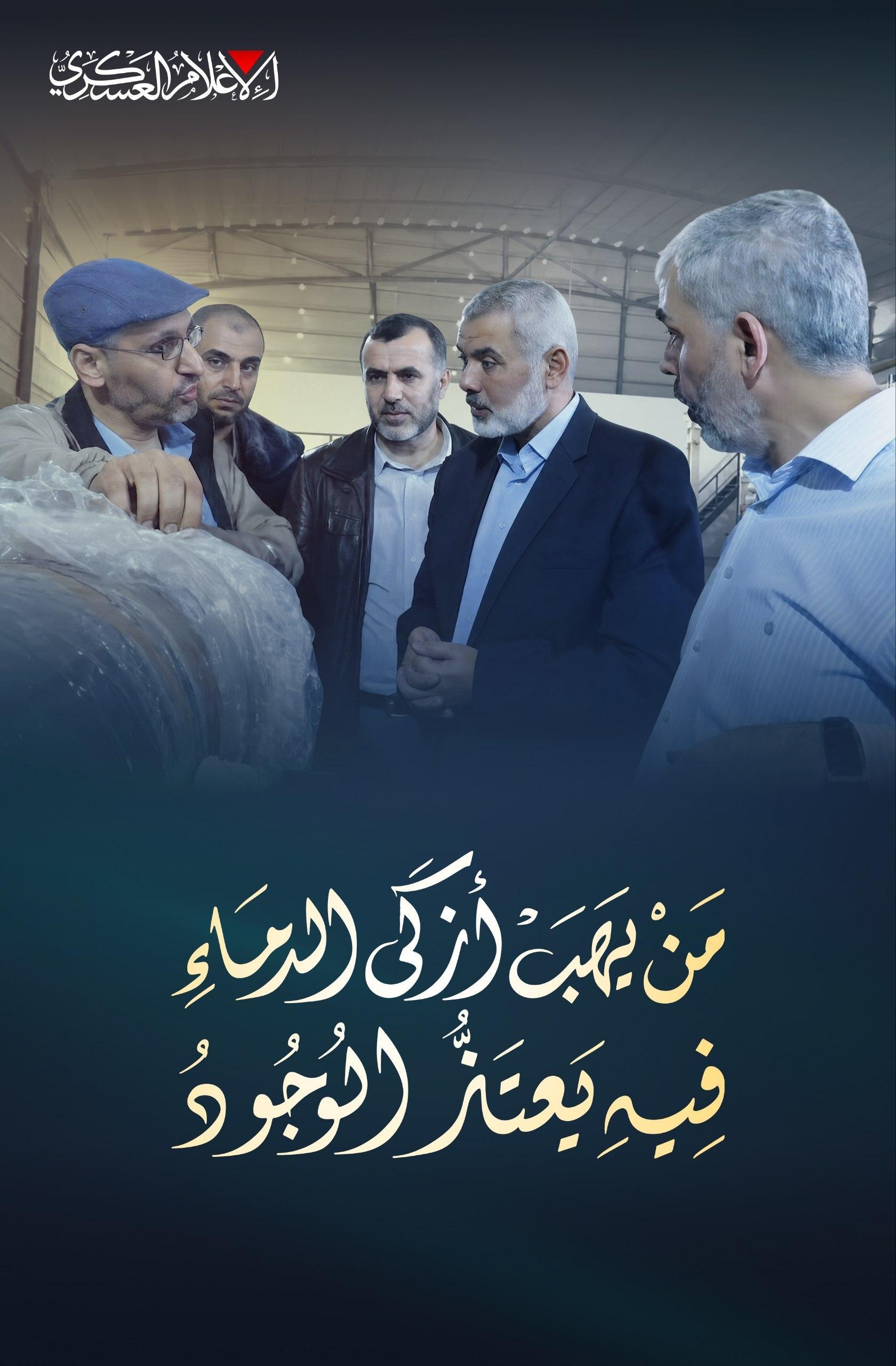
Palestinian factions on Friday marked the second anniversary of the assassination of Ismail Haniyeh, the head of Hamas’ Political Bureau, honoring him as a national leader whose political legacy continues to shape the Palestinian resistance movement.
Haniyeh was assassinated in Tehran on July 31, 2024, in an Israeli strike after attending the inauguration ceremony of Iranian President Masoud Pezeshkian. Hamas and the Islamic Revolutionary Guard Corps (IRGC) announced his death at the time, while Israel did not officially claim responsibility.
In a statement issued on the anniversary, Hamas said Haniyeh “was not an ordinary leader, but an exceptional national leader who left behind a great legacy that will remain engraved in the national memory.”
The movement described him as “a comprehensive national icon with no equal in modern Palestinian history,” adding that he combined political leadership with steadfast commitment to the Palestinian cause throughout decades of struggle.
Hamas emphasized that Haniyeh’s legacy continues to inspire Palestinians as Israel’s war on Gaza enters its third year.
Resistance Committees Praise His Legacy
The Palestinian Resistance Committees also paid tribute to Haniyeh, describing him as “a symbol of unity and steadfastness” whose leadership transcended organizational divisions.
The group said Palestine had lost “a strong national figure” who consistently prioritized the broader national interest over factional considerations.
According to the statement, Haniyeh represented “a model whose positions rose above organizational affiliation,” remaining committed to Palestinian unity and resistance.
The committees added that his assassination came during one of the most critical periods in Palestinian history, as Gaza continues to face Israeli military attacks.
They said honoring his legacy requires strengthening national unity based on partnership and resistance.
The factions renewed their pledge to continue the struggle for liberation, return, and the restoration of Palestinian national rights.
From Refugee Camp to National Leadership
Ismail Abdel Salam Ahmed Haniyeh was born on January 23, 1962, in the Shati refugee camp in Gaza to a family originally from the village of al-Jura, near Asqalan, whose residents were displaced during the 1948 Nakba.
He studied in UNRWA schools before graduating in Arabic Literature from the Islamic University of Gaza in 1987.
During his university years, Haniyeh became active in student politics and later served in several academic positions, eventually becoming dean of the Islamic University.
Following his release from Israeli prison in 1997, he became head of the office of Hamas founder Sheikh Ahmed Yassin.
Political Career
Haniyeh was repeatedly imprisoned by Israel during the First Intifada because of his activities within Hamas and was among hundreds of Palestinian activists deported to southern Lebanon in 1992.
After returning to Gaza following the Oslo Accords, he rose through Hamas’ political ranks.
In 2006, Haniyeh headed Hamas’ Change and Reform electoral list, which won a majority in the Palestinian Legislative Council elections. He subsequently became Prime Minister of the Palestinian Authority in February 2006.
Although President Mahmoud Abbas dismissed his government in June 2007 following Hamas’ takeover of Gaza, Haniyeh continued leading the administration in the Strip.
He later participated in several Palestinian reconciliation initiatives, including efforts that produced a national unity government in 2014.
In May 2017, Haniyeh was elected head of Hamas’ Political Bureau, succeeding Khaled Meshaal.
Al-Aqsa Flood and Final Years
Following the launch of the Al-Aqsa Flood operation on October 7, 2023, Haniyeh became one of the movement’s principal political figures engaged in regional diplomacy and ceasefire negotiations.
During Israel’s subsequent war on Gaza, several members of his family, including children and grandchildren, were killed in Israeli airstrikes.
On July 31, 2024, Haniyeh was assassinated in Tehran while attending the inauguration ceremony of Iran’s newly elected president.
His death was widely condemned across the region and prompted tributes from Palestinian factions, regional allies, and resistance movements, which described him as one of the most influential Palestinian leaders of his generation.